
Book Review: Es Sidr by Omar N’Shea
Omar N’Shea’s work tilts, perhaps uncomfortably, in the folds of the personal and the historical. Es Sidr is no exception as it takes the reader on an intimate search for origins unfolding against the backdrop of Mediterranean politics. It all starts when Omar stumbles on a neatly ordered file containing handwritten letters addressed to his mother. Through these tactile fragments – which turn out to be his own father’s – he attempts to reconstruct his parents’ lives before he existed. Omar doesn’t just record history, he grounds it in the physical weight of the sea, the wind, the breath, and the intimate auto-ethnographic labour of working through the contingency of memory, fragments, revelations and affects that ultimately came to inform and shape who he is.
Although Es Sidr is sometimes described as a memoir this label fails to capture its true scope. A memoir generally grapples with an author’s own first-hand recollections. While Omar immerses us in childhood memories – his mother, the spaces he called home, swimming in Zuwara, hugging friends consumed by HIV – these episodes are less about passive nostalgia and more about bodily survival. If in Returning to Reims Didier Eribon used his homosexuality in Paris to hide his working-class background, Omar admits to using the performativity of queerness to obscure his interracial origins: the darkness of his skin, his ‘dry curls’, and a fear of not passing as ‘Maltese’ that trumped any class or queer shame. As Omar himself notes, when he captures his own reflection in the mirror:
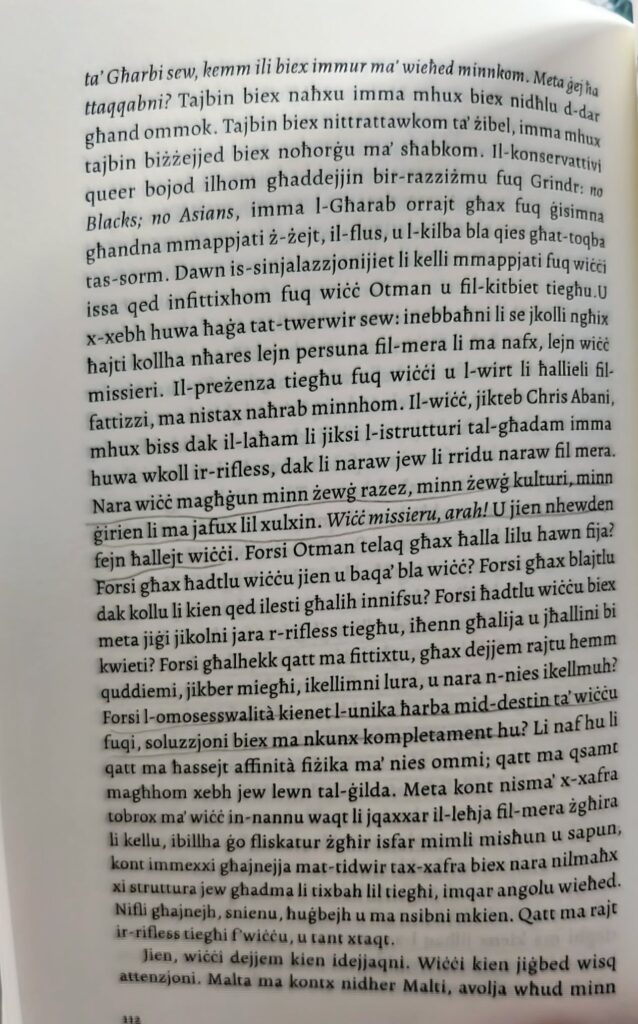
[I]x-xebħ huwa ħaġa tat-twerwir sew: inebbaħni li se jkolli ngħix ħajti kollha nħares lejn persuna fil-mera li ma nafx, lejn wiċċ missieri.
A few lines later he asks:
Forsi l-omosesswalità kienet l-unika ħarba mid-destin ta’ wiċċu fuqi, soluzzjoni biex ma nkunx kompletament hu?
By deploying an archaeological lens, Omar transforms memoir into a genealogical exercise. By unearthing these tactile fragments, he reconstructs his mother’s butch aesthetic, her desires, and more hauntingly, gains access to a father he only knew through the pictures and his own reflection. With these letters in hand, Omar confronts the hollow image of the ‘foreign’ father he grew up fearing would abduct him. Flipping through precarious pages, he discovers a man’s vulnerable, desperate attempts to hold onto a relationship across the Mediterranean:
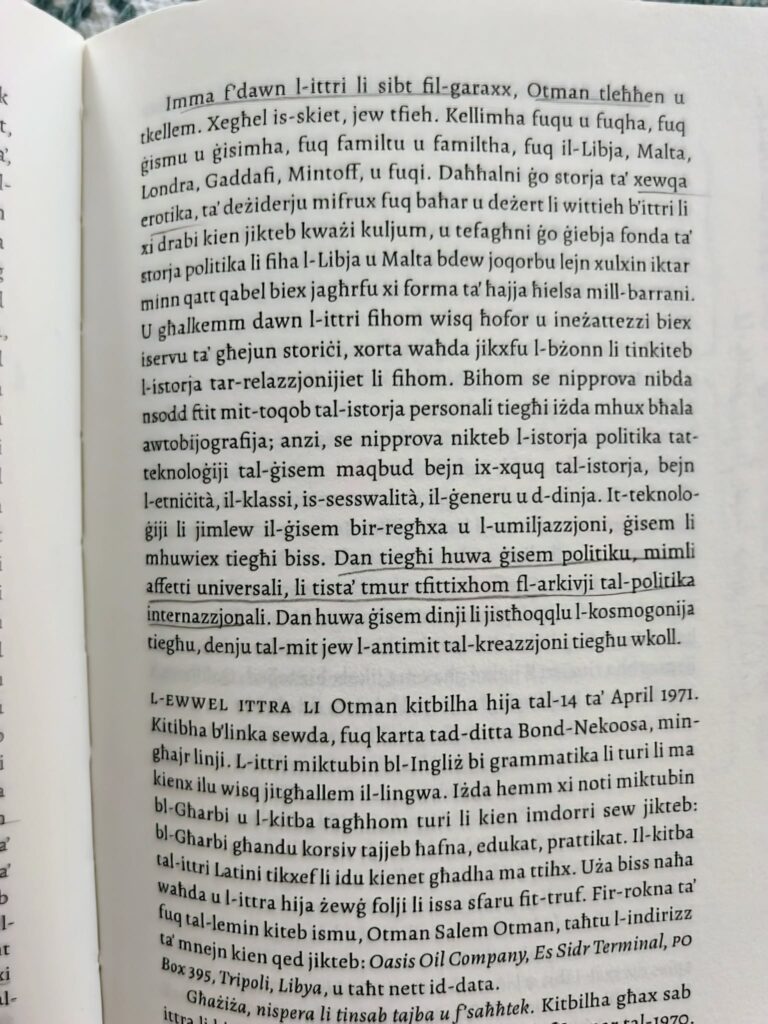
Otman tleħħen u tkellem. Xegħel is-skiet, jew tfieħ. Kellimha fuqu u fuqha, fuq ġismu u ġisimha… Daħħalni ġo storja ta’ xewqa erotika, ta’ deżiderju mifrux fuq baħar u desert… u tefagħni ġo ġiebja fonda ta’ storja…
Through these letters the reader also journeys with the painful realisation of his father’s desire to abort him and his assertion that he will never love a child born out of wedlock. Omar maps these intimate lives directly onto the global political scene: Gaddafi’s coup d’etat in Libya a few weeks after Otman sent the first letter found in the file, Mintoff’s diplomatic negotiations with Gaddafi, the Americans and the British to achieve economic independence and strict geopolitical neutrality for Malta. Far from happening in isolation, these events are presented as the cradle that created the conditions of possibility for his parents to meet, resulting in his own existence.
And perhaps this is why Omar’s work is so poignant. Es Sidr redefines what auto-ethnography or genealogical writing can do in Mediterranean literature. In his own words, Omar uses this archive not for self-indulgent autobiography, but to illuminate how macro-politics inhabit the skin:
U għalkemm dawn l-ittri fihom wisq ħofor u ineżattezzi biex iservu ta għejun storiċi, xorta waħda jikxfu l-bżonn li tinkiteb l-istorja tar-relazzjonijiet li fhom. Bihom se nipprova nibda nsodd ftit mit-toqob tal-istorja tiegħi iżda mhux bħala awtobijografija; anzi, se nipprova nitkeb l-istorja politika tat-teknoloġiji tal-ġisem maqbud bejn ix-xquq tal-istorja, bejn l-etiniċità, il-klassi, is-sesswalità, il-ġeneru u d-dinja… Dan tiegħi huwa ġisem politiku, mimli affetti universali…