A local, audiovisual magazine
committed to reviews
of performing and visual arts.

45: Review

The Publisher Between the Lines: Merlin’s 45


Anniversary books often resemble monuments. They are polished, reverent, and slightly lifeless. 45, published in 2009 to mark Merlin’s 45th anniversary, avoids that fate through a wonderfully simple commission: 10 writers, 10 original stories, and one number that must appear in each of them. The result is not merely a short-story anthology, but a portrait of a publisher drawn by the writers it helped to publish

The number is, admittedly, a gimmick. Its presence can feel delightfully natural or visibly engineered, depending on the story. A radio frequency, a council, a sum of money, and the label on a bottle all emerge from the same prompt. The reader begins to anticipate the number, almost playing hide-and-seek with the editor. When it finally appears, the moment can produce recognition, amusement, or the suspicion that an author has remembered the brief at the last possible minute.

45, an anthology featuring Loranne Vella, Clare Azzopardi, Ġużè Stagno, Mario Azzopardi, Simon Bartolo, Pierre J. Mejlak, Carmel G. Cauchi, Trevor Żahra, Charles Casha, and Mark Camilleri. Photo by Bradley Cachia.

More importantly, the constraint gives the collection unity without forcing its contributors into a common style. The authors range across generations and genres, from Charles Casha and Trevor Żahra to Clare Azzopardi, Loranne Vella, and Ġużè Stagno. Their stories do not blend into a smooth house style, and they should not. The anthology works because “Merlin” comes to mean a space broad enough to contain very different literary voices.

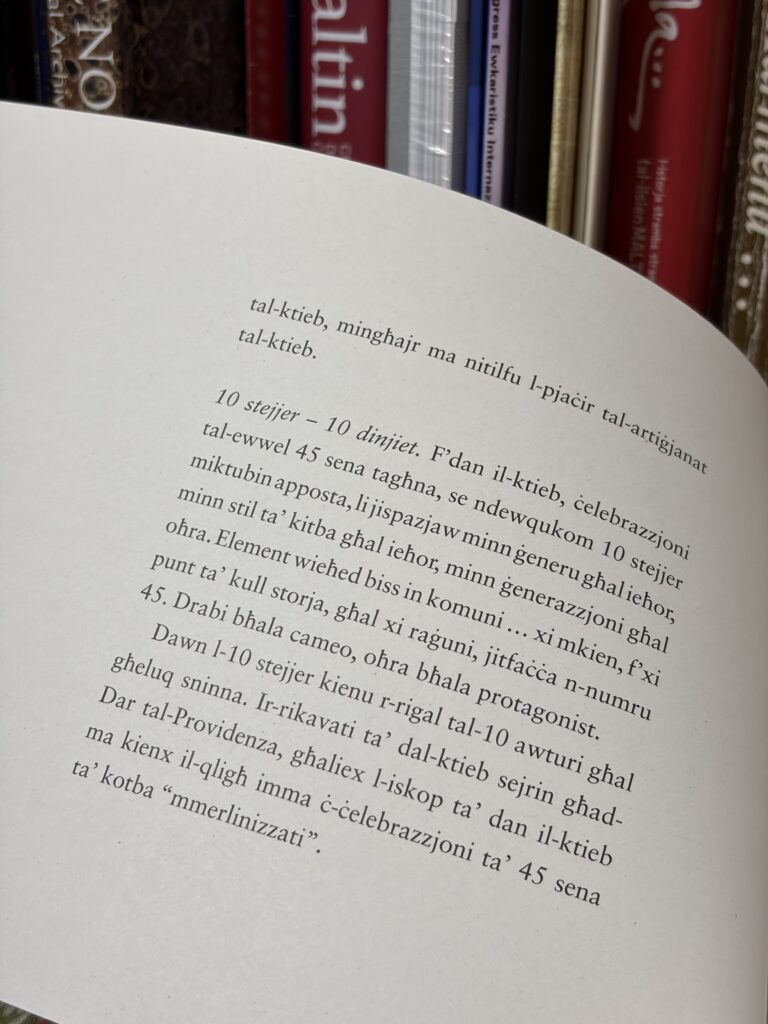
The richest contribution to the book’s self-portrait may be Clare Azzopardi’s “Aqrali xi Ħaġa Ġdida, Qaltilha.” Its protagonist, Lina, grows up among books in her family’s printing and publishing business. Her father repeatedly rejects manuscripts submitted by women, while her mother secretly preserves their work, selecting 45 pieces by 15 women, typesetting and binding them herself, and hiding them beneath the kitchen tiles for 45 years. Near the end of her life, she asks Lina to read her something new. For 45 days, Lina reads one of the hidden works aloud while both her parents listen. In an anthology celebrating a publishing institution, Azzopardi chooses to write about the power publishers possess to admit voices into literature or keep them outside it.

45, an anthology featuring Loranne Vella, Clare Azzopardi, Ġużè Stagno, Mario Azzopardi, Simon Bartolo, Pierre J. Mejlak, Carmel G. Cauchi, Trevor Żahra, Charles Casha, and Mark Camilleri. Photo by Bradley Cachia.

That decision saves 45 from uncomplicated self-congratulation. The story asks what a literary tradition may have lost because somebody behind a desk decided that certain writers were not worth publishing. Its challenge is especially pointed because only two of the collection’s 10 contributors are women, one of them Azzopardi herself. This does not cancel the anthology’s achievement, but it prevents the celebration from feeling complete. Azzopardi places a question mark inside Merlin’s birthday card.

Pierre J. Mejlak takes almost the opposite route in “Mort Naraha, Pa.” Here, the number enters naturally through bottles of “45,” a homemade apricot liqueur named after the 45 days it takes to mature, while the story’s true concern is a dying father who sends his son to find a woman he loved in Spain. The commission becomes almost invisible beneath memory, tenderness, and belated communication. The story was later republished in Dak li l-Lejl Iħallik Tgħid, where it could live independently of the anniversary that prompted it. This is perhaps the best outcome for commissioned literature as the occasion generates the work, then the work outgrows the occasion.

45, an anthology featuring Loranne Vella, Clare Azzopardi, Ġużè Stagno, Mario Azzopardi, Simon Bartolo, Pierre J. Mejlak, Carmel G. Cauchi, Trevor Żahra, Charles Casha, and Mark Camilleri. Photo by Bradley Cachia.

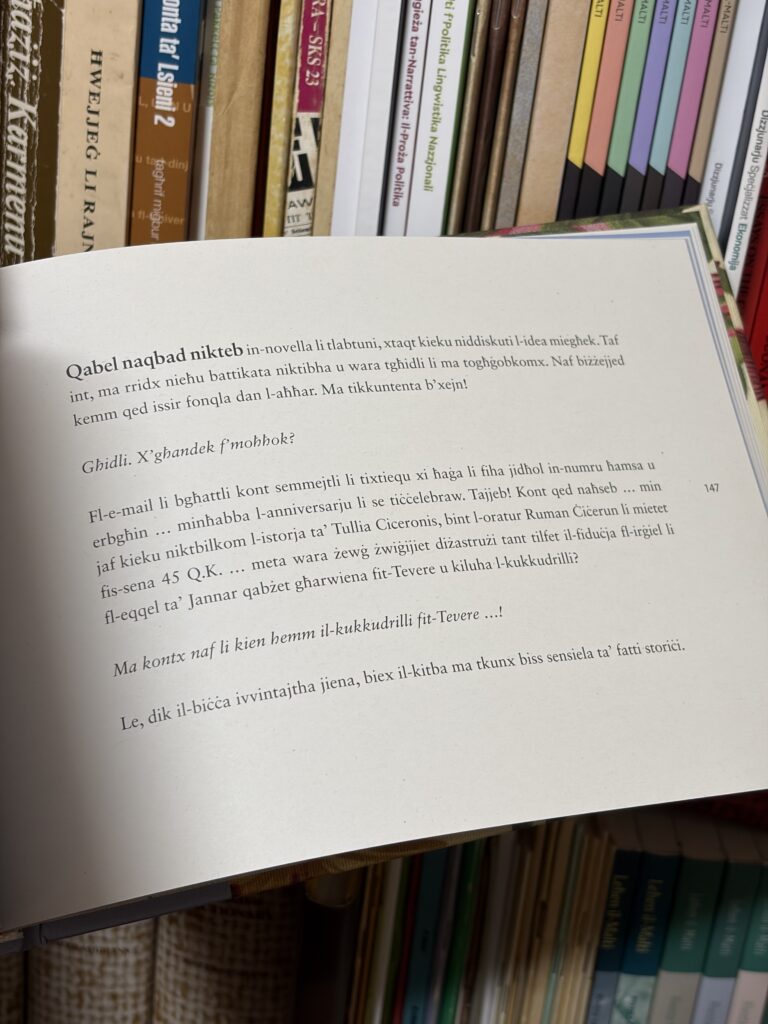
Mark Camilleri’s “Gallo” makes the book’s relationship with time more fascinating still. Camilleri was the sole debutant among nine established Merlin authors. His story introduced Inspector Victor Gallo, who subsequently became the centre of four crime novels: Prima Facie, Volens, Nex, and Alias. What looked like a speculative gesture towards Merlin’s future now reads as a remarkably successful act of editorial trust. The anthology does not simply archive a list of writers already validated by publication. It creates the conditions for another writing career to begin.

Read 17 years later, 45 has therefore acquired a meaning it could not possess in 2009. Merlin conceived it as a celebration of its writers’ past, present, and future, but time has developed some of its photographs. One story entered another collection. Another protagonist escaped into a series. A story about excluded women later found an afterlife on the SEC Maltese literature syllabus, where I first encountered it myself at school.

Not all 10 stories carry equal force, and the recurring number sometimes feels more like an editorial signature than an artistic necessity. Still, that signature matters. 45 shows that a publisher does more than manufacture and distribute books. It convenes writers, proposes constraints, preserves careers, and occasionally risks its name on someone new. Merlin may not have written any of these stories, but it is the character moving quietly between every one of them.
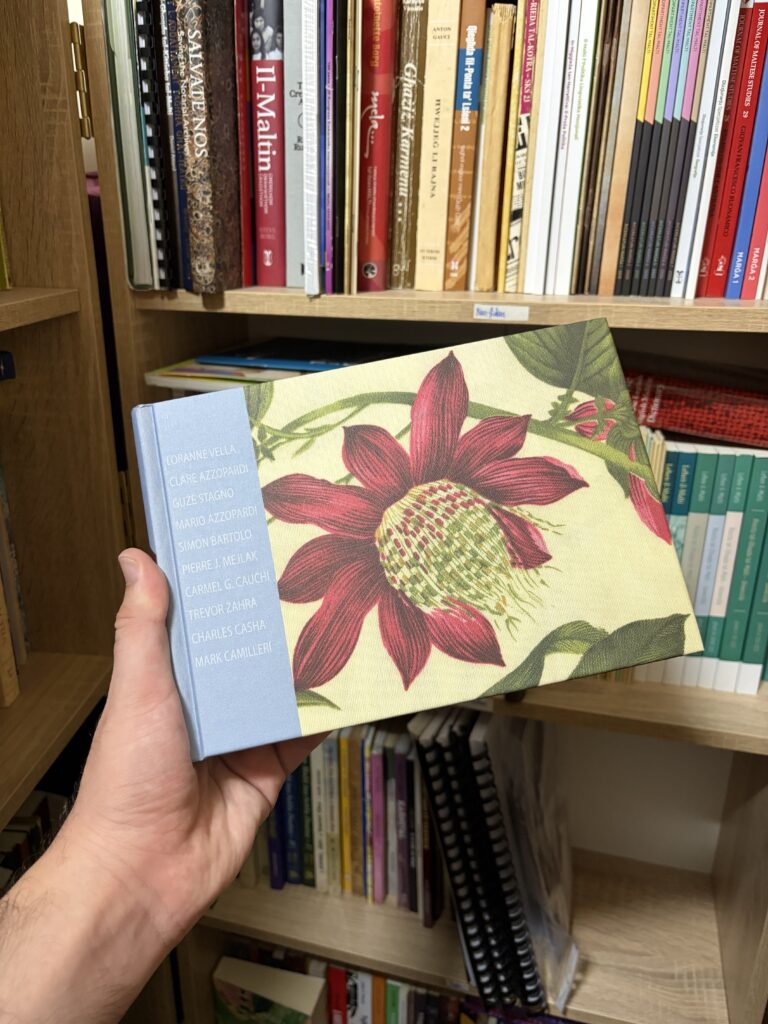
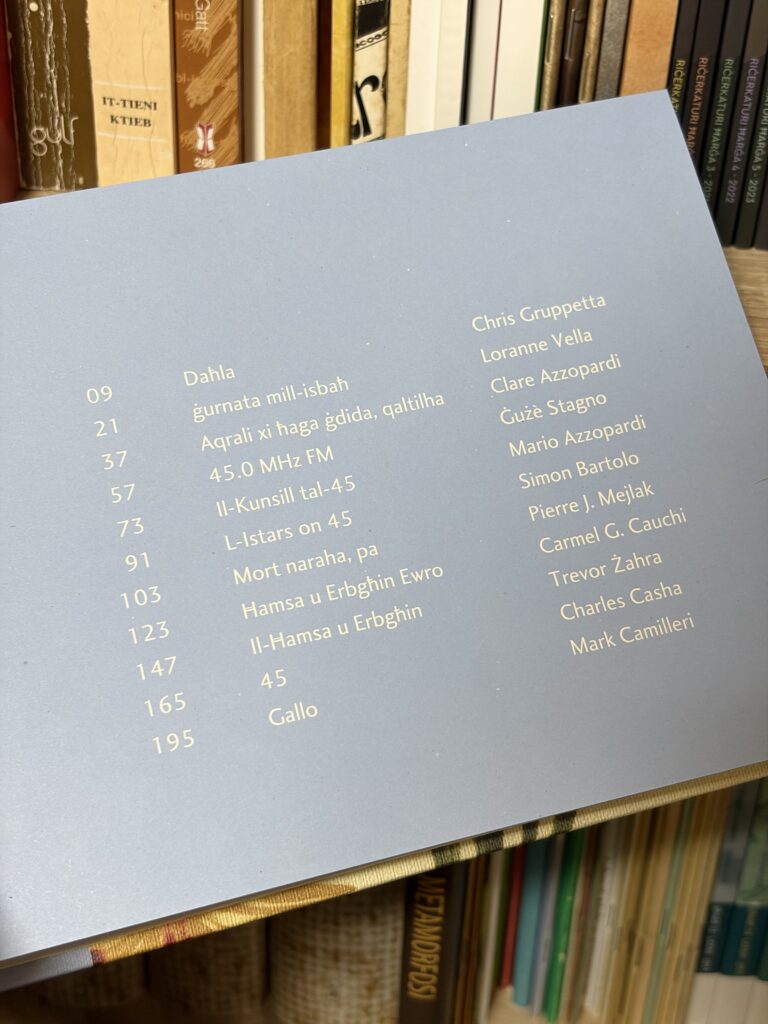
45, an anthology featuring Loranne Vella, Clare Azzopardi, Ġużè Stagno, Mario Azzopardi, Simon Bartolo, Pierre J. Mejlak, Carmel G. Cauchi, Trevor Żahra, Charles Casha, and Mark Camilleri. Photo by Bradley Cachia.

Keep reading

Looking for something else?