
F’ Tarf it-Triq – Charles Casha
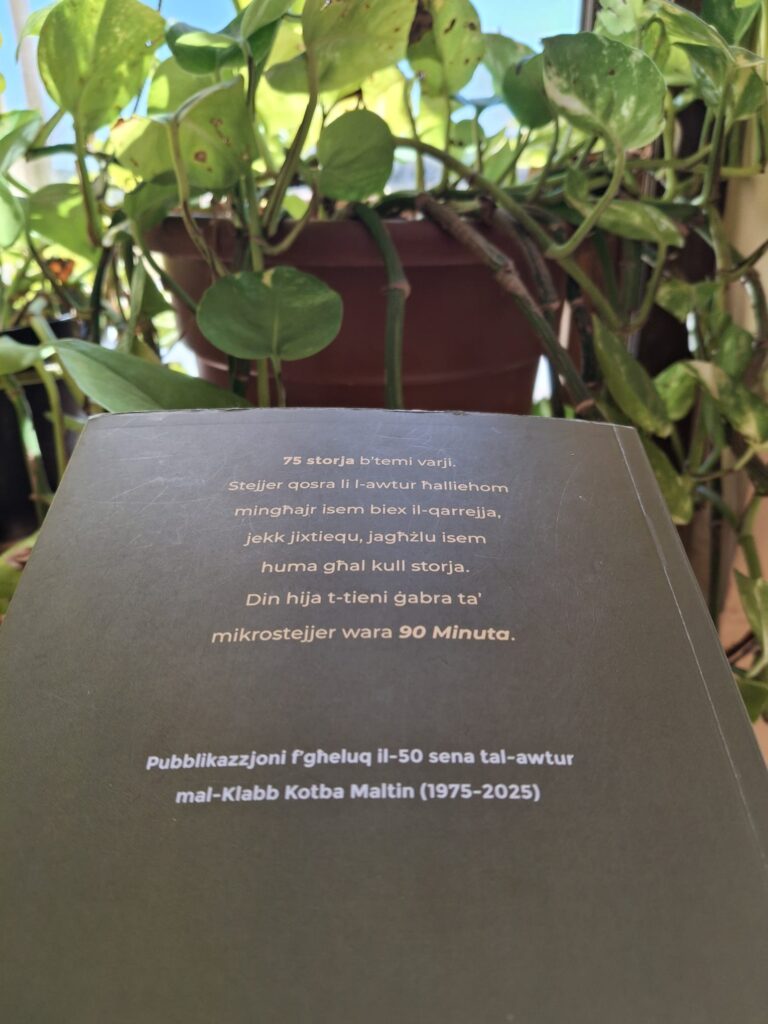
Published in honour of his 50th anniversary with Klabb Kotba Maltin, Charles Casha gathers 75 microstories that capture episodes of Maltese mundanity, from childhood to old age. The book’s title draws from its book cover which portrays a traditional Maltese farmhouse (razzett) sitting at the far-end of a rural alley.
Casha deliberately leaves his microstories untitled. On the contrary, he explicitly invites the readers to name the stories, should they feel the need. Personally, I was not quite sure about this choice. Having numbers instead of titles made the stories feel like an inventory list. The author introduces a very wide range and amount of characters – and interestingly enough, certain characters stand out from the rest.
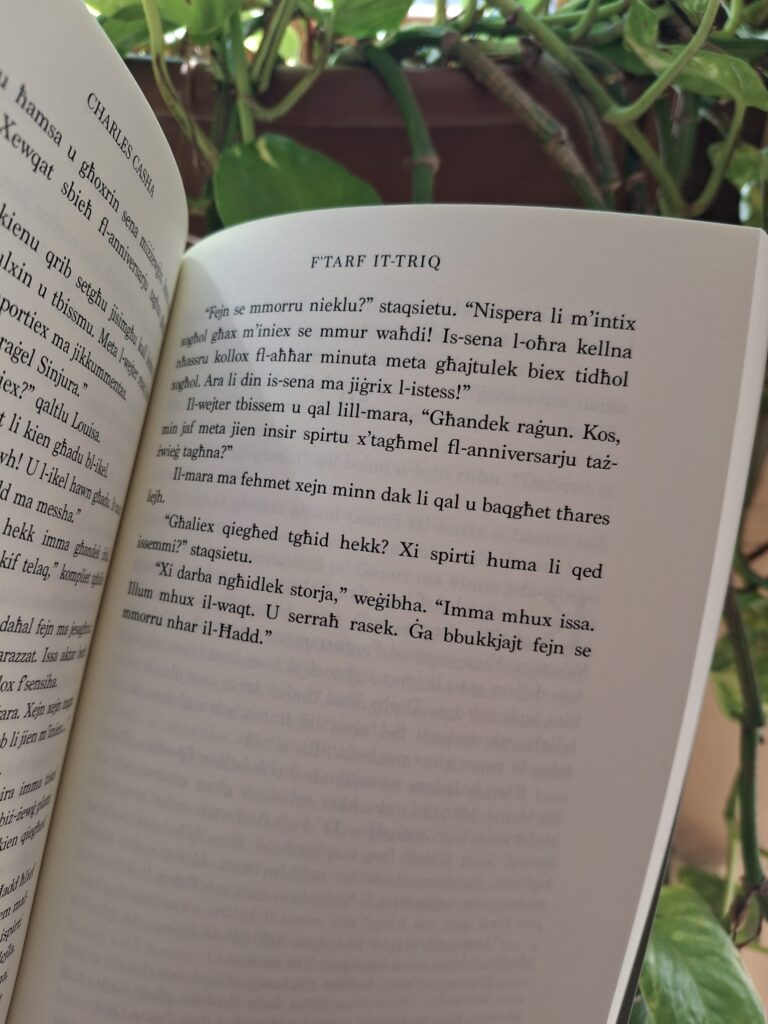
Casha tends to spotlight particular characters in his stories, who are at the end of their tether, be it because of the result of unfortunate life decisions or having the grim reaper nip at their heels, keen to take their lives away. We read of Vanni and his constant fear of sickness and death (“3”), and of the narrator and his untreated childhood trauma from the ‘Sack Man’ (“24”), amongst others. Characters find themselves at the proverbial edge of a cliff, needing to decide whether to retreat to safety, or jump to their demise.
Moreover, the third-person narration is interrupted by a first-person narrator. The interplay between these narratives feels as though Casha wants to be included in the stories he penned, at times imbuing them with sarcasm or humour. I feel that this narrative style is similar to a pre-teen or teenager interrupting an adult’s storytelling, probably something which Casha might have wanted to portray. I liken this narrator to teenagers since some stories display an adolescent curiosity about taboo topics such as sexual assault, prostitution, pornography, death, and queer experiences, coupled with blunt narration. I admire Casha for addressing these topics in an anthology marking his 50 years with Klabb Kotba Maltin, particularly as veteran authors do not always delve into such narrative territory. Perhaps this is, paradoxically, a reflection of how far we have come, and just how much we still need to develop as a national literary sector.
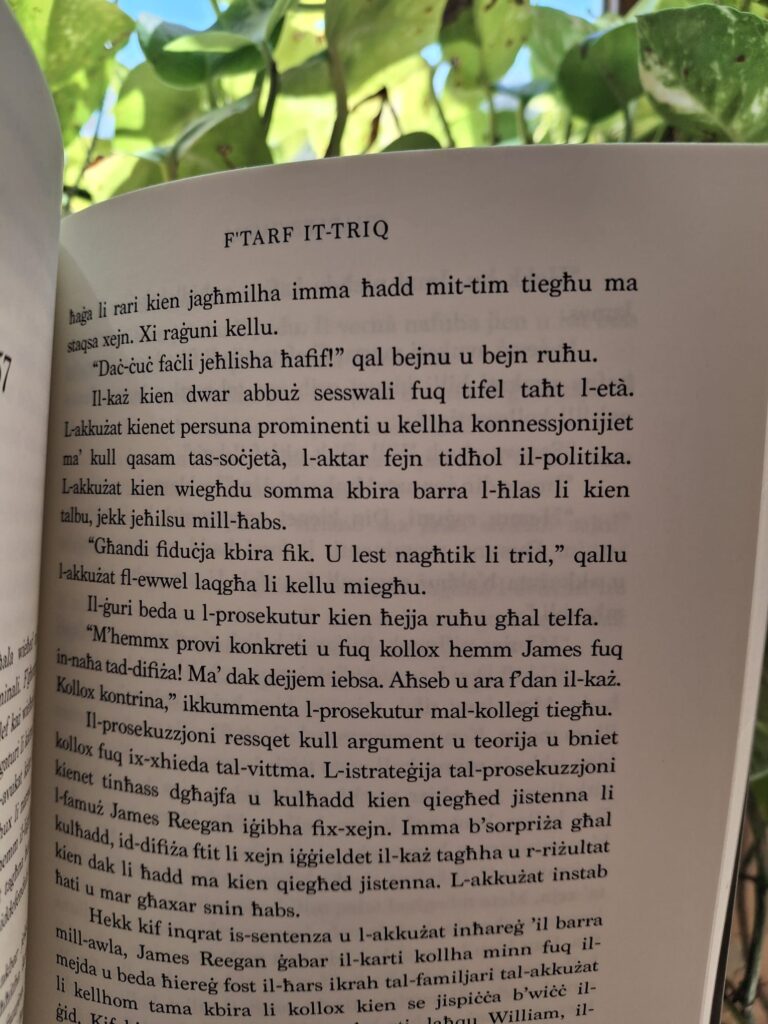
A motif which occurs throughout the anthology is something I would call “coincidences”, like in the story of Anita and Ronnie (“18”), who from distant childhood lovers were romantically reunited in adulthood, and in the story of Fiona/Rita and David (“41”), who were seemingly dating the same girl with the scorpion tattoo. The motif of coincidence, understood as the unlikely convergence of events or circumstances in real life, can be read in two opposing ways. It may function as an authorial strategy that evokes the fantastical logic of fairytales, where improbable events can lead to a positive resolution. Alternatively, coincidence can contribute to a Gothic sense of unease, as in the latter microstory, where it works alongside distinct Gothic motifs like the Doppelgänger and the scorpion symbolism of producing a “sting in the tail” ending. All in all, this motif functions as a common thread throughout the microstories, which at times hit the mark, while sometimes resulting in a “too good to be true” ending.
I have to say that for me F’Tarf it-Triq felt like reading the same story over and over again. Although the plots obviously differ from each other, many of the stories return to the same emotional territory. I felt myself reeled into this repetition and it was difficult to shake the suspicion that the stories were all of the same kind. The narratives, mainly those found in stories 25 to 35, increasingly return to characters whose lives are shaped by sickness, decline and death, which began to affect my reading, and subsequently my reviewing experience.
Having said this, Charles Casha’s place within Maltese literature is difficult to dispute, and F’Tarf it-Triq demonstrates the breadth of his storytelling across a variety of subjects and readership. Yet that breadth is not always matched by narrative variety. With 75 microstories, the collection inevitably offers something for different kinds of readers, but its recurring preoccupation with sickness, death and unlikely coincidence ultimately made the collection feel more uniform than its premise suggests.