
BACKROOMS: The YouTube sensation transitions to the big screen, with plenty of promise.
Hype has become this lingering shadow on film criticism, nowadays. I have become even more skeptical of reviews. Thankfully, Letterboxd is my emotional support film review app. It’s been quite helpful in managing expectations, especially with the recent runaway successes that are Curry Barker’s Obsession and Kane Parsons’s Backrooms.
And the hype surrounding Backrooms may dampen your viewing experience. There was a constant barrage of online chatter leaning heavily on how “scary” it all is. Personally, I found it more unsettling. Does it have jump scares? Yes. Bloody violence? Yes, mostly happening off-screen. Then again, what’s horror for me may not be horror for thee.
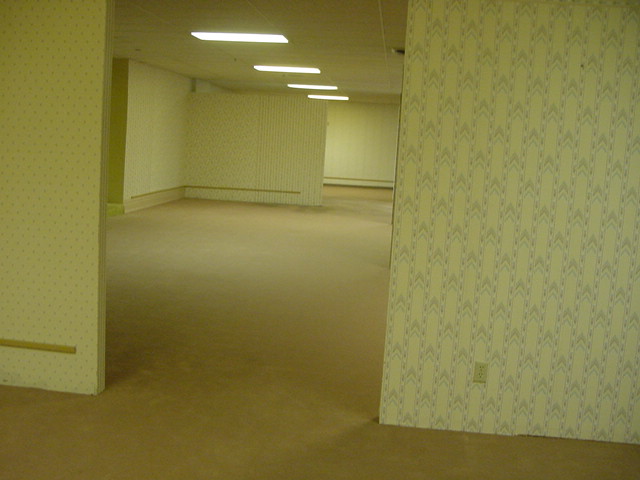
I pretty much loved the cinematography, with wide lenses enhancing the disorienting feeling, and the production design and VFX are top notch. It’s where Kane Parsons’s sure-handedness shines – he did cut his teeth, after all, learning a completely free 3D software, Blender.
Parsons, however, seemed more interested in the characters that experience the Backrooms. The line about describing a dog to someone who’s never seen a dog and asking them to draw it pretty much encapsulates this experience. A commendable effort to centre the people rather than the space itself, but, unfortunately, this is also where much of the film’s weaknesses lie.
Spoilers ahead!
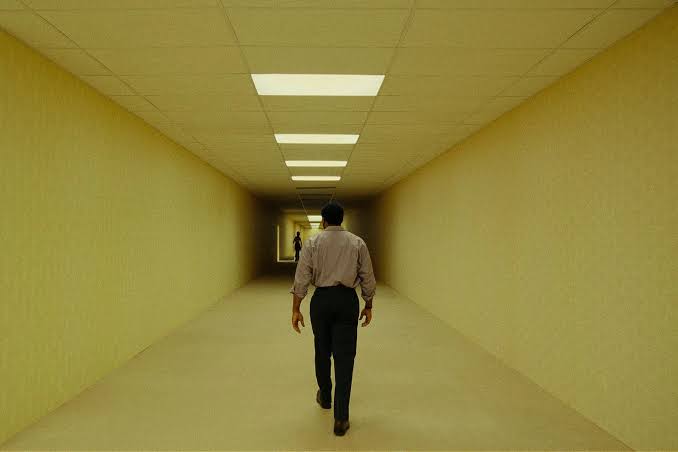
Phil, played by Mark Duplass, represents ASYNC, the company responsible for opening doorways around their neighborhood to this gargantuan liminal space, into which people fall into by accident – the titular Backrooms. Like every other mega capitalistic corporation nowadays, the company is less interested in providing respite and compensation for the people affected by their own creation, more driven to exploit this creation for profit. A reality-bending creation the corporation itself does not understand, and doesn’t seem to want to understand but rather ventures further into it, regardless of the immeasurable harm it may unleash onto the world. *Cough* Much like AI *coughcough*
And while this conglomerate greed is felt throughout the spatial dynamics of the film, I really wanted more of Mark Duplass’s character, a corporate drone who is also trying to make sense of what his company has unleashed. There were hints of his character’s need to connect with the people who have become unwilling participants and victims to this company’s experiments. By no mean is it Duplass’s or the other actors’ fault but rather an issue with the screenwriting.
Renate Reinsive’s Dr Mary Kline is one of those unwitting victims of the corporation’s creation – drawn to the Backrooms to find out what happened to one of her patients, Clark, a failed architect. Her character also needed further emotional charge for the viewer to relate to her inner conflict more. Did Mary feel like she could save Clark, to redeem herself from not being able to save her own mother? Has Mary’s mother actually seen and been affected by these Backrooms herself? And I must say, for those with keen ears, Renate’s Norwegian accent might affect one’s immersion.
Chiwetel Eijofor’s Clark’s character arc remains pretty much flat – begins angry, ends angry. Barely any hint of guilt or introspection. And online discourse, in regards to Clark’s character doubling down on problematic tropes related to Clark’s race, does make some really salient points. The anger and resentment felt by Clark are so lacking in depth and backstory. Mary’s comments on how Clark brushes off his faults as “the way he’s wired” pushes the character further into these problematic tropes. While this is not my point to make, it is worthwhile to keep this in mind.
Even the monster could be considered more of a parody of Clark’s rage rather than a terrifying manifestation of it. I wouldn’t fault anyone guffawing when the creature makes its entrance. Parsons’s original concept for the creatures inhabiting the Backrooms would have worked much better. Yet, I do see and very much appreciate the purpose of the creatures in this version of the Backrooms.
We cannot not mention the Backrooms themselves as being the absolute main character in Kane Parsons’s debut. Parsons feels like a master of turning up the uncanny nature of liminal spaces up to 11. It is where the movie shines. One scene in particular – Mary escaping the monster – gave me serious vertigo with a veritably sinking feeling of existential dread. It showcases the incomprehensible endlessness of this liminal space.
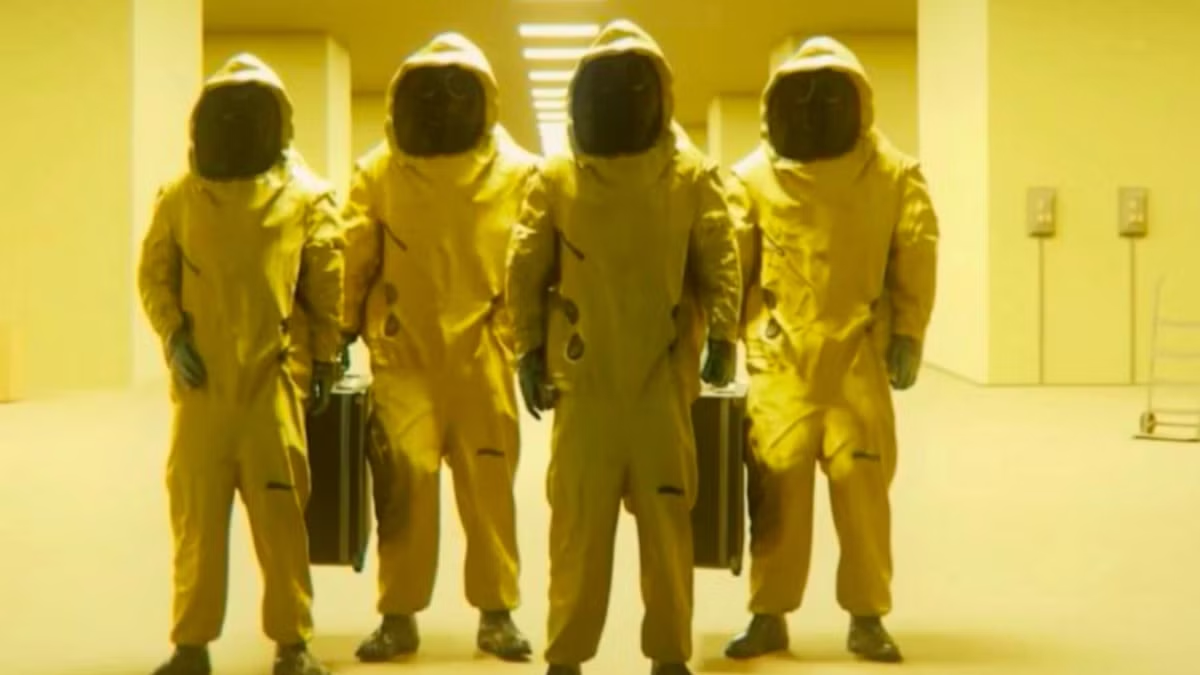
And that dread was felt even more so, when it is revealed that the space is slowly creating garish warped copies, not just of buildings and spaces, but also of humans – with multiple fingers, limbs and eyes, devoid of ego, fear and pain. The comparisons follow naturally – these are images we’ve become accustomed to via generative AI. It may well be interpreted as an indictment of AI corporations who have unleashed something onto the whole world they themselves aren’t able to understand or even control. Because no matter how much the Backrooms tries to copy reality, it will never be able to copy the human soul.
Once again, this is where the film shines and betrays an awareness from the director beyond his youth. And with this in mind, I do recommend watching Backrooms. While by far not perfect, especially in the characterisation department, it’s still a very solid, promising debut, that augurs well for Kane Parsons’ budding directorial career.