
Il-Ġiżimin ta’ Ġona u Stejjer Oħra – Hector Scerri
Hector Scerri’s short stories embark us on a toponomastic journey to a multiplicity of locations and time periods. From the secluded and serene island of Filfla (“Il-Filfilin”), to the luscious green gardens of Ireland (“Use the Baths”) back to World War II and the non-liveable conditions of the concentration camps (“Il-Bambin tal-Ħobż”). Throughout these fifteen stories, Scerri represents seemingly naïve narratives that are familiar to the Maltese individual, which upon deeper reading, paradoxically provide subtle-incisive thoughts all along.
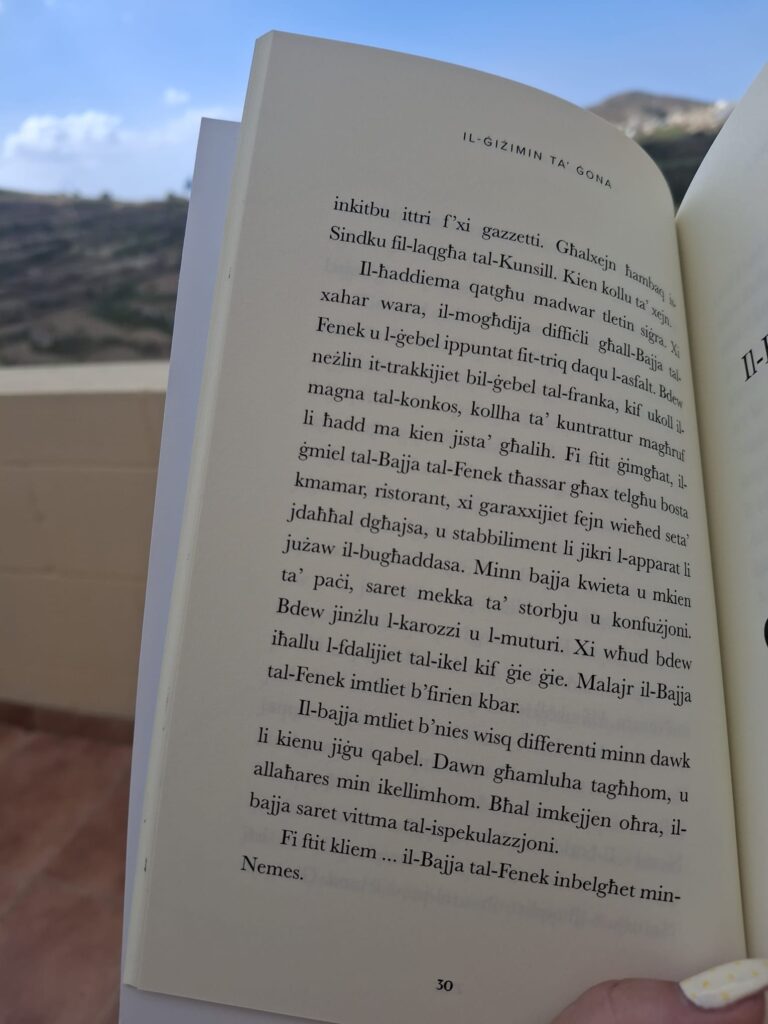
In other words, he defamiliarises the plots of our childhood stories, in order to give us a contemporary application of the universal meaning of such stories and parables. Il-Ġiżimin ta’ Ġona u Stejjer Oħra is characterised with very local yet novel titles, providing a wholesome setting with a new reading of already established narrations. We read of “Il-Bajja tal-Fenek”, which is perhaps an indirect reference to ‘Il-Bejta tal-Fenek’ in Comino and “Ħbieb sa Wara l-Mewt”, possibly indicating a perversion of the Maltese common saying ‘Ħbieb sal-Mewt’ meaning a long-lasting relationship between close-knit individuals.
Speaking of parables and given the religious background of Scerri himself as a priest and a theologian, the biblical parallelisms throughout are also evident, such as in “L-Iben il-Kbir”, a direct reference to the parable of ‘L-Iben il-Ħali’ (‘The Prodigal Son’). In the first short story, “Il-Ġiżimin ta’ Ġona”, we cannot help but compare Ġona to Jonah’s figure in the Old Testament. The greater irony is that, whilst Ġona is listening to Jonah’s story, he remains oblivious to the fact that Jonah’s unfortunate story is also his. Undoubtedly, Scerri’s decision to include such allusions continues to add to the local flavour that this book offers.
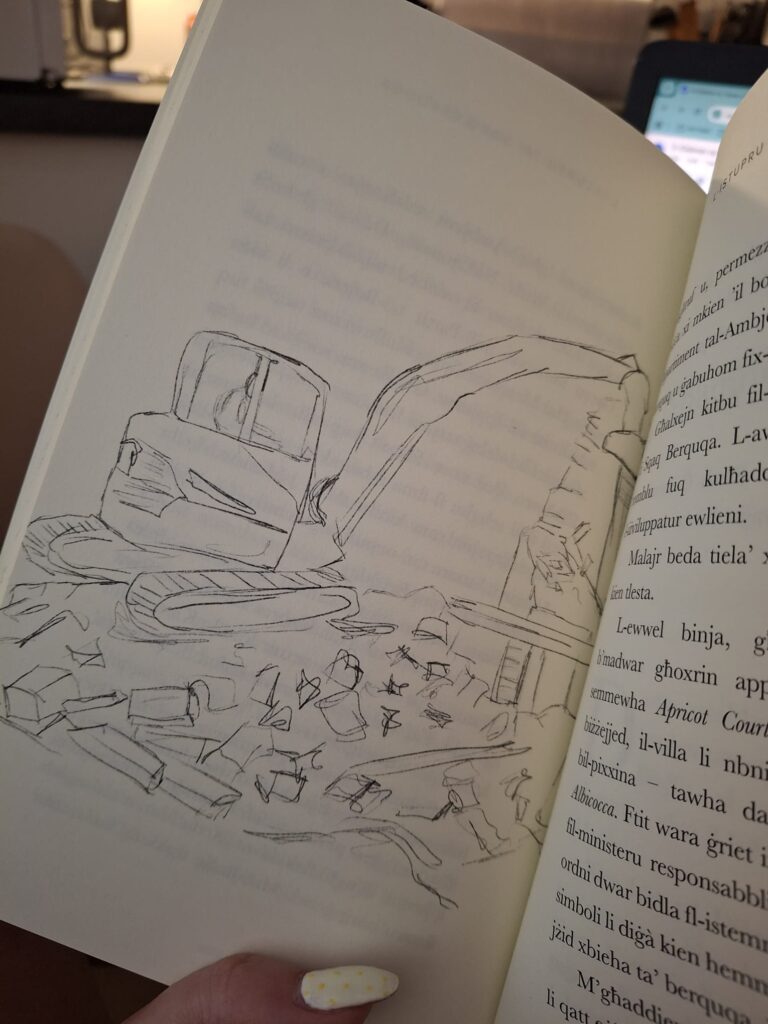
Nonetheless, one cannot speak of the local issues without tackling the environment. In “L-Għalliem tal-Idjomi”, the narrator makes a nuanced comment, “dwar ilsien din l-art li darba kienet ħelwa”, sardonically playing with the opening verses of the Maltese national anthem “Lil din l-art ħelwa” (“To this sweet land”). The undisguised narrator mentions Ħal Minsi (“L-Istupru ta’ Sqaq Berquqa”) u Ħal Mitluf (“Il-Kmajra tal-Garigor” and “L-Istupru ta’ Sqaq Berquqa”), hyperbolating the disastrous effect of construction on traditional Maltese villages. “I-Istupru ta’ Sqaq Berquqa”, as the name strongly suggests, speaks of the rape of a typical narrow street with the rise of the newly built apartments, ironically entitled as ‘Apricot Court’ and ‘Villino Albicocca’, as well as the generational disinterest in agriculture. Although parabolised, Ħal Mitluf is very similar to villages in Malta, and is reflective of the national status quo on the island: a rampant wild west in construction applications and corrupted procedures. Scerri does this without hesitation.
Moreover, the themes of Maltese politics and history, however minuscule and subtle they might be in this book, also help to frame the national context of the short stories to the Maltese historical past and present. The Language Question which dominated the Maltese Islands in the early 19th to the mid 20th centuries is noticeable in “L-Istupru ta’ Sqaq Berquqa” with the names of the new buildings. Indirectly, this choice might suggest the colonial mind that still sucks on the Maltese brain – rather than appreciating our own dynasty, we continually turn our attention to others, neglecting not only our heritage but also the Maltese language itself.
The overt narratorial voice is ever present throughout the stories. This narrator cannot seem to stay silent in a world full of constant demolition. Moreover, this technique helps to shape the child-like rhythm we are used to in fables, providing first and foremost an easy-and-fun-to-read narrative with a narrator that gathers and includes the crowd. Stories are characterised with typical sarcastic quips, such as “il-ħabib tagħna” (“Our friend”) (“Use the Baths”), “Għandi kurżità x’kien jikteb Ċiċerun” (“I wonder what Cicero wrote about this”) (“L-Istupru ta’ Sqaq Berquqa”) and “Tgħid il-ġebla ħadha miegħu? Jien ma nafx.” (“Maybe he took the stone with him? I don’t know”) (“Is-Soppa tal-Ġebla”). But I have to admit, sometimes the narrator butts in too much.
All in all, Scerri serves as a compelling example of how fiction and reality can become so closely intertwined that the boundaries between them begin to blur. In my opinion, his contemporary reinterpretation of traditional Maltese narratives allows readers to engage more deeply with the stories while gaining a richer understanding of the cultural context he seeks to convey, “(l-)art li xi darba kienet ħelwa” (“L-Għalliem tal-Idjomi”). And this is what I find to be the beauty of Il-Ġiżimin ta’ Ġona u Stejjer Oħra. Through this approach, Scerri not only preserves Maltese cultural heritage but also reimagines it for a contemporary audience.