
Book Review: Il-Frammenti ta’ Saffo, translated by Warren Bartolo
To read Sappho’s words is to listen to a voice that refuses to fade into the noise of history. Writing from the island of Lesbos in the late seventh and early sixth centuries BCE, Sappho dismantled the heroic conventions of her era, trading the public theatre of war and civic reason for the interior landscape of desire. Originally published by Ede Books, Aphroconfuso will republish Warren Bartolo’s translation of Il-Frammenti ta’ Saffo from Ancient Greek next year. This upcoming reissue is more than a welcome return of an out-of-print work; it is a vital intervention in contemporary Maltese letters, offering a living, breathing encounter with antiquity’s foremost lyricist of queer desire.
In an epoch dominated by epic grandeur, political philosophy, and the triumph of marital reason, Sappho’s poetry staged a quiet revolution. Where her contemporaries looked outward toward statecraft and conquest, she turned inward, mapping the somatic tremors of love, longing, and loss. In Fragment 16, for instance, she explicitly rejects the military obsessions of the ancient world – cavalry, infantry, and fleets of ships – declaring instead that the most beautiful thing on the dark earth is simply whatever one loves:
Xi wħud jgħidu li armata tal-kavallerija, xi wħud jgħidu li armata tal-fanterija,
oħrajn jgħidu li flotta ta’ bastimenti hija l-isbaħ ħaġa
fuq l-art sewda, imma jien ngħid li hi
dik li wieħed iħobb.
Similarly, in Fragment 31, desire is rendered not as an abstract ideal, but as an overwhelming physical reality – a thin fire racing beneath the skin, a ringing in the ears, the sudden failure of the tongue:
ma jitleħħen xejn;
imma lsieni nqasam, fis
ħuġġieġa rqiqa tiġri taħti il-ġilda,
b’għajnejja xejn ma nara,
widnejja jwerdnu,
l-għaraq ixoqq minn ġo fija, ir-rogħda
taħtfani kollni, niħdar iktar mill-ħaxix,
u mejta jew f’xifer il-mewt,
nistħajjilni.
imma kollox sopportabbli †anki povru†
Through such lines, Sapphic love emerges as an unapologetic validation of vulnerability, elevating personal emotion above the cold calculus of patriarchal glory.
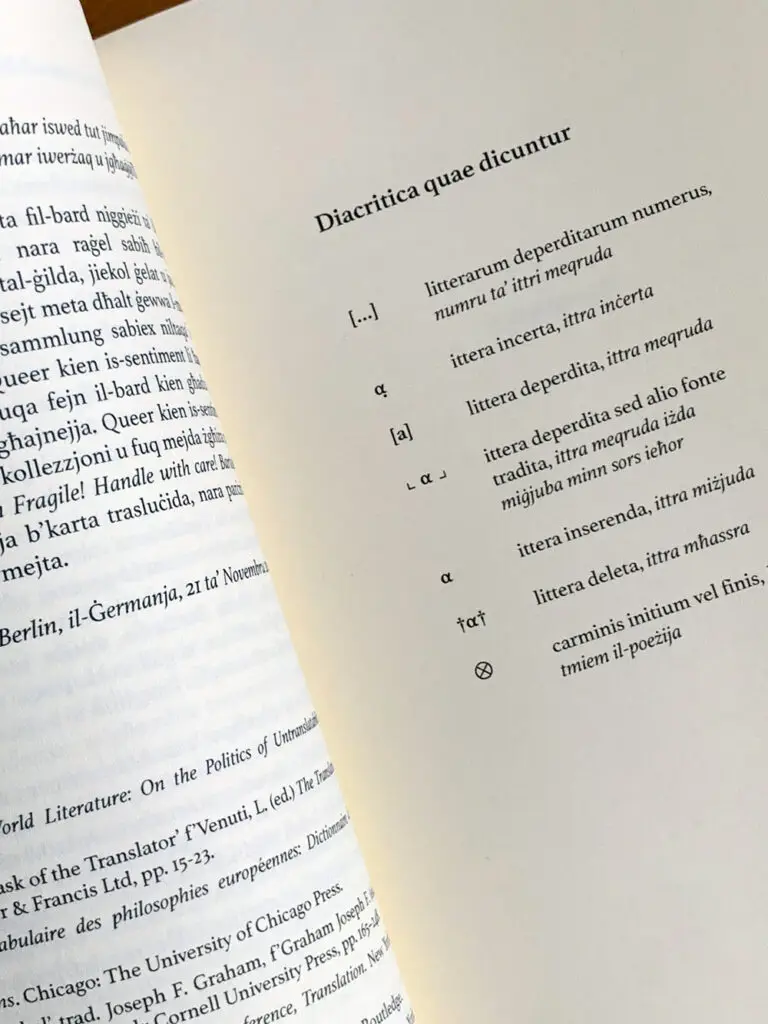
Yet to engage with Sappho is inevitably to confront the poetics of the fragment. We do not possess her collected works; we possess ruins: scraps of papyrus rescued from Egyptian sands, lines preserved incidentally by male grammarians illustrating points of syntax, and verses scraped clean from parchment to make room for later texts. This fractured survival forces us to interrogate the historical contingencies of the literary canon. What is preserved, and what is rendered ‘forgettable’? History’s archives are rarely neutral; they are shaped by ideological choices regarding whose voices warrant institutional memory and whose can be safely sidelined. That a woman writing passionately about female intimacy survived largely in ellipses is no accident. However, in Bartolo’s edition, those broken brackets and blank spaces do not merely signify loss. They become an active aesthetic force, inviting the modern reader to collaborate with silence and trace the contours of what was nearly erased.
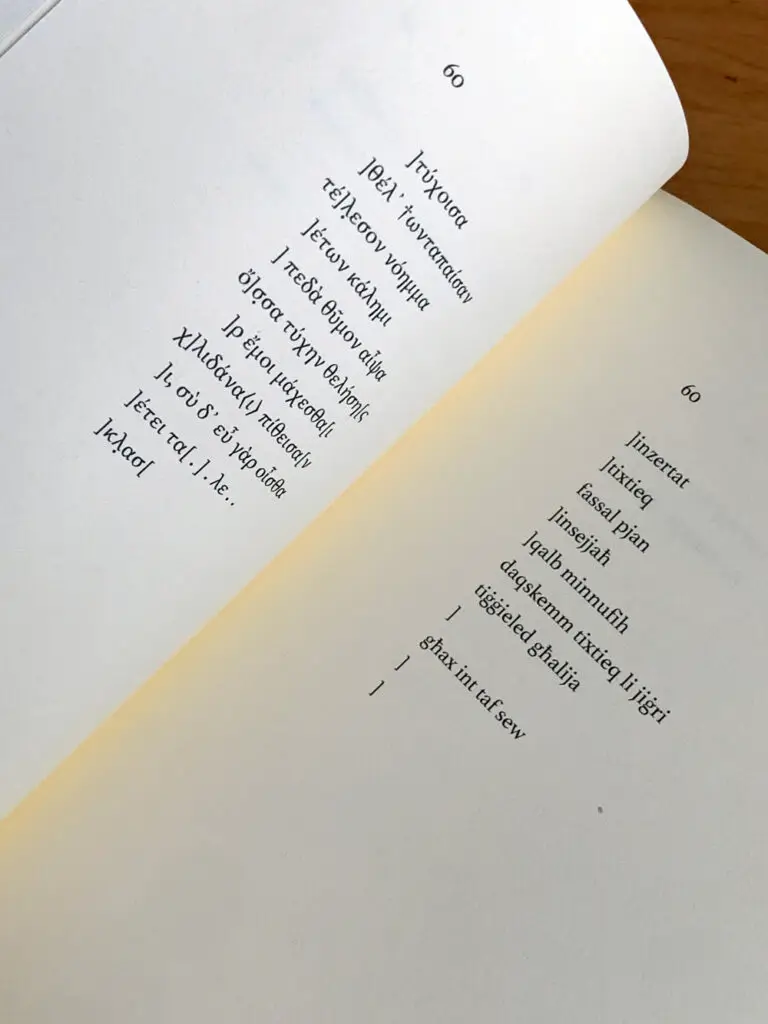
This brings us to the transformative labour of translation itself. Far from being a passive transfer of meaning, translation is a radical reactivation of the original text. It rescues Sappho from the museum glass of Classical philology and restores her work to its original nature: a spoken, sung, and visceral form of art. Bringing Sappho into Maltese carries a profound cultural and geographical resonance. Unlike northern European languages that must bridge a vast climatic and historical distance to reach Lesbos, Matlese is a living Mediterranean tongue forged by island life, maritime trade, and the rhythms of sea and wind. When Sappho writes of love shaking her heart like a mountain wind falling upon oaks (Fragment 47: u Eros regħedli qlubi, bħal riħ tal-muntanja jaqa’ fuq il-balluta), or invokes the sensory intimacy of orchards, salt air, and twilight, Maltese meets her on familiar terrain. Furthermore, a language that has itself weathered centuries of marginalisation and layered survival due to colonial conquests proves a uniquely fitting vessel for Sappho’s enduring fragments. Bartolo’s translation demonstrates that Maltese possesses the classical weight, precision, and erotic register required to house foundational world literature.
With Aphroconfuso set to bring Il-Frammenti ta’ Saffo back into circulation next year, readers are offered an indispensable bridge between the ancient Aegean and contemporary Malta. By restoring Sappho’s fractured lyrics to a vibrant Maltese vernacular, Bartolo reminds us that what history tries to sideline often endures precisely because it mirrors our own fragmented sense of self. As Judith Butler reminds us, the self is inherently precarious, opaque, and never fully able to give a complete account of itself. In that light, Sappho’s broken papyri cease to be mere accidents of history; they become an honest reflection of the human condition. In Maltese, Sappho is no longer a distant relic of antiquity; she is an islander speaking across the water, entirely at home.