
Bejn Ramel u Ċagħaq – Ġorġ Borġ
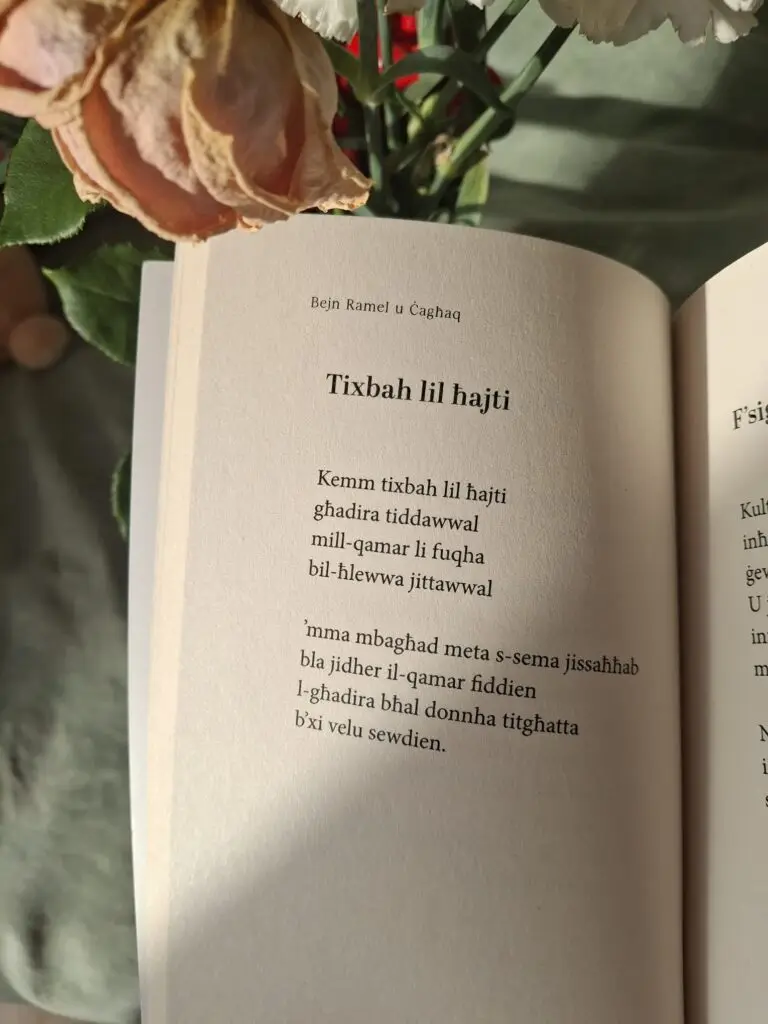
Maltese poet and translator (Animal Farm, George Orwell) Ġorġ Borg presents an exquisite poetry collection in Bejn Ramel u Ċagħaq (2025) (In Between Sand and Pebbles). He explains how he was inspired by life’s constant struggle between hardships and ease, symbolised by the pebbles and the sand. Arguably, this metaphor brings about local dimensions, where we find ourselves in difficult situations, characterised as pebbles, and the ease of sand slipping from our hands.
Admittedly, his poetry is lyrical and condensed in short verses, with a constant rhyme pattern, that switches mainly between rhyming couplets and an alternate rhyme. A traditional form, which is reflected in the themes of nature, transience of time, love, and religion. One can say that the form may feel antiquated and harkens to an older generation of poets, however, Borg’s technique brings forth an inner beauty that shifts narratives away from a longing towards a romanticised era or a ballad on today’s societal issues. Rather, the poems proclaim a contemplative nature, anchored in the 21st century and strive to engage in dialogue with the reader. This agency for human faculty in a world that reduces attention spans and critical thinking to three-second algorithms, is a refreshing take, and one which I embraced. Through his poetry, Borg presents us with the reality that we, as humans, seem to be ‘In Between’ different decisions that could change the course of our lives, which brings on philosophical questions regarding our true place in the world.
Borg reflects on a ‘living afterlife’, an oxymoronic metaphor on a state of being, through the sequence of time and space, which reminded me of C.S. Lewis’ The Great Divorce (1945), where souls cannot enter Heaven without being cleansed from sin, and if souls have yet to be cleansed, they are trapped in the “Grey Town”, an inbetween place. Borg plays with the concept of space and time through a juxtaposition of intense freedom of choice in contrast with confinement and restriction, and questions whether liberty is ‘Heaven’, or whether it can become ‘Hell’, as can be seen in his poems “Distanzi” (“Distances”) and “Spazji” (“Spaces”). The ‘in between’ element just like “Grey Town”, may be Borg’s version of a ‘living purgatory’. It is here that, similar to Lewis’ The Great Divorce, Borg presents the struggle of feeling cleansed from sin, to then soil our souls with wrongdoing, trapped in a living purgatory, similar to “Grey Town”.
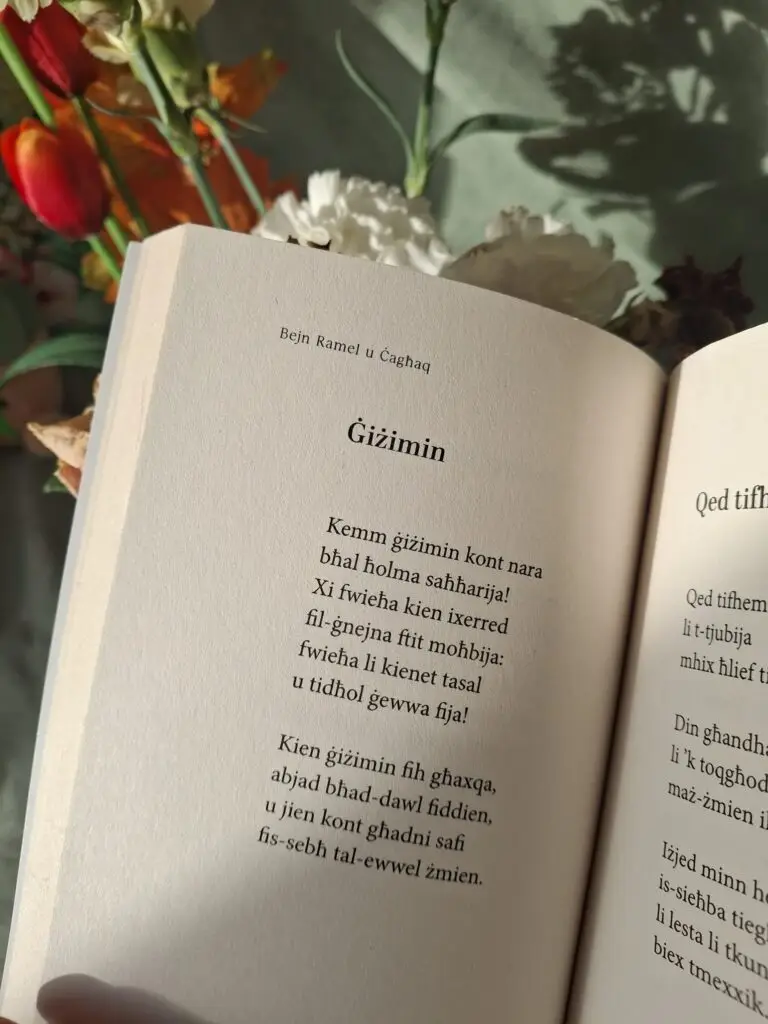
Borg weaves further religious and philosophical questions through the poems on nature: the poems Werqa (“Leaf”), Blat (“Rocks”), Xemx ħanina (“Merciful Sun”), Ġiżimin (“Jasmine”), Kaskati (“Waterfalls”) and Qawsalli (“Rainbows”) convey a more meditative energy, grounding the collection. Borg explores the origins of existence through the beauty of nature, and posits the claim that through nature and environment, we meet with God and subsequently with ourselves. He presents the duality of nature in Blat, contrasting the ‘lejl ta’ qamar’ (‘moonlight night’) with daylight, and describes rocks as having form and a sense of joy rather than being formless particularly when such elements produce a sense of beauty in the mundane: “jissieħeb f’seħer ta’ ġmiel fiddien u delikat”. Borg spotlights mundaneity, presenting a discrete cry for opposing the alienation of the duality in nature itself.
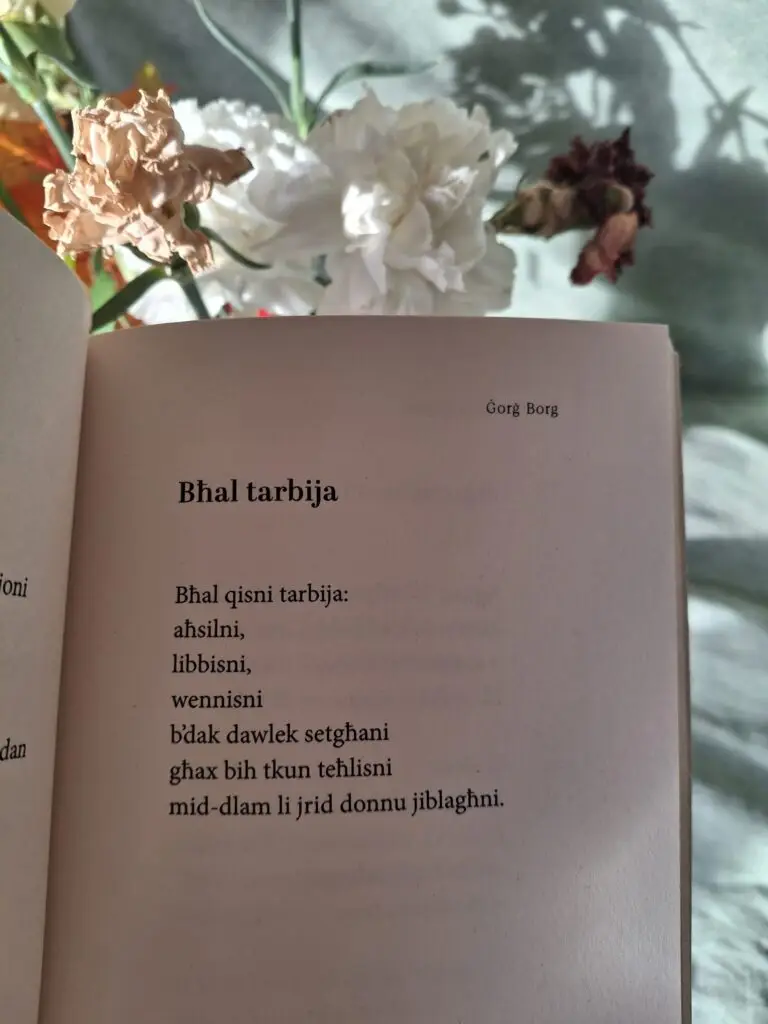
In conclusion, this poetry collection explores the meaning of humanity. Anchored in current issues, this contemporary take is most interestingly intertwined with themes which for many might feel clichéd, yet, Borg delicately shifts this narrative by focusing on the philosophical and varied meanings of ‘living’. I truly found that this collection gently pushes our beliefs and presents us with thought-provoking discussions, one poem at a time.