
Váh: Beyond Words and Landscapes
In one of the poems in Váh (2024), Immanuel Mifsud records an hour-and-a-half train journey between Trenčín and Bratislava, but not the name of the person who shared it with him. The two passengers spoke to one another in languages neither understood. At the station, they collected their bags and went their separate ways. By the poem’s end, the speaker is in another country and another month. His account ends with a question that can no longer be answered.
That discrepancy between the precision of an itinerary and the incompleteness of an encounter offers a way into Váh. The book takes its title from a Slovak river and combines Mifsud’s writings, paintings, and drawings. Travel provides its locations, but the poems are rarely concerned with describing destinations for their own sake. Instead, they linger on what the traveller cannot establish with certainty about the people and places he encounters.
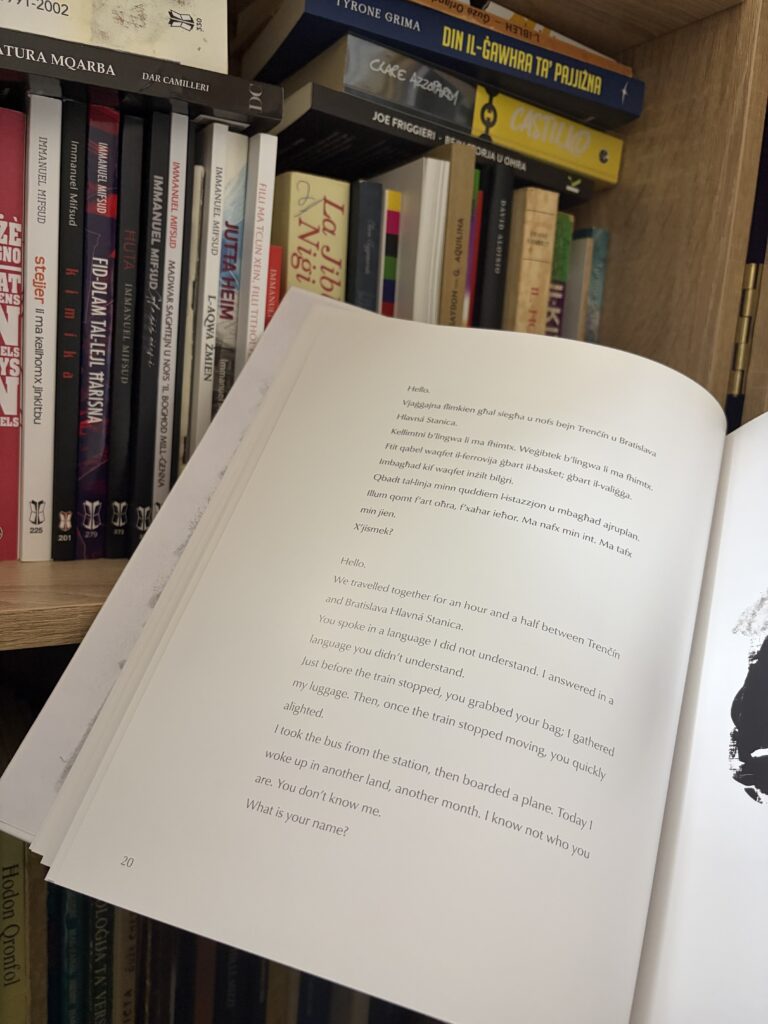
The speaker remembers the stranger’s departure and his own subsequent journey by bus and plane. These details might belong in an ordinary travel diary, but here they only make the missing information more conspicuous. “Ma nafx min int. Ma tafx min jien.” The admission works in both directions. The stranger remains unknown to the speaker, but the speaker has been equally inaccessible to the stranger. The final “X’jismek?” is not a question posed during the journey. It comes too late, after the possibility of an answer has disappeared.
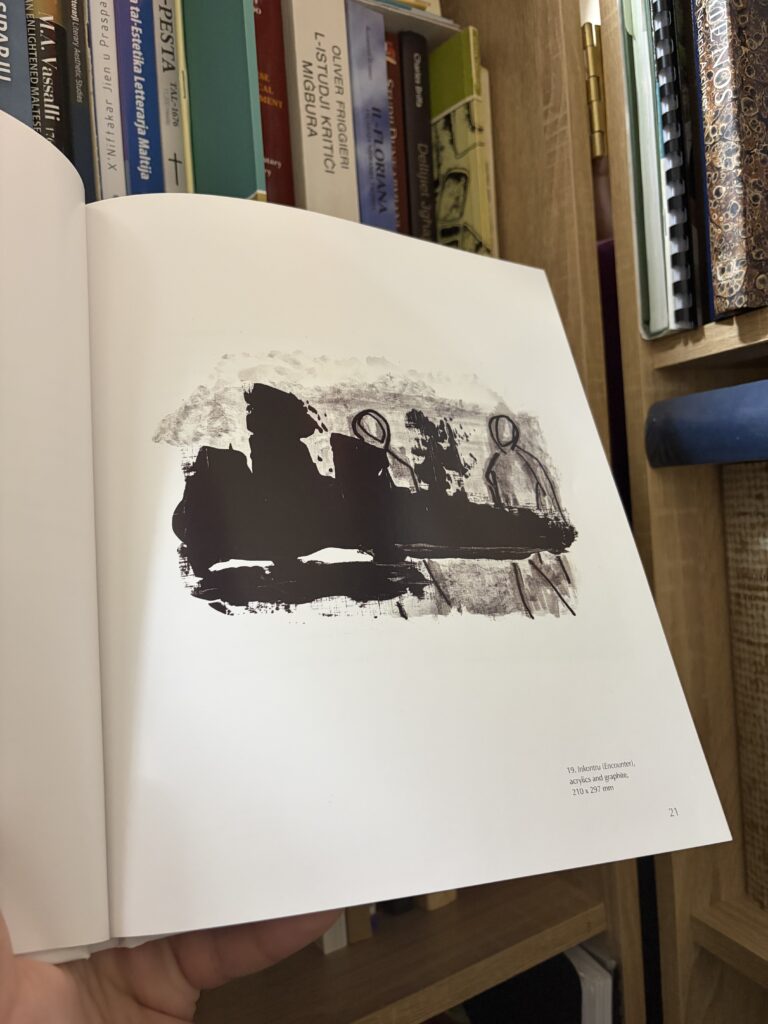
The adjacent artwork, “Inkontru,“ shows human-like outlines emerging from a dense, dark horizontal form. It neither identifies the passengers nor reconstructs the railway carriage. Its figures are present but difficult to distinguish. The pairing is effective because the poem supplies a precise sequence of events while the image preserves the encounter’s lack of clarity. In a bilingual book, the episode also introduces a useful tension. Translation makes the poem available to another reader, but understanding its words cannot repair the failed exchange it describes.
The forests elsewhere in Váh demand a different kind of attention. On one page, the speaker is warned against entering dark trees for fear of leaving his face behind. On the next, the trees are called suspicious. They have heard too much gunfire and, in a repeated formulation, too much silence. Their branches stir at the approach of footsteps. These lines personify the landscape, but their force depends on the reference to violence. The trees are not threatening simply because they are dark. Their apparent fear has a history. Without the mention of gunfire, the warning might belong to any ominous woodland. It is this particular detail that makes a landscape which could otherwise remain atmospheric a place marked by events.
That historical association becomes more particular later in the collection. A poem describes figures emerging from the spruce and recalls Jozef Letrík and Jan Lupa, two-year-olds associated with defending their country. The Slovak dedication “Česť ich pamiatke” appears in both the Maltese and English versions of the poem, without an accompanying translation. Following the poem, Mifsud places a pastel image of a group whose faces are scarcely differentiated. The poem names two individuals; the artwork presents an indistinct crowd. Neither cancels the other. Together they hold the tension between remembering particular people and representing a collective past.
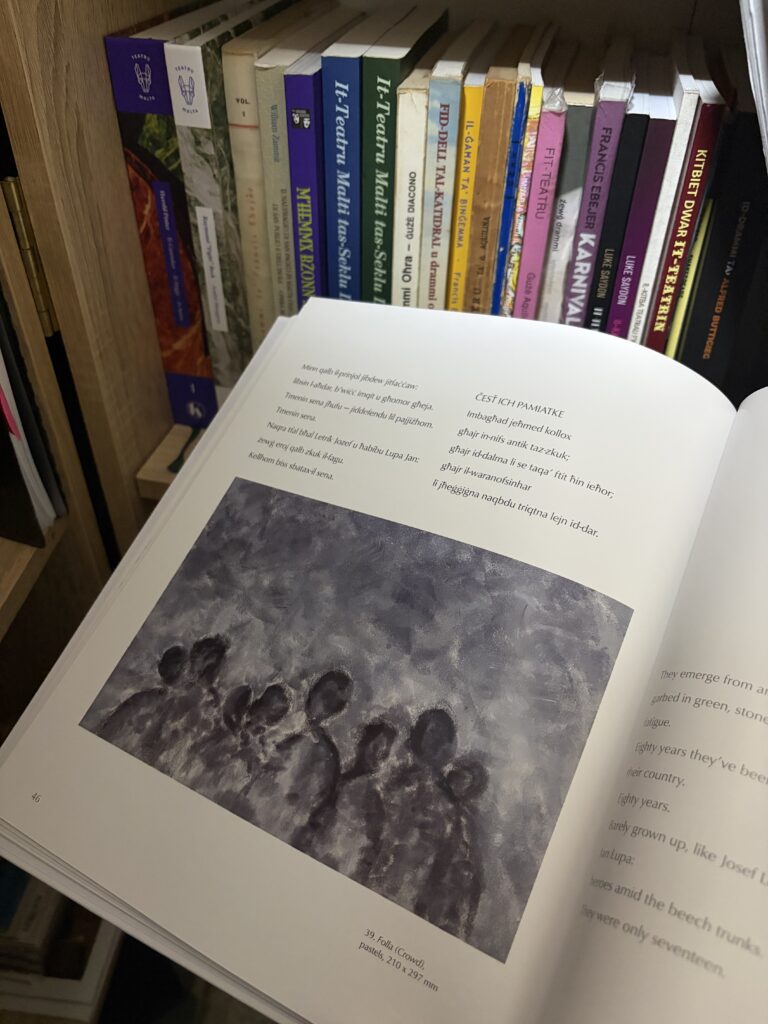
These passages also clarify why the images matter beyond the book’s appearance. They do not consistently illustrate an adjacent text. Sometimes they withhold the very particulars that the words provide; sometimes the words clarify what the dark forms alone could not tell us. Mifsud has long written Maltese poetry set outside Malta, but Váh is particularly interesting in how it asks the reader to look and read in tandem. Its strongest pages recognise that visiting a place is not the same as knowing it. A journey can be remembered down to the station, while another person remains unnamed; a landscape can be drawn in detail, while its history requires a different act of attention.