
Ix-Xita Tinżel Rasha ‘l Isfel – Francesco Grech
Reading Francesco Grech’s poetry collection Ix-Xita Tinżel Rasha ‘l Isfel feels like I voyeuristically delved into someone’s mind – with thoughts that somehow merged into my own. This personal and intimate compilation represents an array of themes that vary from nature, love, yearning, love lost, and everything else that intimacy connotes with it.
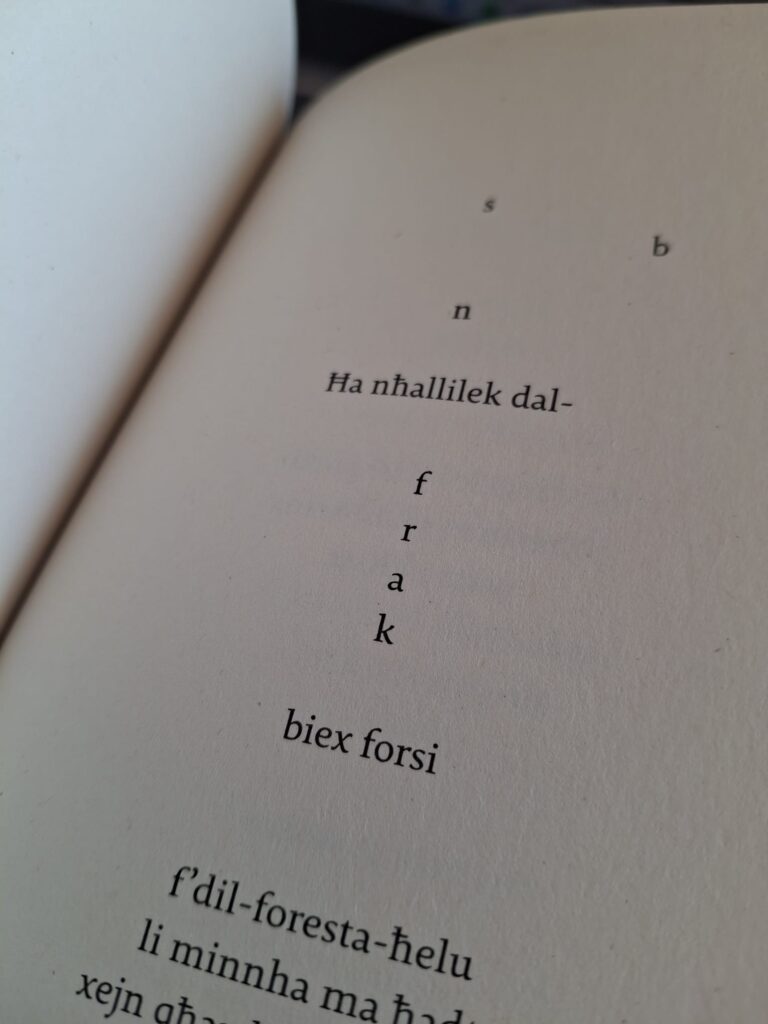
Firstly, all the poems seem to redefine the definition of poetry itself and of poetical conventions, since none of the poems seem to have a title as their first line; a technique which has been gaining speed throughout these last few years. On the contrary, Grech turns this concept upside down and instead, ends numerous poems with one line or even a word:
A verb.
A question.
A noun.
An adjective.
A phrase.
I find this technique very much suitable for the (very) contemporary style of the book, and it helps the reader to see the whole collection as one, or better, as a continuity, imitating a stream of consciousness. Nonetheless, this inverse style reflects the title and the crux of the book, imitating the rain pouring upside-down.
Water, or liquid as a state, symbolized mainly by the rain in the title, is the main recurrent motif which is used to describe the multiple purposes of it in our daily experiences. Water has been used multiple times in poetry, from symbolising grief to the power of renewal and new birth. In Grech’s anthology, water represents tears, both happy and sad, while sometimes the imagery juxtaposes a sprinkler used to water plants with the human seminal fluid, both a symbol of fertility and growth. This liquidity is the intrinsic quality of water, the characteristic which makes it “take the form of that which it hugs” (“U tieħu l-forma ta’ dak li tgħannaq”, p. 29). This repeated, intimate gesture of hugging does not just personify the fluid but is also used to animate inanimate objects like trees and leaves (“Ħalluni fil-ħamrija taħt xi siġra li tgħannaqni bi frigħetha”, p.98), further intensifying closeness and parallel movements of nature and humans.
The last section, if we can call it that, entitled “U titwaħħad mal-iġsma biex trattabhom f’għajn fertili” (“And [it] unifies with the bodies to soften them into a fertile spring”) carries within it the most intimate and erotic poems in the book. Here, the poems reach their most explicit nature. Euphemism? What is that? Grech says the word as it is, as it is used between friends or even, in our heads, when we are alone with our uncensored thoughts: “Toqba sewda”, “demm”, “qatra”, “immerraq”, “imbeżlaq” (p.96). Brace yourself. I discovered that my thoughts no longer belonged to me anymore. The unfiltered words written down black on white, or white on black…
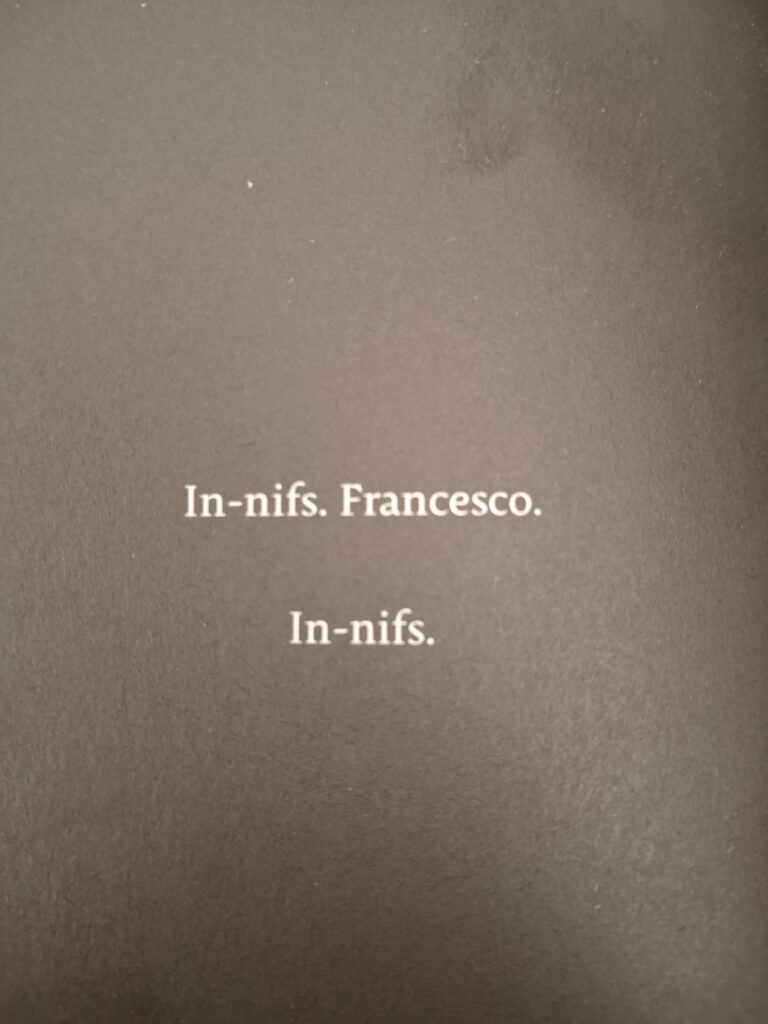
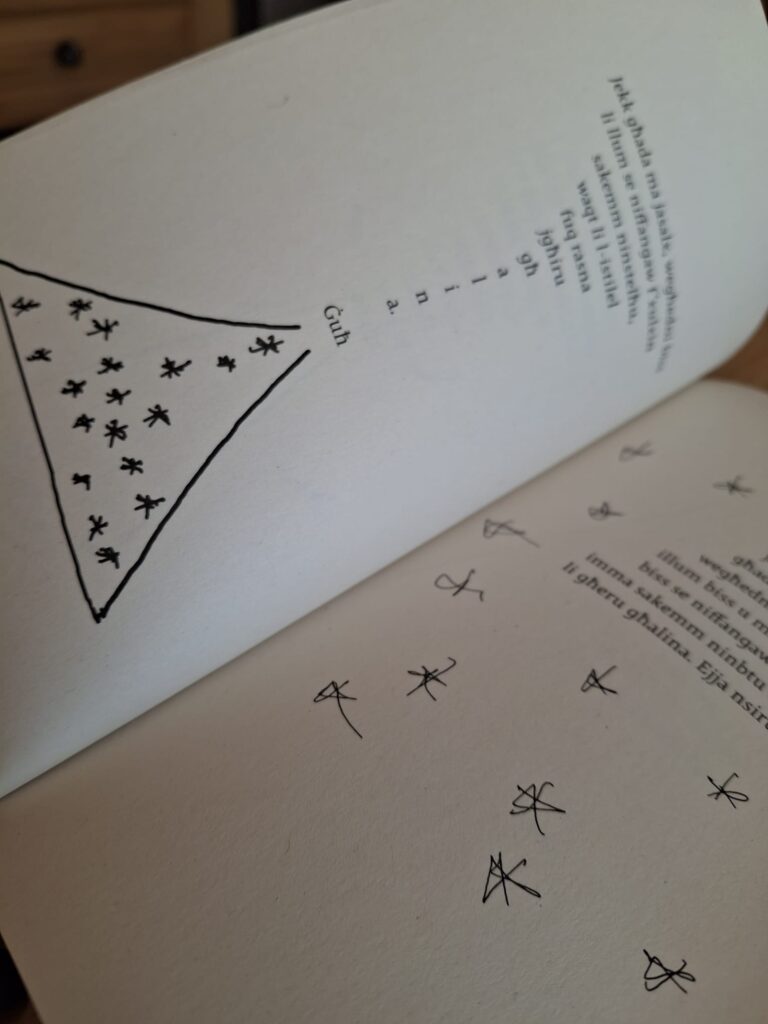
Some poems are indeed written white on black. The style of them stands out to be that of concrete poetry. Grech visually intervenes in his poems in ways that further reinforce their interconnectedness: he paints curls in poems that explicitly evoke hair and curls (p. 87), halts the poem to portray the secrecy of the secret (p. 56), and literally scribbles over the verb “nħassar” (“I erase”) (p. 4). These stylistic decisions work to unify the collection on both a material and visual level, blurring the boundaries between text and image.It feels like there is an overall wish to reunite with our origins, back to the world’s essence. A reunification in which everything appears to reach a state of wholeness is central to this imagery.
This sense of completion is further reinforced through the recurring motifs of the stars, the moon, the soil, the roots, and the wings, among others. These elements evoke a cyclical understanding of existence, in which separation and fragmentation give way to renewal and regeneration. I recall Murad Shubert’s Il-Ġeografija tal-Irmied u l-Ġwienaħ, in which ash and wings function as a synecdoche for death and life respectively, while simultaneously embodying the perpetual cycle of regeneration between the two. In this sense, the imagery does not present death and life as opposing or mutually exclusive states, but rather as interconnected stages within a continuous process of transformation.
Grech’s collection oxymoronically publicises the intimate, without compromising it. Through its poetics, more specifically, through concrete poetry, he manages to reunite the body with the raw, essential parts of the earth; the essence of what it really means to be a human. Additionally, he is contributing to the queer literature by breaking down the stigmatisation of physical intimacy through the word play that is privy to those who truly feel and understand it. With this publication, Grech really shows himself as an innovative author, even if the themes of nature and love are thought to be exhausted.