
Qarn: On Tender Writing
Romeo Roxman Gatt’s Qarn is described as “a memoir of transition, a protest essay, a poetic manifesto, a utopian strategy, a love letter.” It is also a book that documents journeys: the author’s return to Malta, to his language, his family and, ultimately, to himself. Although, given its central theme, the book can be read as a document on gender transitioning, it is much more than that. What the book demonstrates is that matters of gender and sexuality are always more than that; they spill over into reflections on self-acceptance and self-transformation, on belonging and rejection, on longing and unsatisfied desires.
The book’s title, Qarn, is noteworthy, even if in a tongue-in-cheek way. ‘Qarn’ is the word that Google Translate gives for ‘horny’, even if that word technically refers to a singular horn. Perhaps this error is an appropriate one. Rather than a mistake, this semantic deviation calls our attention to the innovation and experimentation that language and life harbour within them.
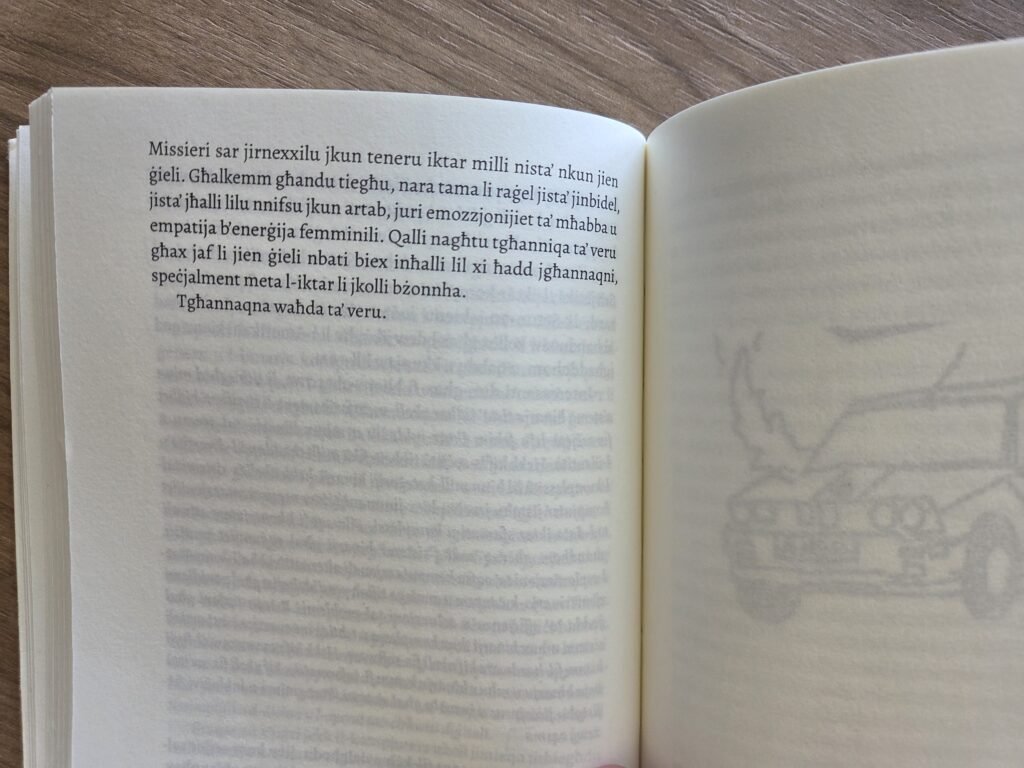
In fact, Qarn itself defies easy categorisation as a text. It sways between memoir and the essay, draws on theoretical texts, at times offers playful verses, and even artistic sketches by the author. This is the type of text that has come to be associated with Aphroconfuso, the book’s publisher, where genre is less important than the movements that texts perform and the affordances they allow.
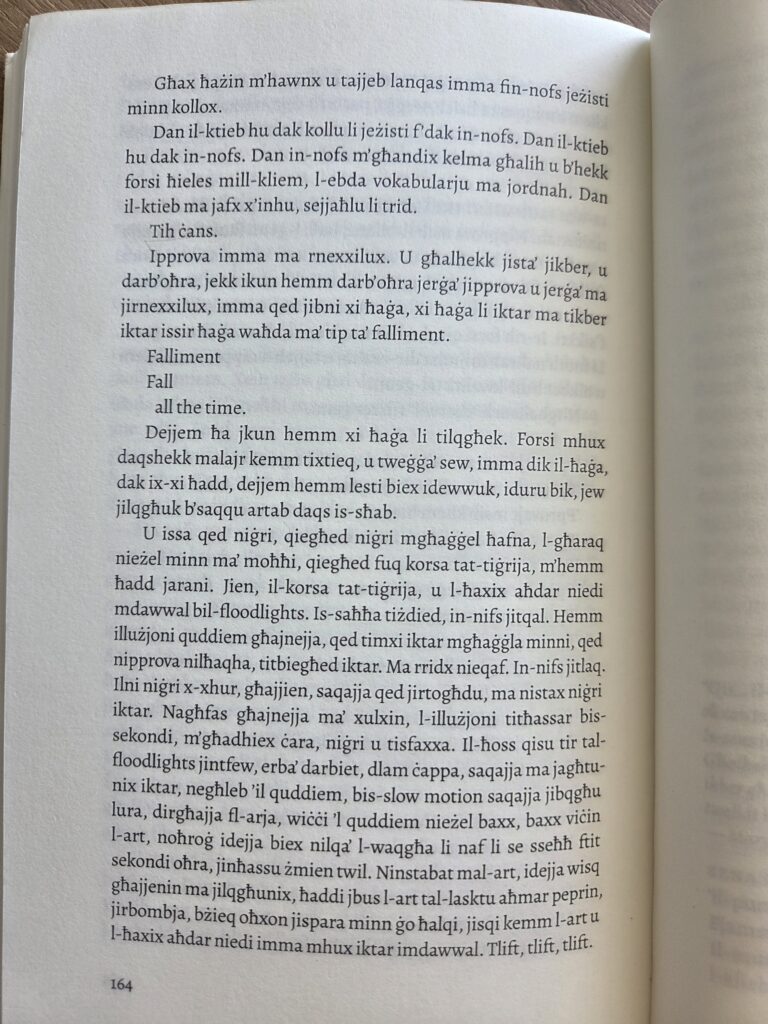
Being a memoir of transition, one might expect Qarn to follow a certain linearity or have a progressive narrative arc. But what is particularly interesting in this book is how it challenges easy conceptions of what it means to write (about) oneself. Reading Qarn made me think of Judith Butler’s Giving an Account of Oneself and the exciting but also difficult complications that such an endeavour presents. We might think that to narrate oneself is the easiest thing ever – after all, who knows us more than we know ourselves? – but as Butler shows, we tend to be less transparent to ourselves than we might think. We are relationally entwined with others, with language, with our psychic grips, and these complicate any easy or linear narrative we might want to put forward to explain who we are or how we came to be what we are.
In a sense, Qarn demonstrates that to narrate oneself goes beyond the self as it is an activity that includes others; those close as well as those who are distant, kinship ties and impersonal socio-political ones. An essential element of the book is the author’s relation to his family. What is striking is the warmth with which Romeo describes his interactions with his family; the tenderness of care, the outburst of affection, the worry about each other’s illnesses or fatigue, the transition to a more open way of communicating that manages to transcend layers of unspoken concern.
Qarn also shows that to narrate oneself sometimes amounts to a political gesture, especially when this is done by persons who do not or choose not to conform to societal norms. The book raises questions on what it means to narrate oneself when the dominant discourse about some identities consists of derogatory, hateful or pathologizing language. This forces us to reflect on what it might mean for someone to narrate their self when the available language is one that is entangled in a history of woundedness.
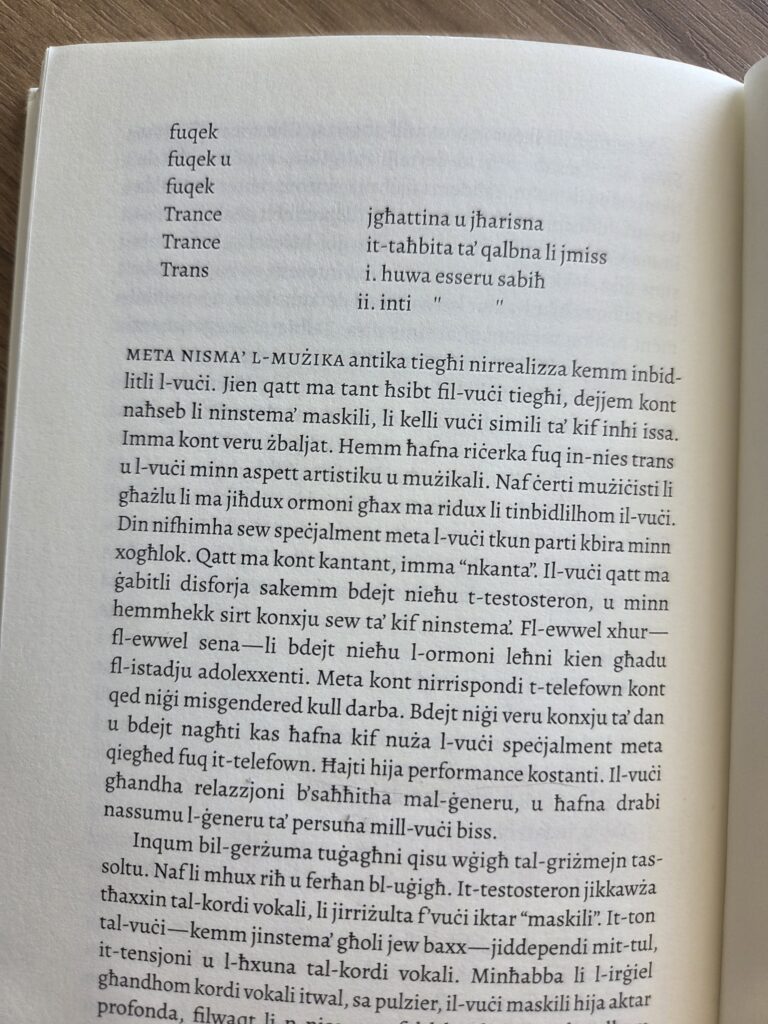
To this, Qarn responds with a parodic playfulness. Besides the pathos of various of its pages, the book also contains moments of high energy and power. It pushes language (and the Maltese language) in order to make it describe experiences in one’s own words. The book registers a vast range of affects and sentiments that, in their totality, capture the complex and ambivalent nature of being human. At times, sometimes simultaneously, the book complains and pleads, it protests and worries, resists and stumbles. It oozes emotions, particularly those that cannot always be reigned in: grief, hurt, longing and anxiety but also excitement, ecstasy, intimacy and lust.
A strength of the book is that it lures in the reader. It invites connection with the words and their rhythm. It does not close off. At times, the reader can feel directly addressed through the book’s use of the second person pronoun, which heightens the intimacy of the prose: “Fejn int, meta ġej, tħallinix waħdi, għajjejt” (pg. 143).
This is a crucial quality of the book. By swaying between affirmation and vulnerability, confidence and hesitance, Qarn is an important contribution to discussions around gender and sexuality which oftentimes tend to happen at too high a temperature and with a volatility that precludes genuine understanding. As transphobic and queerphobic sentiments persist in a world marred by destructive culture wars, Qarn stands as an invitation to those who are willing to listen and embrace identities that are different to theirs. The book’s sensitivity is a strong response to politicians all around the world, including in Malta, who are portraying gender issues as a dangerous attack on ‘the order of things’ or as matters that children and young people need to be protected from. In response to this hardness, Qarn calls for openness: “Kull ċans li jkollok irtab” (pg. 54).