
Ippermettili Nitlaq: The Conditions of Unconditional Love
Bradley Cachia read and reviewed the playtext from Alfred Buttigieg’s collection of plays “Id-Drammi ta’ Alfred Buttigieg” (p. 111-170, 2024). This review is brought to you by the National Book Council.
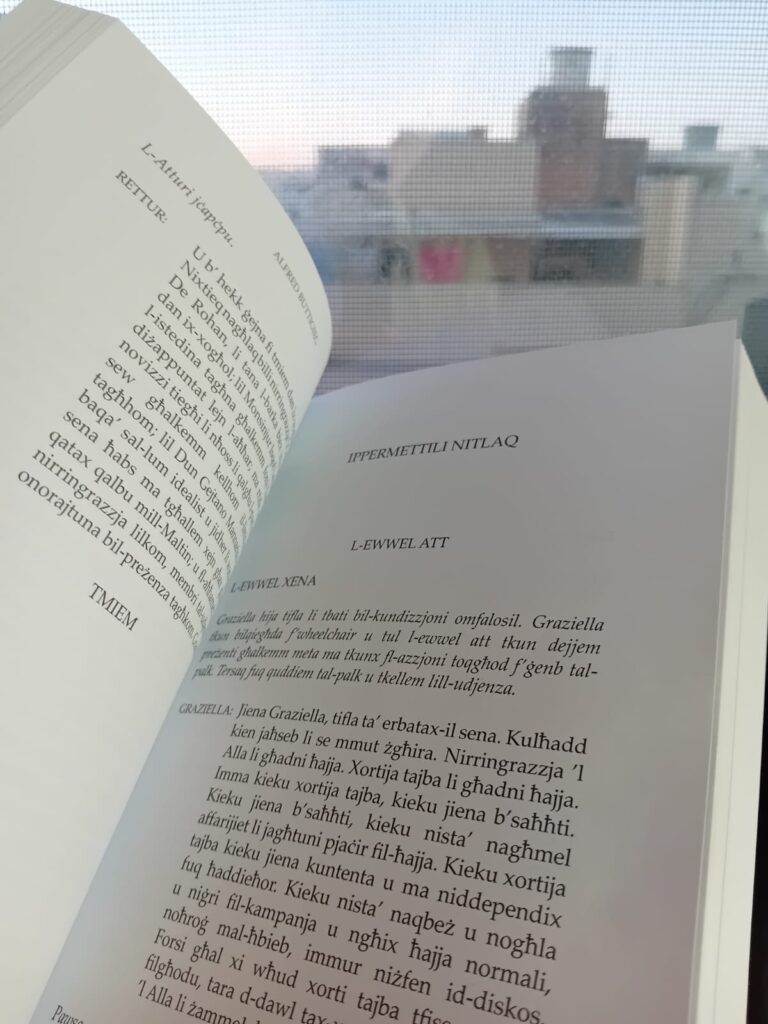
Ippermettili Nitlaq follows Graziella, born with omphalocele, a condition in which the intestines develop outside the body, and traces the layered forces that shape her life long before she has any say in it. Medicine, religion, family economics, and cultural expectation all converge on this one small body, each claiming to act in her best interest, none of them quite asking what she actually wants.
Alfred Buttigieg opens his play with Graziella inviting an audience to imagine her exposed abdomen, with no preamble or easing in. Just a body, on display, asking to be looked at, making readers feel uncomfortable before they have had the chance to decide how they feel about this situation.
The hospital scenes do exactly what good dramatic writing should: they let behaviour speak. Dr Alberta Borg sweeps in for two-minute visits, barely glancing up from her notes, and at one point expresses irritation that a required operation will delay her planned leave. Nurse Johanna, by contrast, is the playtext’s conscience, insisting repeatedly on Graziella’s humanity in the face of colleagues who treat her as a clinical problem to be managed. When Johanna describes Graziella’s eyes as seeming to ask why she is being kept alive in such pain, it lands not as melodrama but as a quiet, urgent ethical question that Buttigieg has the courage not to resolve.
What unsettles most, though, is not the medical machinery. It is the religion. Graziella’s mother Fiona refused abortion on grounds of faith, but still did not fully embrace and accept her child’s condition. There is an irony in this that Buttigieg does not spell out but allows to settle: the very faith that compelled her to carry the pregnancy to term is built on a theology of acceptance, of receiving what is given without condition or prejudice, yet that same faith could not bring Fiona to accept the child who arrived. Her love is genuine and evident, but there is something quietly devastating about watching that love operate within such rigid, religious limits.
It’s that familiar local unease: the recognition that even the things we consider unconditional, parental love above all, are so often conditioned by an authority that sits entirely outside the relationship. And Buttigieg presses this further. If faith demanded that Fiona carry Graziella to term regardless of the suffering that awaited her, the play inevitably raises another questions: was the fact of Graziella’s life prioritised over the quality of it? Buttigieg leaves that question painfully open. The same logic applies in reverse to the question of euthanasia that hangs over the play’s later scenes: mercy, in both directions, is foreclosed by doctrine. Graziella is kept alive and suffering, not because anyone has weighed her experience against the alternatives, but because the framework within which such decisions are made already predetermines the acceptable answer.
Fiona’s dream of the daughter she hopes Graziella will one day become, walking, running, swimming like other children, is tender precisely because it is so oblivious to itself. This is not a mother imagining who Graziella is, but one imagining who she wishes Graziella were, projecting onto her child an image of the child she had pictured long before this one arrived. It is a mother loving a child she has partially invented, and the real Graziella with omphalocele — the one in pain, asking through her eyes why she is being kept alive — exists at a slight but unmistakable distance from that image. Meanwhile, Richard, the father, quietly worries about the mortgage. Buttigieg does not linger on this or make it dramatic; he simply puts it there, plainly, and it stings.
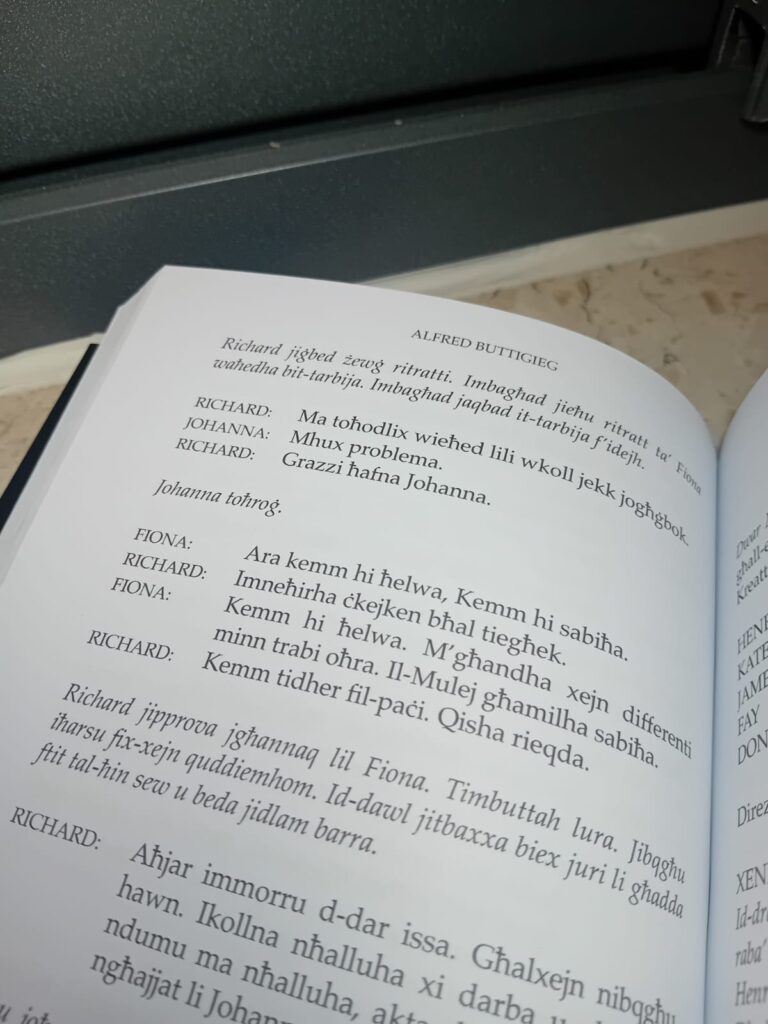
The text’s cleverest structural move is giving Graziella her own narration. She interrupts scenes to explain her condition in clinical detail, temporarily becoming the most authoritative voice on the page. It is a satisfying reversal. But Buttigieg is too honest a writer to let it become triumphant. The knowledge Graziella possesses about her own body grants her no real power over the decisions already made about it. Her authority is retrospective, and therefore hollow. That honesty is the defining quality of this text: it speaks its mind without flinching, without softening the edges to make the reader feel better about what they are witnessing.
The final scene, in which Fiona and Richard hold their deceased daughter and marvel at how beautiful she is, how no different from any other baby, is where everything lands. The acceptance they could never quite extend in life arrives only when Graziella no longer needs it.
Written in 2008, Ippermettili Nitlaq has not aged into irrelevance. If anything, it has aged into urgency. Abortion and euthanasia remain conversations Malta keeps starting and never quite finishing, and a text this clear-eyed about what it means to make decisions on behalf of a body that is not yours sits with us precisely because the ethical contradictions it exposes remain unresolved.
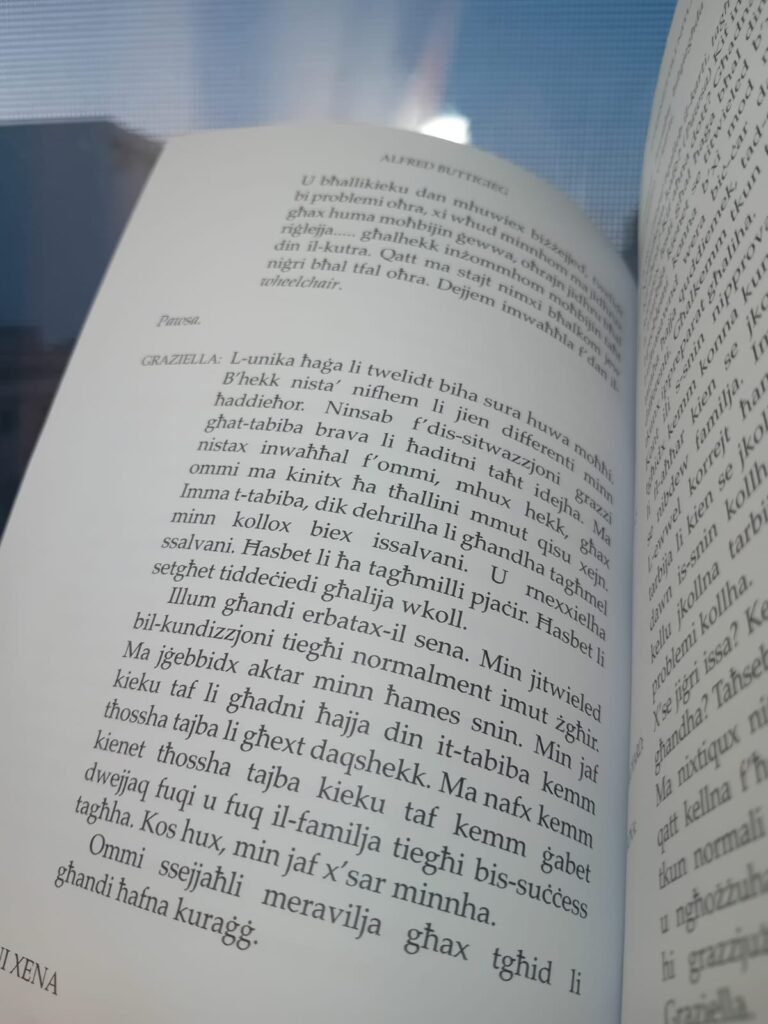
Ippermettili Nitlaq Dramatis Personae
GRAZIELLA: Daughter of Fiona and Richard Camilleri, born with omphalocele, aged 14
FIONA CAMILLERI: Mother of Graziella, aged 32
RICHARD CAMILLERI: Father of Graziella, aged 29
DR ALBERTA BORG: Paediatric Surgeon, aged 53
DR HENRY VELLA: Paediatric Registrar, aged 35
JOHANNA SPITERI: Neonatal Intensive Care Nurse, aged 45
ANTHONY SPITERI: Johanna’s husband, aged 48
LIPPU XIBERRAS: Hospital orderly, aged 56