
This review is brought to you by the National Book Council.
At times, this book feels like what it truly is: a collection of short stories. At others, it does not. The stories seem to bleed into one another, much like the characters themselves. Through recurring metaphors, fragmented memories, and shared emotional landscapes, Shubert gradually dissolves the boundaries between separate narratives, creating a volume that no longer portrays fictional characters alone, but real people. Fiction and reality begin to merge into a world that feels both intimate and unsettlingly familiar.
Il-Ġeografija tal-Irmied u l-Ġwienaħ (The Geography of Ashes and Wings) presents a contemporary reimagining of geography. Individuals and groups from different lands and cultures, including Malta, are shown in their vulnerability whilst enduring diverse tragic experiences, often unbeknownst to one other: from the death of a politically-opposed friend in “Mafkar”, the expired residence permits of a widow in “Residenza”, to a near annihilation of the world in “Mejta”. Yet, this vulnerability is not always explicit. In “Lewż”, men appear conscious of the danger surrounding them, attempting to hold back their emotions, only to become the very figures shaking the almond blossoms from the almond tree.
Shubert also represents women across social classes, demonstrating how vulnerability transcends status and privilege. In “Waiter”, a woman drives a luxury car with a siamese cat in the passenger seat instead of a baby in a carrycot. Despite this opulent facade, it does not reflect her true inner self, which remains fragmented. Beneath performances of affluence, she is destined to feel discomfort towards injustices on others, particularly emotional distress towards those whose suffering far exceeds her own. Wealth, Shubert suggests, may conceal vulnerability, but it cannot erase it. Vulnerability takes up different forms, ever emphasising this innate characteristic of human beings.
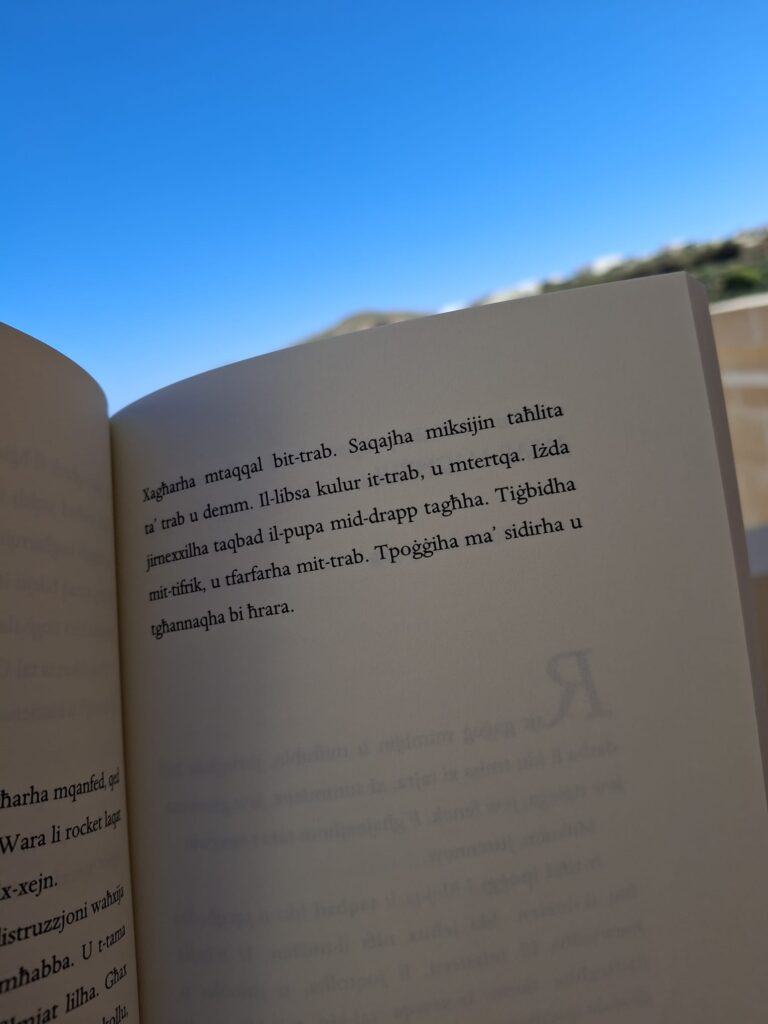
A brief glance at the table of contents, the titles compel the readers to construct images and expectations. However, seemingly hopeful titles prove to be deceptive. From the gothic titles “Kefen” u “Mejta”; to the toponomastic titles “F’Tehran” u “F’Gaża”, to apparently romantic “L-Imħabba”, “Qalb” u “Ġmiel”, Shubert weaves in unjust human experiences, such as displacement, grief and war trauma. Any promise of respite or relief is swiftly taken away by the brutality of the worlds these stories inhabit.
Recurring motifs create continuity across the fragmented narratives. The motif of the ash, alludes to destruction and memory, while complements the visual identity of the colour grey, repeatedly used to describe the landscapes carpeted in dust. Feathers in comparison, hold a double meaning: a motif which can be interpreted both as the remains of something burnt and also a symbol of flight and freedom. On the one hand, can these feathers represent the faded and forgotten dreams, while still carrying the hope for a better tomorrow? Together, ash and feathers become symbols of a persistent tension between despair and survival.
Colour also becomes central to the sensory world of text. The white and red imagery in “F’Gaża” and “Pupa” contrasts with the grey, clouded ambience surrounding the characters. In “F’Gaza”, the colour white evokes an ocean of tents and the innocence of children, embodied in the young girl’s white-and-red dress. The colour red repeatedly functions euphemistically for blood, which in turn oxidises and dries brown, a remnant of memory of a human life and bodily violence.
Arguably, children whose vulnerability remains entirely unperformed. Unlike the adults surrounding them, they make no attempt to conceal fear, grief, or confusion. In “Fatima”, the reader is presented with, perhaps, one of the most obscure imagery in the entirety of the book: a little girl innocently playing with the amputated human arms following a ballistic attack, later which she places them in a vase, instead of the flowers. The imagery of the grotesque juxtaposed with innocence conjures a guttural reaction to the normalisation of violence and horror, from the perspective of a child. Similarly, in “Bandiera”, this innocence is corrupted by normalised violence, a reality which becomes the reader’s nightmare.
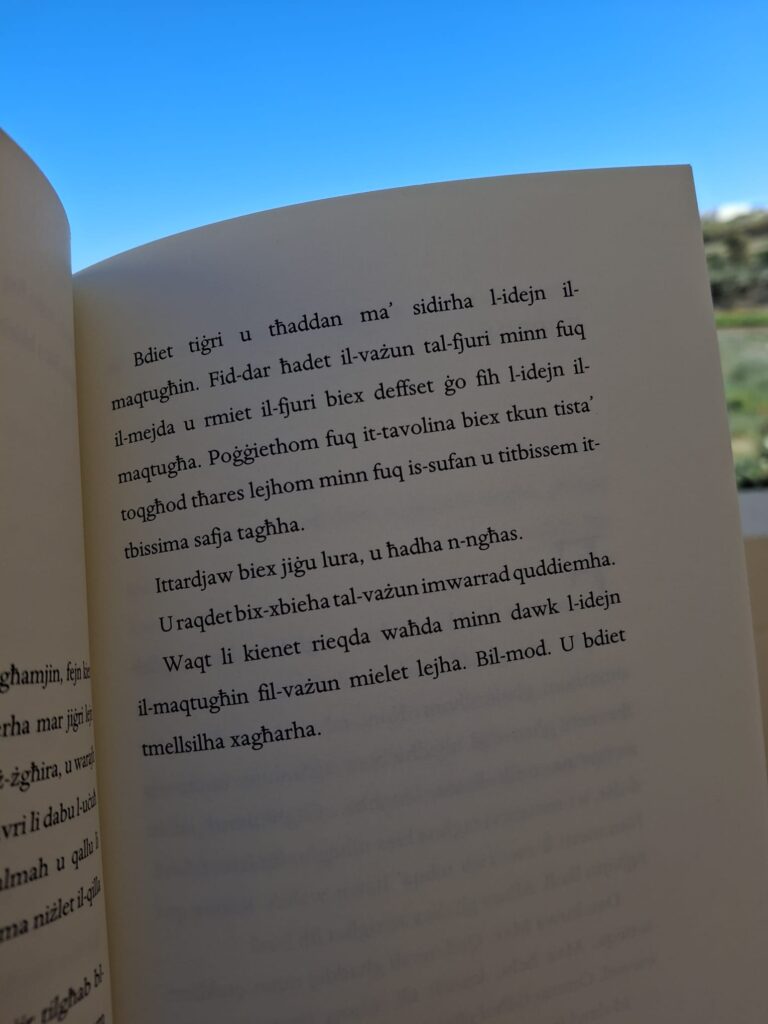
Furthermore, the overt narrator intermittently interjects through subtle commentary threaded across the series of stories. Rather than disrupting immersion, these observations guide the reader’s engagement, akin to remnants of a journal entry , a subjective documentation. Shubert’s comments also shed light on the cruelty that animals, whether domesticated or not, are subjected to in these stories. In this regard, a disturbing parallel can be drawn out; whilst humans are slaughtered by figures of authority, animals are slaughtered by those same humans. Victims perpetually become perpetrators, feeding into a Foucaultian cycle of violence from which nobody emerges untouched.
This dehumanisation can be read through the first set of stories, where humans are described through animal imagery. In “It-Telfa Ġewwa”, goats symbolise herd mentality and political blindness, while in “Klieb”, militia are referred to as dogs, demonstrating the animalistic, reckless hunger of the corrupt military in their acts of child rape. Subsequently, the language used throughout is vulgar, macabre and direct, forcing the reader to confront sensorial imagery of death and human cruelty.
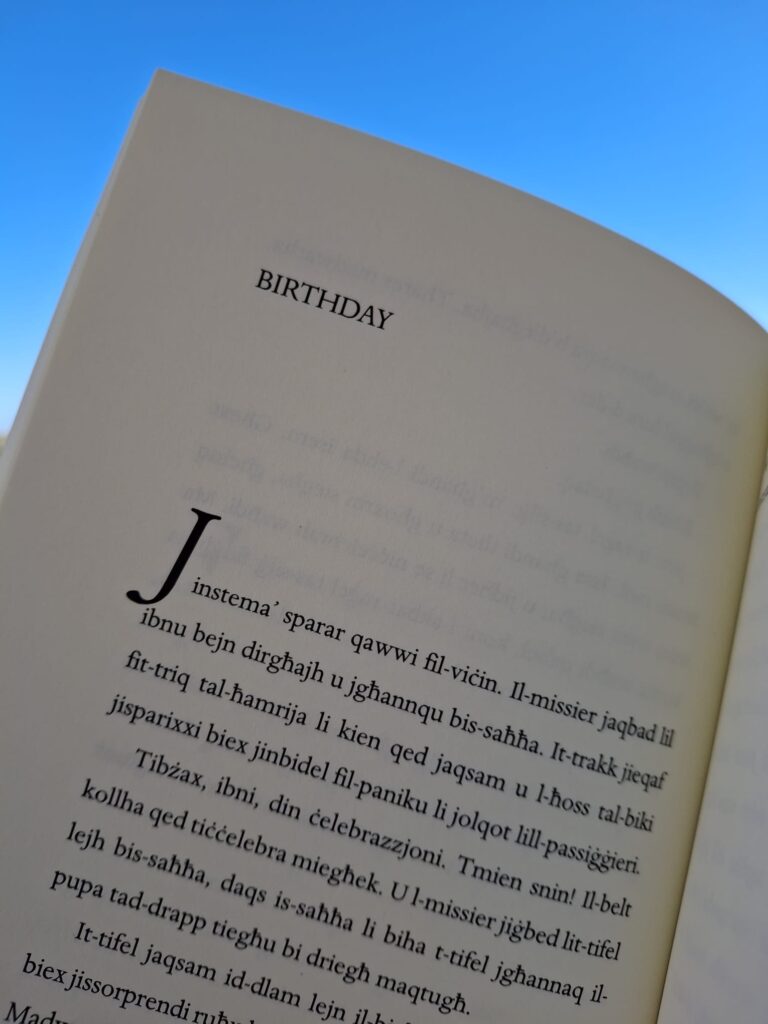
As Jean Paul Borg observed in his review of Shubert’s previous work Imbagħad il-Qiegħ, the author reminds Maltese readers that he does not come from the same background. The theme of the War that is unfolding in neighbouring territories, – is one in which the Shubert reader cannot evade. Phrases such as “katavri mkarkrin jintnu”, “katavri tal-imħanxrin” u “katavri li dabu l-uċuħ tagħhom” construct a deeply sensorial aspect with death and decay.
Ultimately, ash and feathers are interconnected symbols of a vicious cycle: of death, and life, of suffocation and liberation, of dreams, and reality. Shubert serves as not just a storyteller, but a witness of human and animal suffering; an advocate for all that requires protection, and a reminder for all of us to “cling to [our] dreams” before they disappear.