
Anemone: Nepotism, Be Damned — This Is Great
When Anemone was announced, the knives were out. After dropping the mic with Paul Thomas Anderson’s critically beloved Phantom Thread, Daniel Day-Lewis was breaking his retirement to star in his son Ronan’s directorial debut. The internet responded with accusations of nepotism, with critics all but sure that Anemone would be a well-intentioned but messy stain on the actor’s legendary filmography.
It comes as a pleasant surprise, then, that “nepo-baby” or not, Ronan Day-Lewis has proved himself to be a remarkably gifted filmmaker. He has crafted an assured, visually striking chamber piece—a psychological drama brimming with mood and a dark fairy-tale aesthetic.
The story, written by both Ronan and Daniel, concerns two brothers, Jem (Sean Bean) and Ray (Day-Lewis). Both are retired British Army veterans who served in Northern Ireland during the Troubles.
While Jem has seemingly found peace in a quiet suburban life with his wife Nessa (Samantha Morton) and son Brian (Samuel Bottomley), Ray has become a recluse, living in a hut deep in the forest. Jem tracks down his brother in order to lure him back to civilization over a family matter, and the film follows the estranged siblings as buried traumas are uncovered.
It’s a very fitting epilogue to Day-Lewis’s career, should this be his actual final statement. It serves as an intriguing counterpiece to In the Name of the Father (1993), in which Lewis starred as Gerry, a young Irishman wrongly accused of being an IRA bomber. Clearly, the subject of the Irish conflict is close to Day-Lewis’s heart, being of Irish descent himself.
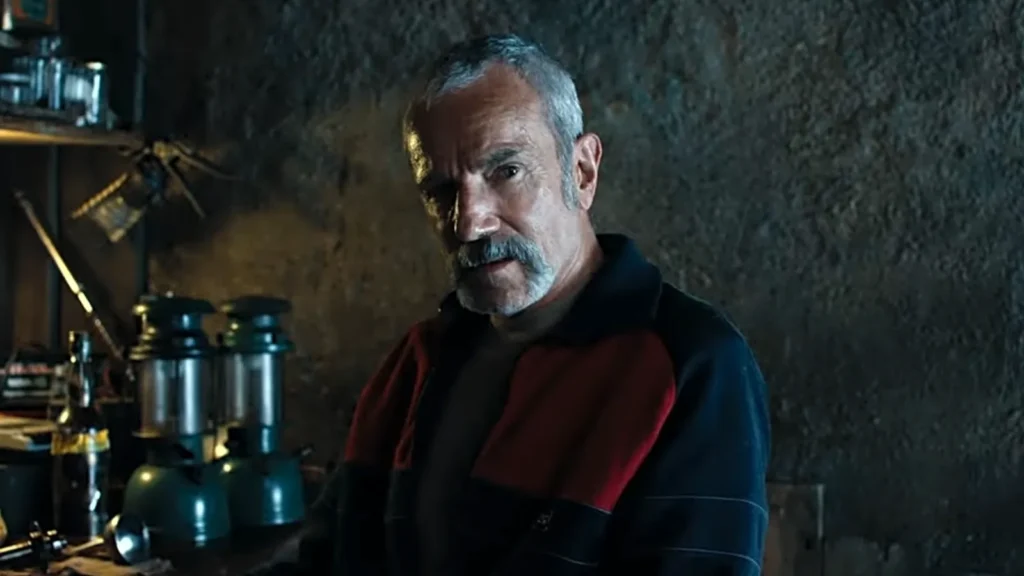
Alternatively, it could be viewed as a companion piece to The Ballad of Jack and Rose, another time Lewis was directed by a family member (his wife, Rebecca Miller). Just like in Anemone, Day-Lewis played a character who eschewed society and lived off the grid. Perhaps a therapist would find that an intriguing hint at the actor’s home life.
Regardless, it’s a joy to see Day-Lewis back on the big screen, and Anemone gives him plenty of juicy monologues to dig his method teeth into. He is as riveting as ever. However, the screenplay does feel oddly theatrical at times. Ray’s big speeches feel written to give its star a showcase to strut his stuff. Meanwhile, Sean Bean’s Jem is given very little to do, serving mainly as an audience for Ray’s rambles and raves. Bean is an underrated talent, and it would have been thrilling to see him go more head-to-head with a powerhouse like Day-Lewis in a more active role.
One of the film’s true stars is cinematographer Ben Fordesman. The film is replete with stunning, dreamlike imagery that gives Anemone a mythic feel. This seems like an intentional choice. There is something biblical about Anemone: Cain-and-Abel-style sibling conflict, the prodigal father, a plague of hailstones sent crashing down from above…
Ronan is clearly a disciple of Paul Thomas Anderson, and much like in Magnolia, Anemone infuses family drama with religious foreboding. It may be a little meandering at times, and not all of its visual tricks work, but Ronan is clearly infatuated with cinema, and this is a very promising and mature debut for the 27-year-old.