
Come for the Silence
a review of Wens: Comfortable Silence
by Giulia Privitelli
…
a thought which springs to mind,
a word I cannot find,
a picture without lines,
an endless sky full of stars.
Wens: Comfortable Silence, Rebecca Bonaci’s new offering comes across as just that: an offering. But of the most intimate and sacred kind; an offering that is as vulnerable as the life that conceived it, a love that laboured, and a vision that surrendered itself not to sleep but to dream. Perhaps it is the chromatic and stylistic consistency of the artworks; the sensitivity of the display and the selection by which each dreamscape (for what else shall we call them?) has been framed; or perhaps it is due to the contrasting moods evoked between monumental pieces and miniatures of floating, swirling, weightless bodies, light-filled rooms and womb-like cavernous spaces, that I too found myself oscillating between a state of complete and utter absorption in Bonaci’s vision of solace, and my own inner world: that space yearning for a wholesome stillness, nay, acceptance.
From the first room till the last, yes, Bonaci’s works hang transparently, as though windows into a familiar yet completely other realm, invitingly, as though one may easily step within. And yet, there is something that lies always beyond reach, beyond understanding, shrouded in mystery, in sanctity. The offeror and the offering are bound in a union that cannot be undone, or replaced. One creates the way one can, and loves and grieves, also, the way one can. It is the same with joy, with finding peace, fulfilment, and consolation. Bonaci has her way, and here she shows us what that is, but we cannot enter through the same door, or creep in through the same window.
The works, in their gentle quietude can thus come across as painful, depending on where it is one stands—not physically, in space, of course. The powerful and consistent use of red is carnal to the point of burning; aggressively pointing to the flesh, at once universal and ancient, but also so current and mortal. Flesh can be death-defying, but is constantly traumatised by the possibility of loss, of decay, of forgetfulness. Where does one turn to escape from such a condition? Inward? Outward? Both, at the same time? ‘Wretched person that I am! Who will rescue me from this body of death?’—the words of the Apostle flashed in my mind, while the works continued to hang tantalisingly between an inner and outer world, shaped by the gravitas of loss but seemingly unaffected, or resistant, to its pull. The works not only hang, they are tantalising. Silence not yet befriended presents itself with thorns, akin to Roland Barthes’ analysis of a ‘photograph’s punctum … that element which rises from the scene, shoots out of it like an arrow, and pierces’ the viewer. Silence, like the photograph or the painted ‘windows’, opens up a place for memory, for unspoken thoughts, for deep trauma and profound dreams, unuttered out of fear or, equally, out of reverence.
And yet, there is something else other than pain, something akin to hope: ‘the punctum is a kind of subtle beyond—as if the image launched desire beyond what it permits us to see … it is not only of the form but also of intensity; it is time’. The intensity of time experienced in waiting, but also in healing. Strangely, some verses I had written a while ago made their way into my notebook.
What is a wait when
we torment each other with a promise
neither of us can keep?
Or when we endlessly hope
for something we might never reach?
What is a wait
when once it was said
that hope could be an evil thing,
the worst of them lies which one could believe,
and which throughout history kept man alive
convinced of some impossible dream?
What is a wait
when it takes the form
of a chronic thought which never leaves
or keeps returning like some incurable disease?
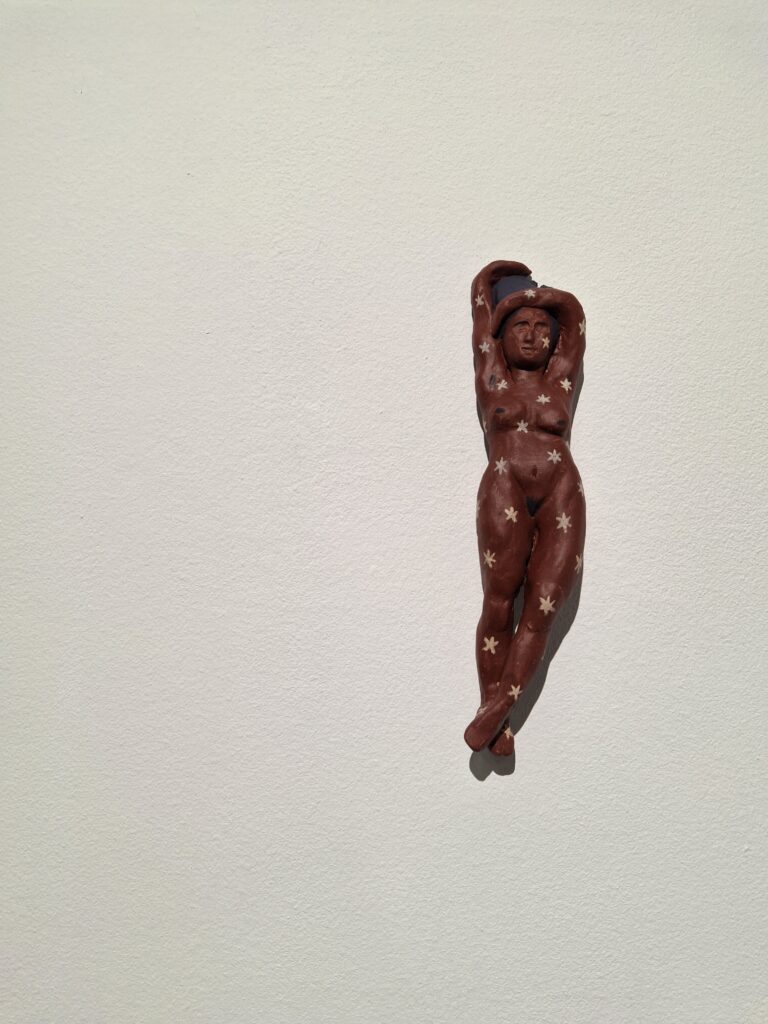
Time is experienced differently for those who rest purposefully. Senseless and aimless waiting feels eternal, as does the slumber of the bored and of the depressed. There is, in Bonaci’s paintings and painted statuettes, a sense of the eternal too; yet, it is one that comes across as a form of temporary sleep, full of life, rather than an endless, desperate death. The statuettes, more specifically, bring forth those sleeping terracotta statuettes several of us attune with Maltese prehistoric heritage are familiar with. It helps, too, that these figures are placed within a recurring backdrop of stars, moons, floating bodies, and dreamlike landscapes. The fascination with the unknown, with the ‘otherworld’, with the loss and gain of life is similarly recurring, cutting across time and space; it too, perhaps, has something to do with the sacred. No wonder that offerings, even when brought as ‘free gifts’ to the altar, were done so in the hope of some form of transformation, and as an outward expression of a desire burning deep within: from misfortune to good tidings, from sickness into health, from separation into union, from death into life.
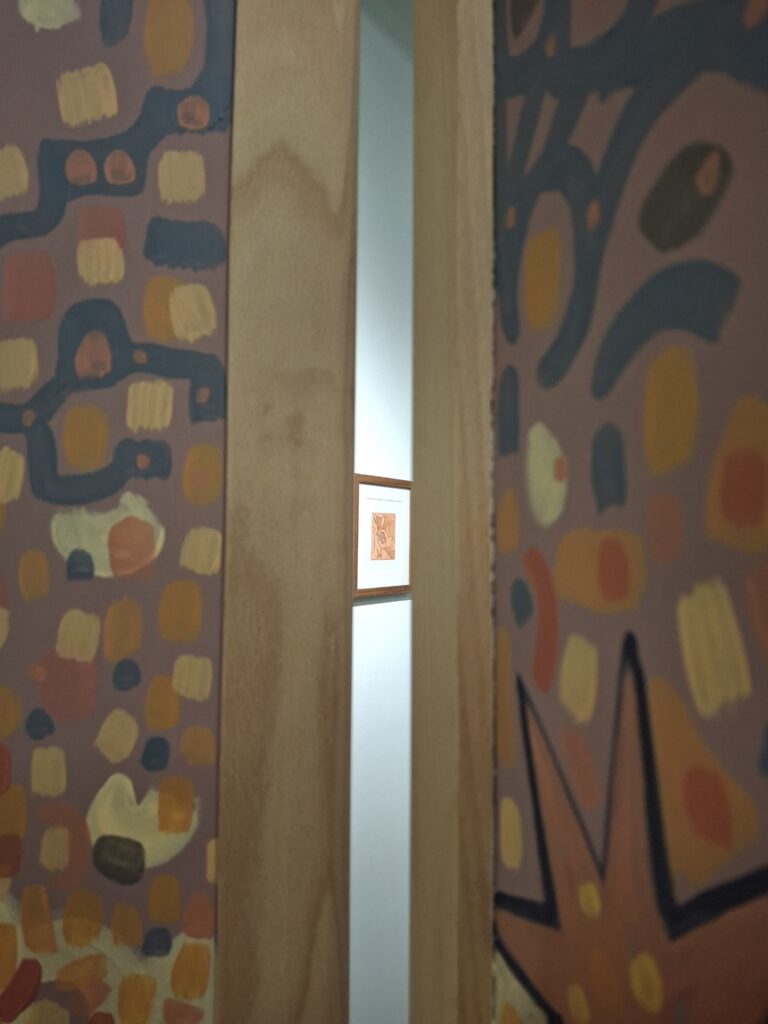
As I made my way into the last room, a painted folding frame, typically associated with bedrooms, stood between me and the most intimate corner of the show. It functioned like a form of ‘spirit screen’, but really, concealing nothing. For what else could be more intimate, more vulnerable, more personal than what I had already seen? What more than those peaceful dwellers of a creative cosmos where no words are necessary, inviting whoever wanders far and deep enough into an ineffable, all-encompassing, generative silence?
Wens: Comfortable Silence, curated by Gabriel Zammit, is on show at Valletta Contemporary until the 17th October.