
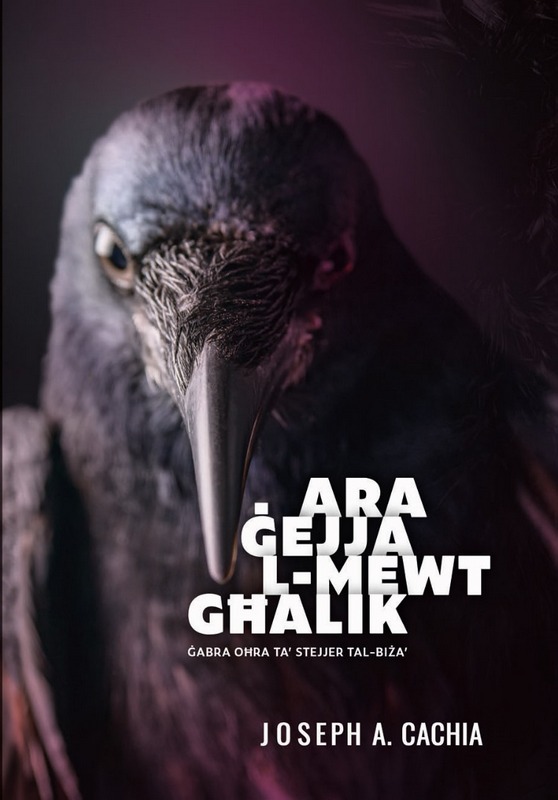
Shadows in the Sun: A Review of Joseph A. Cachia’s Ara Ġejja l-Mewt Għalik
At first impressions, the island of Malta is typically described as sparkling Mediterranean waters, sun-drenched limestone, and church bells ringing through the afternoon heat. But beneath the light of this idyllic image lies a rich, darker tapestry of folklore, superstition, and urban legends based on horror and revulsion. It is precisely within these shadowy fissures that Joseph A. Cachia sets up his chilling anthology, Ara Ġejja l-Mewt Għalik.
Translating roughly to “Look, Death is Coming for You,” the title itself is a rendition of a psychological horror. In Maltese culture, this phrase is instantly recognizable; it is a line plucked straight from a traditional, innocent children’s playtime rhyme. By taking a nostalgic memory of childhood and twisting it into a promise of impending doom, Cachia sets the tone before you even turn the first page. You are in familiar territory, but something is deeply, terrifyingly wrong. It sets the stage for the overtones of darkness as the landmark feature of the entire anthology. A darkness that is not the absence of light, but the necessary compound of it.
The text is thus an exploration of the vulnerable underbelly of light both physically and metaphorically. In terms of the former, it portrays the violent blindspot of knowledge: death, the dark spirits, and fear of the unknown. In terms of the latter, it symbolizes the antithesis of the prevailing good. In fact, reminiscent of some canonical literal works such as Greek and Shakespearean tragedy, Dante’s Inferno, and Macchiavelli’s The Prince, the author’s Preface specifically notes that evil frequently gets the upper hand and is unpredictably triumphant.
The book is structured as a collection of ten short independent stories (għaxar stejjer tal-biża’), each exploring different facets of horror. The collection opens heavily with the titular story, “Ara Ġejja l-Mewt Għalik,” which serves as the ideological anchor for the entire book. The narrative follows a young boy who suffers a head injury whilst being blindfolded and playing the traditional playground game with the same title. Cachia literalises this dark playfulness: the protagonist is left haunted by this childhood incident which, ironically, leads him to his own unforeseeable tragic death. In a twist of events, this persistent memory blinds him (first literally, then perceptually) whereby, in a blind panic, causes him to fall to his death from a scaffolding of his soon-to-be marital home. In standard fiction, foresight is a weapon or a privilege; under Cachia’s pen, it becomes an inescapable psychological execution.
By weaponising a domestic nursery rhyme, Cachia violates the safety of the “home,” signaling that the familiar spaces we inhabit are porous, fragile, and haunted by what we try to forget. The domestic space of security becomes the site of doom and terror. This is a persistent theme throughout the novel’s narratives. In ‘Il- kwadru misħut,’ Cachia takes a classical tale of a haunted artwork and bodes it with a unique Maltese historical twist. A modern married couple buys an antique painting, only to discover it brings pure terror into their lives. Painted by Tomaso Lanzon, the painting portrays a knight on horseback which is later revealed to be cursed. The curse is rooted deep in Malta’s history, tied to an evil spirit of a long-dead Knight of St. John who raped a woman and was subsequently killed by the woman’s father. This creates a perfect example of the invasion within the familiar home. The couple’s domestic residence is suddenly invaded by a dark secret from the past. Every time they look at the canvas, it feels like the painting is staring back at them until the echoes of the horse’s hooves finally capture the young wife. It shows that cultural heritage is never truly dead but is constantly luring and haunting the liminal spaces of our existence.
Cachia demonstrates how spirits, the haunting and ghosts are not an external monster, but the materialisation of cultural myths and an exposure of the shadows of the unconscious. This is, in fact, noted by the author himself in the epigraph quoting Shakespeare’s ‘The Tempest’, “Hell is empty, and all the devils are here.” Consider the story, The Haunting Vow —“Inħobbok anki wara mewti”. The premise follows a deeply devoted husband who constantly promises his wife that his love will endure far beyond the grave. When he unexpectedly passes away, that sweet, romantic vow curdles into an oppressive, terrifying haunting. The dead husband returns not as a comforting memory, but as an intrusive, ghostly manifestation of an unbreakable contract. The haunting highlights the horror of absolute permanence: a vow intended to provide security becomes a prison.
Furthermore, this is starkly evident in the story of the young boy pulled from the bottom of a deep, dark well. Perhaps the most culturally resonant story in the collection taps into the visceral, deeply ingrained childhood fears of every Maltese person. He survives physically, but his mind is traumatised by whatever he witnessed in the watery depths. Cachia plays with the ambiguity of the boy’s distraught state. A triangulation between near-drowning experience, experiencing the pitch black blindness of the depths of the well, or perhaps coming face-to-face with Il-Belliegħa; the legendary, child-snatching well-monster of Maltese folklore. The monster becomes a stand-in for the ultimate, unnameable traumatic blindness when staring straight into the abyss of the unknown. The psychological horror here is masterfully executed, leaving the reader to fill in the terrifying blanks.
Joseph A. Cachia’s writing style is notably fast-paced, unapologetically concise, and refreshingly accessible. While the tight short story format occasionally leaves the reader wishing the author would linger longer in the psychological tension, this remains a minor grievance. Across these ten tales, Cachia demonstrates that true horror lies not in alien landscapes, but within the familiar childhood rhymes, domestic vows, and historical artifacts. Ultimately, Ara Ġejja l-Mewt Għalik holds a dark, unblemished mirror up to the cultural psyche. It serves as a chilling reminder that no matter how brightly the Mediterranean sun shines, the eerie shadows are always waiting to cross the threshold.