
Valletta Early Music Festival 2025
Il Parnaso confuso & La Corona
Teatru Manoel, Valletta, 7th November 2025
When it comes to operatic culture in Malta and Gozo, the tradition of community-centred productions of the Italian core repertoire of the long 19th century seems unlikely to dwindle any time soon. Yet attempts to diversify, broaden or disrupt the narrow selection of musical works in general that for the most part continue to fill concert programmes, while hardly new, have only become more energetic and more urgent in recent decades. How curious, then, that it is of all things an ‘early music’ festival – that is, a festival ostensibly preoccupied with historical, ‘old’ musical repertoire – where such efforts may be discerned. The performance under review represents the third iteration of the Valletta Early Opera Festival, described in the programme notes as ‘an annual celebration of early opera [that] showcases performances of works from the canon of early opera which are rarely performed; focusing on underperformed pieces by acclaimed composers as well as others who have fallen by history’s wayside’.
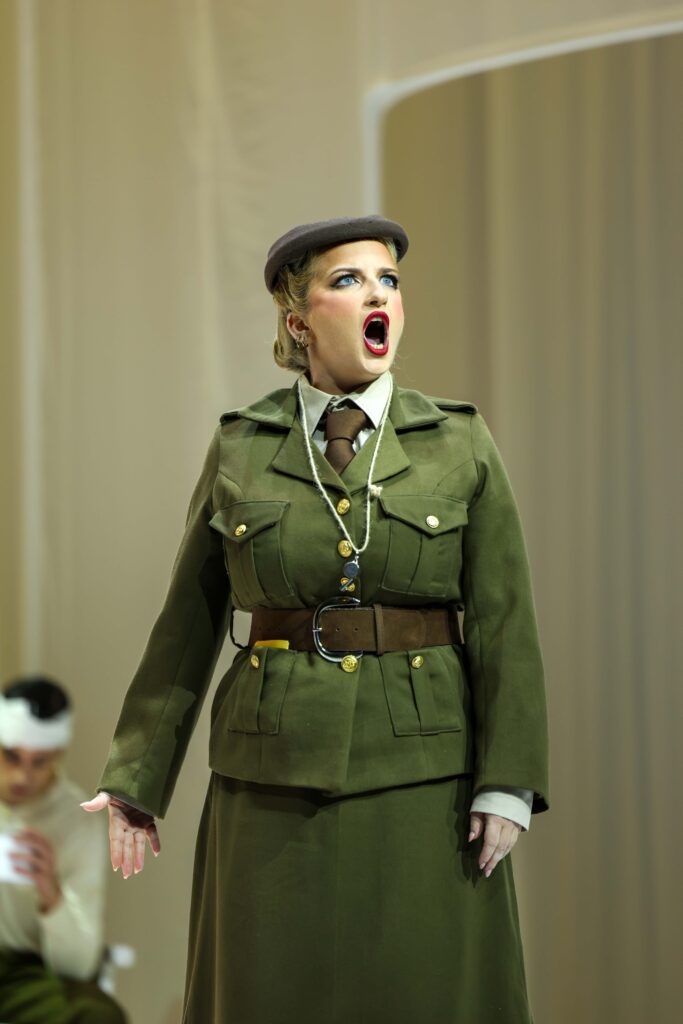
In this year’s edition, audiences were treated to a pair of relatively obscure operas by a composer and a librettist both firmly enshrined in the operatic canon: the Bohemian composer Christoph Willibald von Gluck (1714-87) and the Italian poet Pietro Metastasio (1698-1782). The works in question, Il Parnaso confuso and La Corona, are one-act ‘serenatas’ dating to 1765, respectively designated a ‘serenata teatrale’ and an ‘azione teatrale’ (the latter being a subgenre of the ‘serenata’ and the last of its kind to be written by Metastasio who invented it). Intended – remarkably – for amateur performance by the archduchesses at Schönbrunn Palace, Vienna, to honour various family occasions of the Habsburg monarchy, the two works sank into oblivion and only recently have attracted serious interest from anyone other than musicologists. (As it turned out, the performance of La Corona originally scheduled for 4th October 1765 was cancelled and the first performance took place in 1987.)
For this production, the two works were presented together in a double-bill separated by an interval. The Festival’s Artistic Director Kenneth Zammit Tabona anticipates that the production might ‘establish a sort of Cav and Pag coupling’, a reference to the convention of performing Cavalleria rusticana and Pagliacci in the same evening. (What would be the snappy nickname for this pair? Parn ’n’ Cor, perhaps, to rhyme with Harnoncourt?) The form and size of the works make them well suited to such coupling: both are disposed in a single act, employ a cast of only four singers and (at least on the face of it) make few scenic demands. The apparent straightforwardness of the works, though, may also be a source of difficulty. There is a certain stiffness in the use of Classical mythological archetypes even when they are being sent up. The music is part of the dramaturgical problem here: the solo arias (in da capo form, with the first section returning after a contrasting idea or mood) are generally long musical numbers that prioritise vocal prowess and dexterity over dramatic naturalism or psychological complexity.
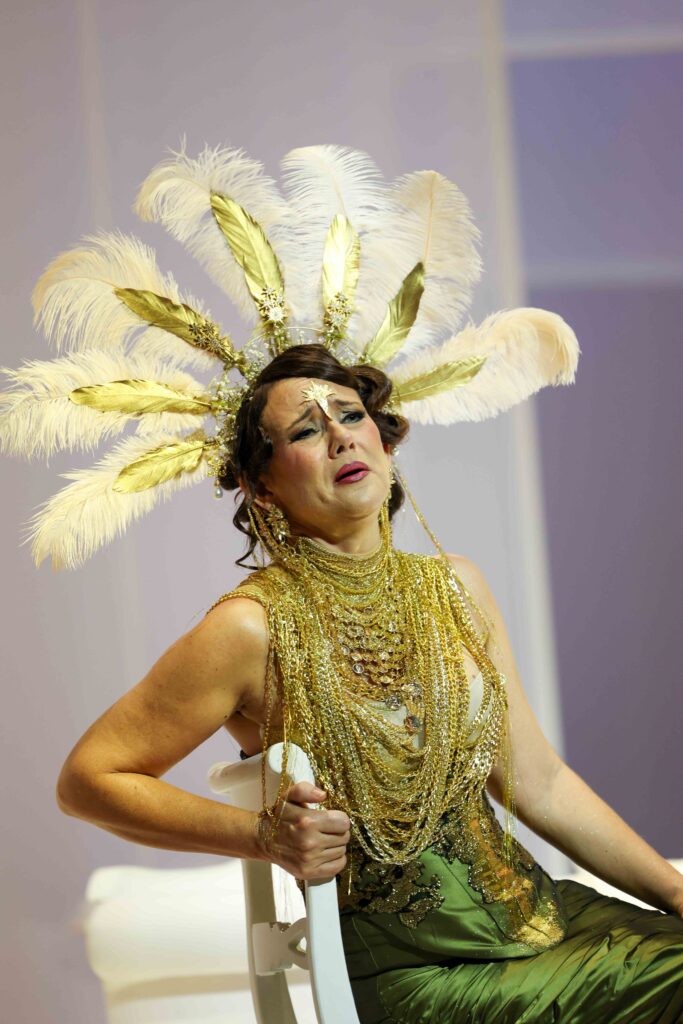
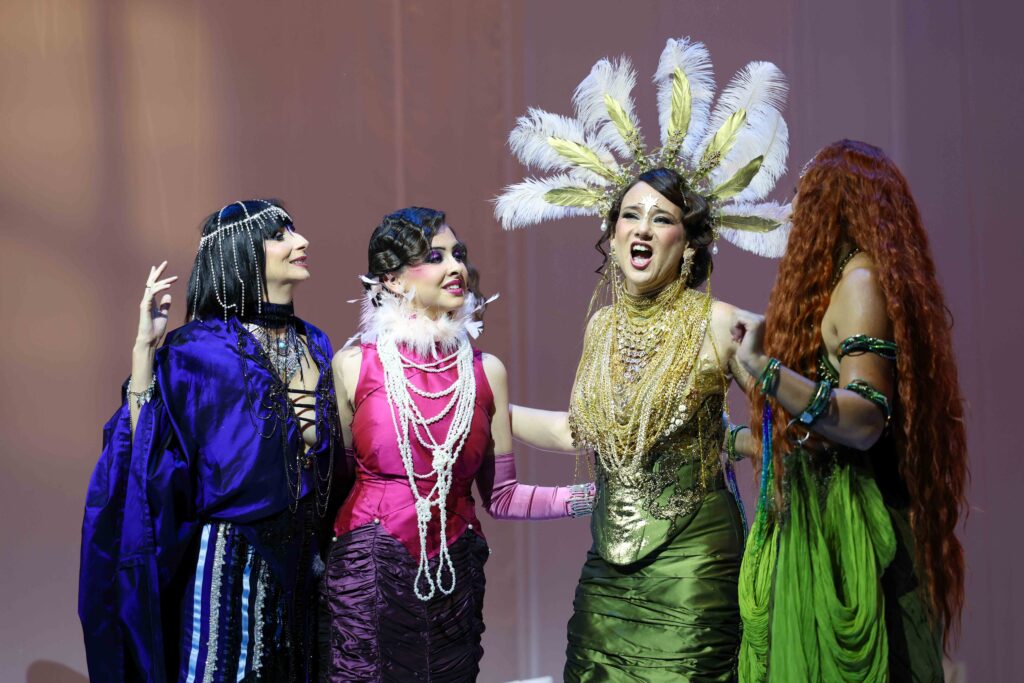
So the question arises: what to do dramaturgically during these long numbers that repeat the same poetic phrases and music? In Il Parnaso, the answer was to fill the space with comic set pieces. These kept the scene busy but sometimes it felt lacking in motivation. The work is already a funny idea to begin with: Apollo summons Melpomene, Euterpe and Erato to honour the wedding of Holy Roman Emperor Joseph II and Maria Josepha of Bavaria (which was the actual occasion of the work itself), but as the Muses learn that the festivities are taking place tomorrow, they panic and squabble, each vying to assert her own art over her sisters’. Not only that, it’s already a contemporary satire on Classical archetypes and in some sense looks ahead to the operas of Jacques Offenbach (in the second half of the 19th century) or to those of Richard Strauss and Hugo von Hofmannsthal (in the first half of the 20th). The addition of the historical reference (a 1920s cocktail party) in this instance distracted from the wit of the original work itself.
This opera was set in the world of the ‘Roaring Twenties’, and the costumes, designed by Luke Azzopardi, did a lot of the work in terms of establishing historical time and place, compared with the somewhat abstract, unobtrusive set by Anthony Bonnici, but there were some nice touches in the choreography by Simon Riccardi-Zani (such as the slow-mo Charleston). Warmly subtle lighting by Moritz Zavan Stoeckle set the emotional temperature of certain scenes, and the sudden changes of lighting at the start of the B section in a few of the da capo arias added scenographic interest.
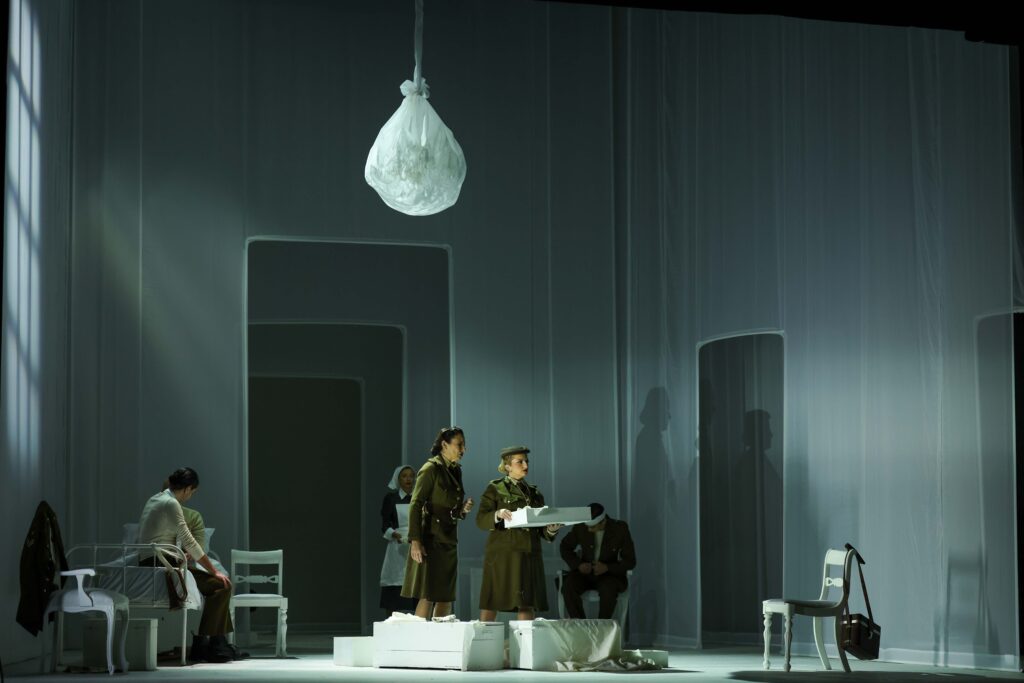
In La Corona, the response to the above-mentioned challenge (how to stage a long, repetitive aria?) came in the form of individual performances and interpretations. In particular, Francesca Aquilina, in the role of Atalanta, not only sang well but invested the vocal fioriture with an emotional naturalism that brought the scene to life (for instance, in Atalanta’s first aria, ‘Rammento/ Che della dea di Delo’). There were two casts (one for each opera) of four singers each, and common to both casts were Gillian Zammit, who took on the roles of Apollo and Meleagra in Il Parnaso and La Corona respectively, and Caterina Iora, as Melpomene and Climene (their appearance completely transformed between the two operas). Performances were well executed generally throughout the two casts, although at times agility in the fast passagework and intonation suffered under the sheer demands of Gluck’s fearsome vocal writing. Another highlight in the cast this evening was Gabrielle Portelli’s turn as Erato in Il Parnaso, a performance that combined vocal flair with characterisation and stage presence.
Leading the whole thing, as always in live opera, is the conductor, in this case Giulio Prandi (who has appeared in previous editions of this Festival). Prandi kept the music moving along in a sprightly, dynamic fashion, and the performance by members of Arianna Art Ensemble was excellent throughout, not least when individual players made appearances sul palco.
A second and final performance will take place on Sunday evening, 9th November.
Christoph Willibald Gluck – Composer
Pietro Metastasio – Librettist
CREATIVE TEAM
Brett Nicholas Brown – Stage Director
Giulio Prandi – Conductor
Giacomo Biagi – Assistant Conductor
Anthony Bonnici – Set Designer
Luke Azzopardi – Costume Designer
Moritz Zavan Stoeckle – Light Designer
Simon Riccardi-Zani – Choreographer
CAST – IL PARNASO CONFUSO
Gillian Zammit – Apollo
Cledia Micallef – Euterpe
Gabrielle Portelli – Erato
Caterina Iora – Melpomene
CAST – LA CORONA
Francesca Aquilina – Atalanta
Gillian Zammit – Meleagra
Caterina Iora – Melpomene
Bettina Zammit – Asteria