
‘Death, Transcendence, Resurrection: Mozart’s Requiem … & Other Works’
Three Palaces Festival
31st October 2025
St John’s Co-Cathedral, Valletta
_____________________________________________________________________________________
As the name suggests, the Three Palaces Festival 2025 (27th October to 2nd November) gives audiences the opportunity to experience concerts and various other kinds of performance in some of the most splendid heritage spaces that Malta has to offer. The concert (titled ‘Death, Transcendence, Resurrection: Mozart’s Requiem … & Other Works’) was not quite the culminating finale of the Festival (held on the 31st of October) but might be the ‘biggest’ performance in this year’s Festival programme at least in terms of the scale of performance forces. The concert took place not strictly in a palace but in the palace-like St John’s Co-Cathedral, Valletta – an interior so opulent that it might have tested even Henry James who by his own admission ‘could stand a good deal of gilt’. Indeed, the sins of the world (speaking of guilt) and the souls of the dead were hovering in the background of this concert programme. Happy Hallowe’en!
It was a nice enough idea to perform a Requiem on 31st October, although the Easter-coding of the concert title (‘resurrection’) and the inclusion of the terrifyingly affirmative ‘In sempiterna saecula amen’ from Rossini’s Stabat mater (the third item on the programme) seemed to downplay the connection rather than embrace it. The main work on the programme was Mozart’s Requiem KV 626, the Austrian composer’s famously incomplete setting of the Mass for the Dead commissioned by Count Walsegg-Stuppach for his late wife in 1791 and ever since the subject of mythmaking as well as numerous completed versions. The concert opened with a pair of works – Barber’s Adagio for Strings and Pärt’s Cantus in Memory of Benjamin Britten for string orchestra and bell – that represented funeral elegies.
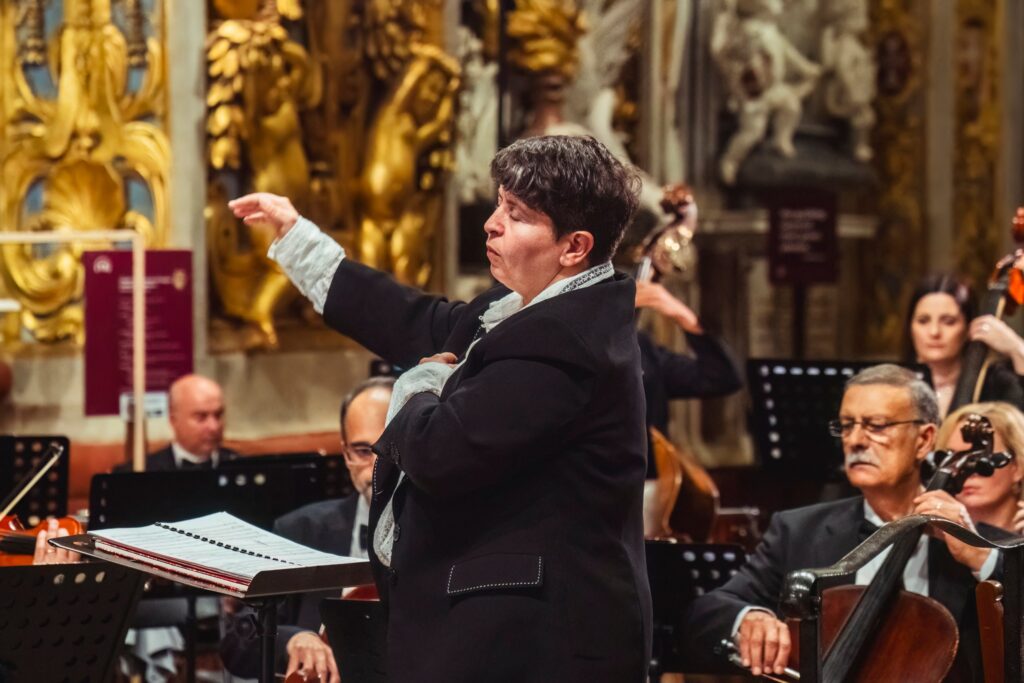
Probably more significant than the ostensible theme was the concert’s occasional function as an anniversary celebration of the Maltese choir (and Mozart’s namesake) the Amadeus Chamber Choir, founded in 1990 by conductor and singer Brian Cefai and described in the programme notes as ‘one of Malta’s oldest amateur/semi-professional choirs’. Conducting duties were shared out this evening: Cefai helmed the Requiem, while the first three items on the programme were conducted in an engaging, dynamic style by Michelle Castelletti, who also serves as the Artistic Director of this year’s Three Palaces Festival and contributed the programme notes for all events. The Amadeus Chamber Orchestra (about which no information is given in the programme other than the players’ names) performed throughout.
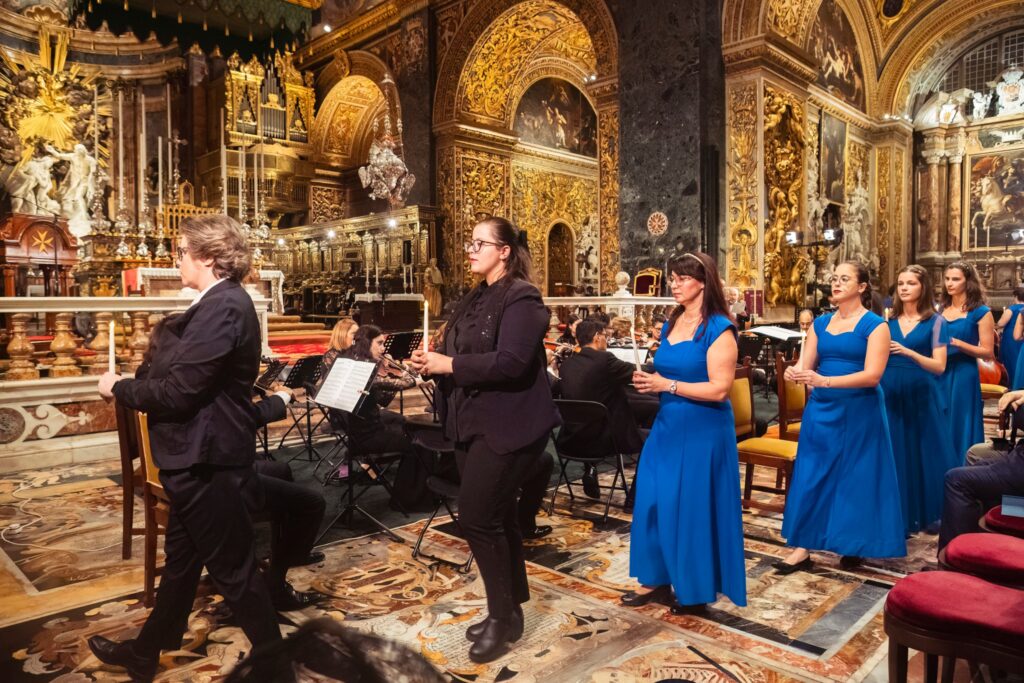
Interdisciplinary collaboration added variety to the proceedings: during the performance of the Pärt, members of the choir entered the space in a choreographic sequence by Francesca Tranter that (like the musical work) combined the mournful and the hopeful in a single image, and by the end of which the choir members had assembled on the steps of the altar via the side chapels just in time for the first choral work of the evening. The Rossini was performed with an intense energy that stood in almost hilarious contrast with the two funereal works preceding it. Because the Barber and the Pärt are both for string orchestra alone (with the addition of a single bell in the latter), issues of intonation and tone production in the string sections were more exposed in those works, for instance at the climax of the Pärt which requires sheer volume and intensity of sound in the sustained notes. There were nonetheless some beautiful moments in the orchestral playing, especially from the winds, such as the interweaving clarinet and bassoon lines in the opening Introitus of the Requiem.
It was genuinely refreshing to hear Mozart’s Requiem sung (partly) in Maltese in a translation by Anita Frendo (also one of the singers in the Amadeus Chamber Choir). There were a few moments where the Maltese sung translation missed the word-painting in Mozart’s (or Süssmayr’s) setting of the Latin text. For example, the opening words of the baritone solo ‘Tuba mirum spargens sonum’ (‘The trumpet will send its wondrous sound’), sung with clear projection by Joseph Lia, are illustrated in the vocal line by a quasi-fanfare on the start of the line followed by a long, low note on the word ‘sonum’. In Frendo’s Maltese translation the line is rendered: ‘Ħoss mill-isbaħ ġej mit-tromba’, which reverses the words for ‘sound’ and ‘trumpet’. Sung translations inevitably involve trade-offs of this kind, and for me (even as someone without the linguistic comprehension) there was a lot to be gained in the way this translation placed Mozart’s popular work in a radically new light.
My only serious problem with the translation is that it did not go far enough. I say ‘partly’ in Maltese: it was really a bilingual version, but unlike Haydn’s and Baron van Swieten’s The Creation/Die Schöpfung (1800) which was conceived as an oratorio that could be performed in either English or German, here the sung text was a mixture of Maltese translation and original Latin, usually alternating between the two within a single movement. The result was an awkward compromise. Why not go the whole way and perform the Requiem entirely in Maltese?
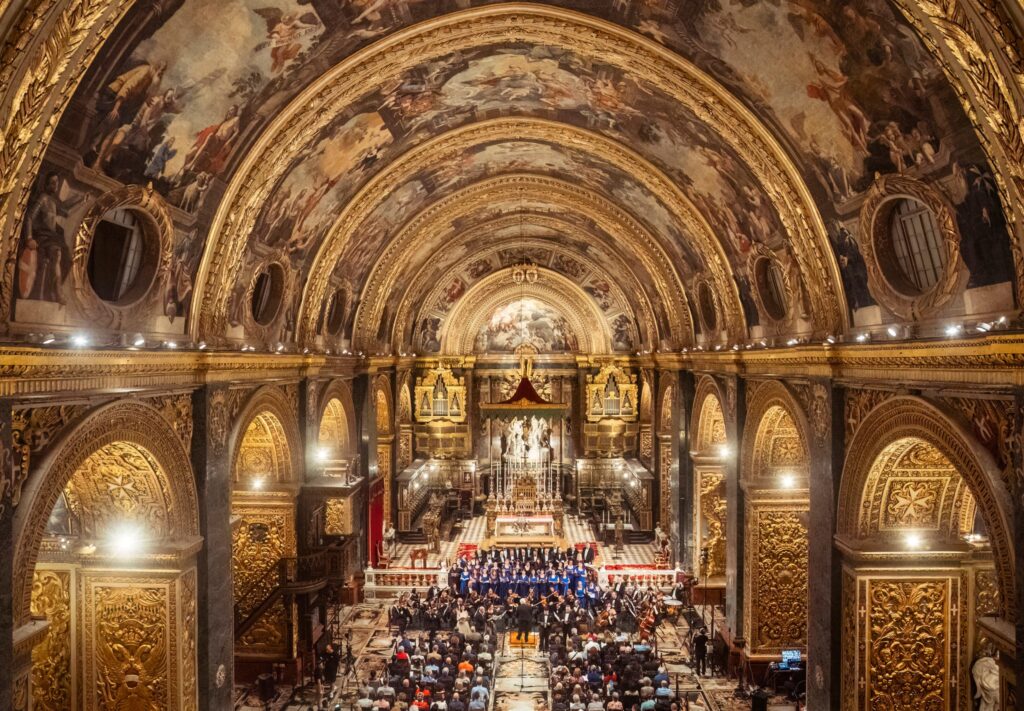
Like an actor intent on upstaging everyone else around them, the Co-Cathedral was arguably the real star of the show. And so it was all the performers could do to contend with the challenging reverberant acoustics of the space. For slower music such as the Barber and the Pärt, the acoustic helped rather than hindered, whereas in the Rossini and the Mozart much of the faster-moving material collapsed into an indistinguishable mass of sound, only occasionally punctuated by a lone clarinet here, a roll of the timpani there. In general, the Requiem was given in a somewhat ponderous, heavy interpretation, with tempi on the slower side of things. This might potentially have combatted the washy, swimming-pool-like acoustics of the Co-Cathedral, but in reality the lack of ensemble coordination militated against any such clarity. At times the choice of tempi created problems for the poor soloists who nonetheless carried themselves gracefully and gave fine performances of the solo and ensemble numbers. It would be remiss not to point out the considerable disruptions caused by the TV crew filming the concert, with at least one crew member speaking over the radio at a normal volume on numerous occasions during the music.
As a celebration of local musical institutions in Malta, this concert had much to recommend it, and the (half-)vernacular version of Mozart’s Requiem was a highlight that I personally would like to experience again in a more developed state. In the last moments of the Mozart, as the bare fifths on the final word ‘Mulej’ rang out in the vast space of the Co-Cathedral, it was as if Mozart’s music had been reclaimed, echoing (metaphorically) inside Malta’s own cultural identities and traditions.