
Ari Aster’s complex contemporary western might just be one of the most provocative films of the year so far.
Ari Aster (Hereditary, Midsommar, Beau is Afraid) continues to cement his reputation as one of contemporary cinema’s boldest film makers. Aster doesn’t simply release films, but cultural events. His latest work, Eddington, is nothing short of audacious, capturing the anxieties and sheer absurdities that sparked from the outbreak of Covid19 in 2020 (and its aftermath) with a scope and intensity unmatched by his peers. Be warned: this is a film that spares no one, critiquing all sides of the political and cultural spectrum, and the result is captivating.
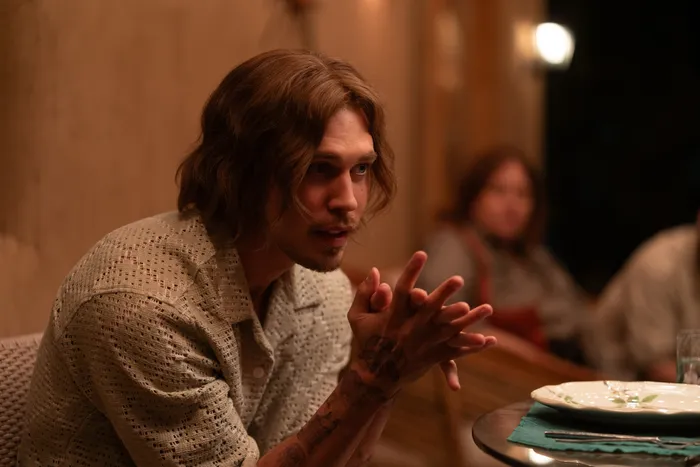
Set in May 2020, in the fictional town of Eddington, New Mexico, as COVID-19 lockdowns are imposed and protests over racial injustice spark after the murder of George Floyd, Eddington plays out like a contemporary western.It is essentially a showdown between Sheriff Joe Cross (Joaquin Phoenix) and Mayor Ted Garcia (Pedro Pascal). Garcia enforces mask mandates and lockdowns while Cross opposes these mandates, decrying them as violations of individual liberty. Conflict escalates when Cross decides to run for mayor, setting into motion a local feud that becomes simultaneously more personal than we initially think but also indicative of a larger social and ideological war. Along the way, we also follow Louise (Emma Stone), Joe’s emotionally fragile wife; Dawn (Deirdre O’Connell), Louise’s conspiracy-theorist mother; and Vernon Jefferson Peak (Austin Butler), a charismatic cult figure who preys on the delusions of the town.
The western tropes of dusty landscapes and standoffs remain, with an added 21st century spin of increased paranoia, conspiracy, and culture war. Yet beneath the satire lies something more quietly devastating: Eddington is ultimately about loneliness. Its characters speak, but rarely communicate. They posture, argue, and broadcast, but never truly listen. Aster shows us a world in which people are literally more connected than ever through their devices, yet moreisolated than at any point in living memory. This lack of genuine communication fuels paranoia, desperation, and ensures every character is locked inside their own echo chamber.
The film also confronts the Black Lives Matter movement, and it does not hold back on being provocative in its satire. Here, activism is often treated as performance: white Gen Z characters turn protest into a vehicle for popularity, posting choreographed solidarity online while, in bitter irony, the town’s only significant black character becomes the scapegoat. Aster cuts to the core of systemic injustice by contrasting the reality of lived Black experience with the superficiality of social-media activism.
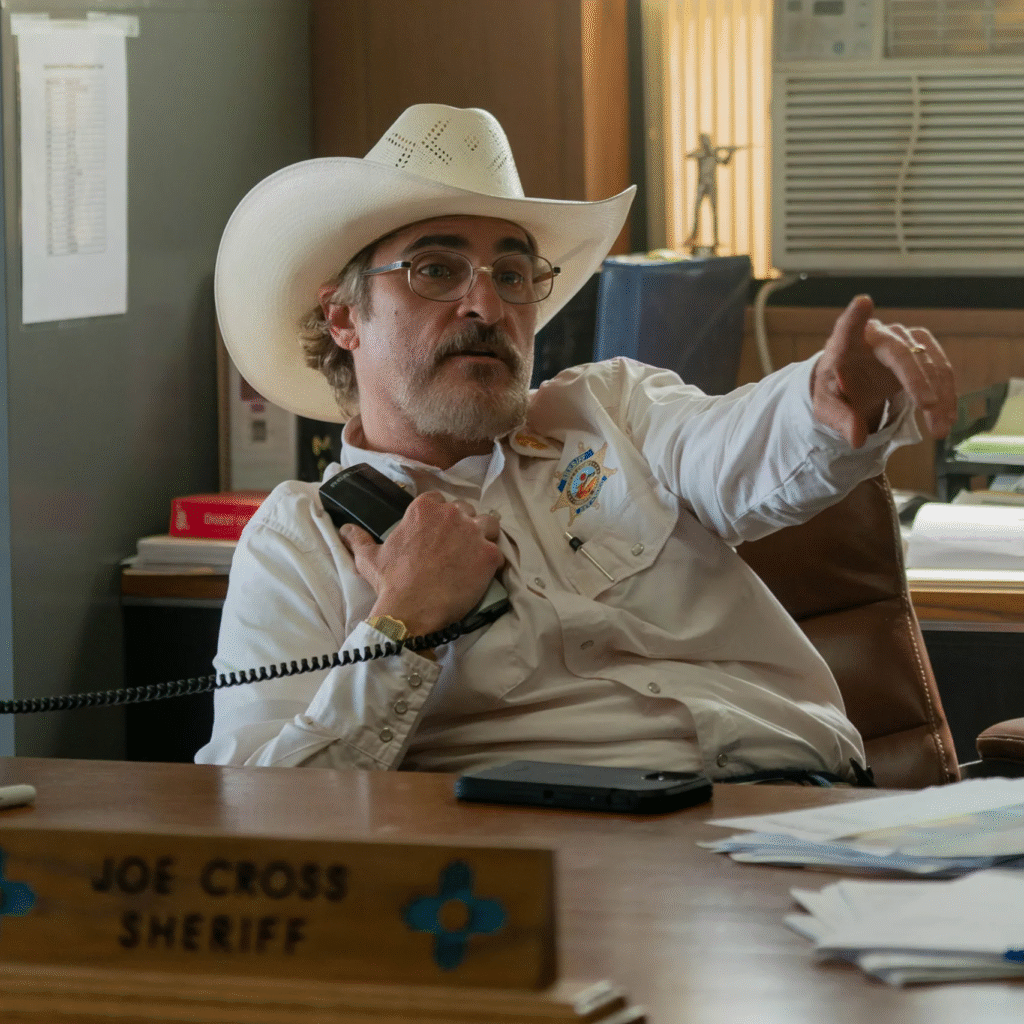
Phoenix’s Sheriff, Joe Cross, embodies the absurdity of the contemporary hero: a middle-aged white man who craves nothing more than to be needed, and who goes to dangerous lengths to achieve that validation. Phoenix is perfect for the role, delivering another memorable performance following his previous collaboration with Aster, Beau is Afraid. He is at once pitiable in his desperation and ominous in his potential for harm. Aster warns us that the “losers” of the world can be the most dangerous when left to their own devices.
In contrast, Pedro Pascal’s hilarious portrayal of Ted Garcia represents a more polished version of the same hunger: a public figure ever sensitive to what is in fashion, always aligning with trend, optics, and what looks good rather than what is necessarily true. Their duel becomes not just political, but symbolic of two distorted models of masculinity: raw desperation versus curated heroism. One of the film’s most striking achievements is its rendering of our digital lives. Few filmmakers have so effectively translated the rhythms of online communication to the screen. Notifications, texts, and Instagram posts are not mere background noise but they sway the narrative with the intensity of jump scares, reminding us how our digital spaces amplify paranoia and dread.

The supporting cast is equally impressive. Emma Stone brings a raw vulnerability to her role, while Austin Butler delivers a performance of simmering menace: his character is charismatic and dangerous, feeding off the town’s unrest and conspiratorial leanings.
It must be said that the film will not be for everyone. Its relentlessness, both in tone and ambition, and it may overwhelm some audiences. The film is long, dense and bristling with ideas. Yet for those willing to embrace its audacity, Eddington is cinema at its most daring. It is an incendiary western for the digital age, blending absurdism, satire, horror, and a piercing meditation on loneliness. Its depiction of a recent past filled with horrors was sometimes difficult to confront; scenes of masked people queuing up socially-distanced outside supermarkets, was as disturbing as the headless figures in Hereditary. It felt too close to home and unearthed a traumatic time I buried deep into my subconscious in a way only great art can do. To me, it stands as one of the most exhilarating and essential films of the year so far, surpassed by maybe only Bugonia (produced by Aster) which actually would serve as a perfect companion piece to Eddington, but more about that next time.