
XitwaŻfin | Winter Dance – Exploring Human Resilience in ŻfinMalta’s Winter Double Bill
This edition of XitwaŻfin, staged from the 19th to the 21st of December, presents a formidable collaboration between ŻfinMalta, Malta’s National Dance Company, and the German-based ensemble Of Curious Nature. On a brisk winter evening, the Valletta Campus Theatre was filled in anticipation of this double bill. The staging was notably minimalist; with the wings removed, save for two at the upstage perimeter, and a grey dance floor, a striking departure from the conventional black dance carpet, which, framed by clinical perimeter lighting, offered a stark, evocative canvas that immediately ignited the audience’s imagination.
The programme opened with Fulgence, a visceral work by Samir Calixto performed by Of Curious Nature. Stemming from the Latin vocabulary, meaning ‘radiance,’ the piece serves as a choreographic study of the inner light that manifests when the human spirit is pushed to its threshold. The work initiates with a soloist, his tattooed back turned to the auditorium, navigating a series of fractured, staccato movements within a pool of light. He is soon joined by a dancer in a black unitard, a figure embodying the sensation of encroaching darkness. While the soloist’s tattoos were a coincidental detail, they served the work’s aesthetic perfectly, creating the illusion of darkness shifting beneath the skin.
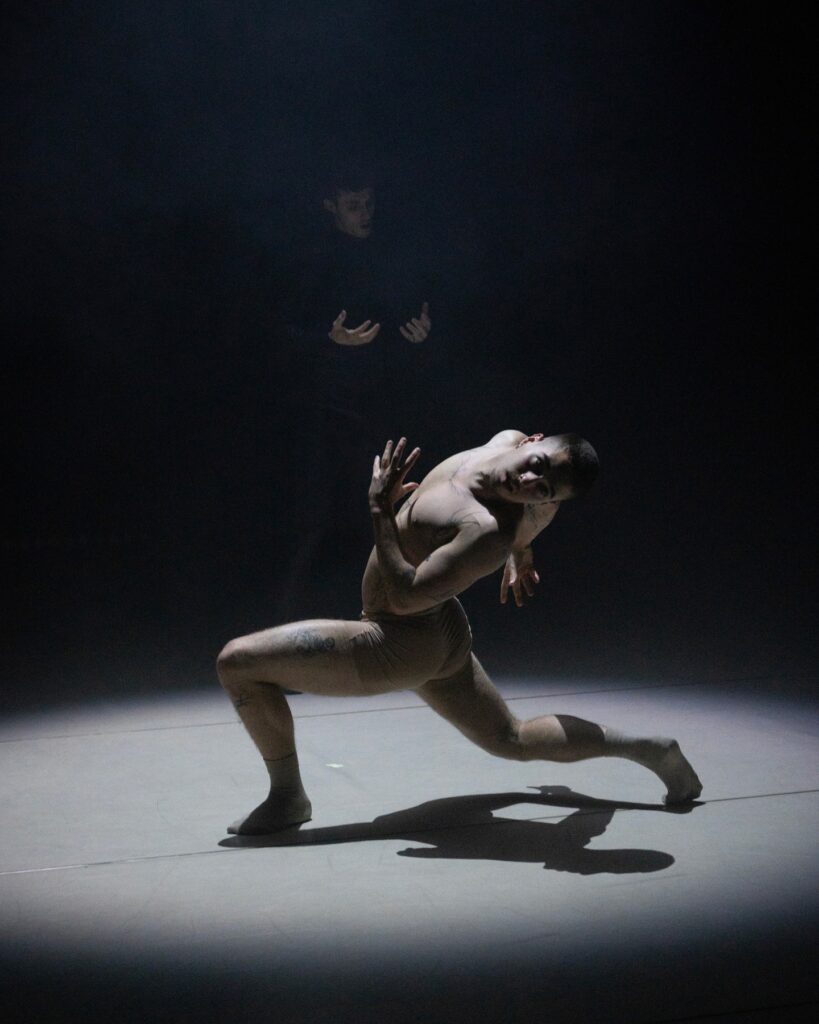
As the piece evolves from isolated solos into ensemble configurations, it echoes a profound ‘rebellion of being’. Calixto employs a striking mechanical motif, as dancers traverse the central light with industrial, conveyor-belt-like precision before splintering into complex linear and group patterns. The integration of choreographed breathwork introduces a haunting auditory dimension, heightening the intensity of the physical execution.
A momentary heartbeat-like pulse, which initially suggested a finale, proved instead to be a masterful bridge to the work’s climax: the shedding of darkness. In a striking silhouette, the dancers stripped away their black unitards to reveal skin-toned undergarments. In this section, the return of audible breath sounded notably lighter, enhancing the rawness and fluidity of a euphoric release. This liberation was short-lived, however, as the score took an eerie turn and the stage was abruptly engulfed in darkness via a blackout in the lights. From stagnation to liberation, the choreography is structured to begin in a heavy state, representing confinement, and gradually explodes into an act of liberation. The dancers moved with euphoric bursts, driving the ‘darkness’ to the surface of the skin, truly reminiscent of what the choreographer intended to communicate with this work. Truly a performance that left the audience yearning for more.
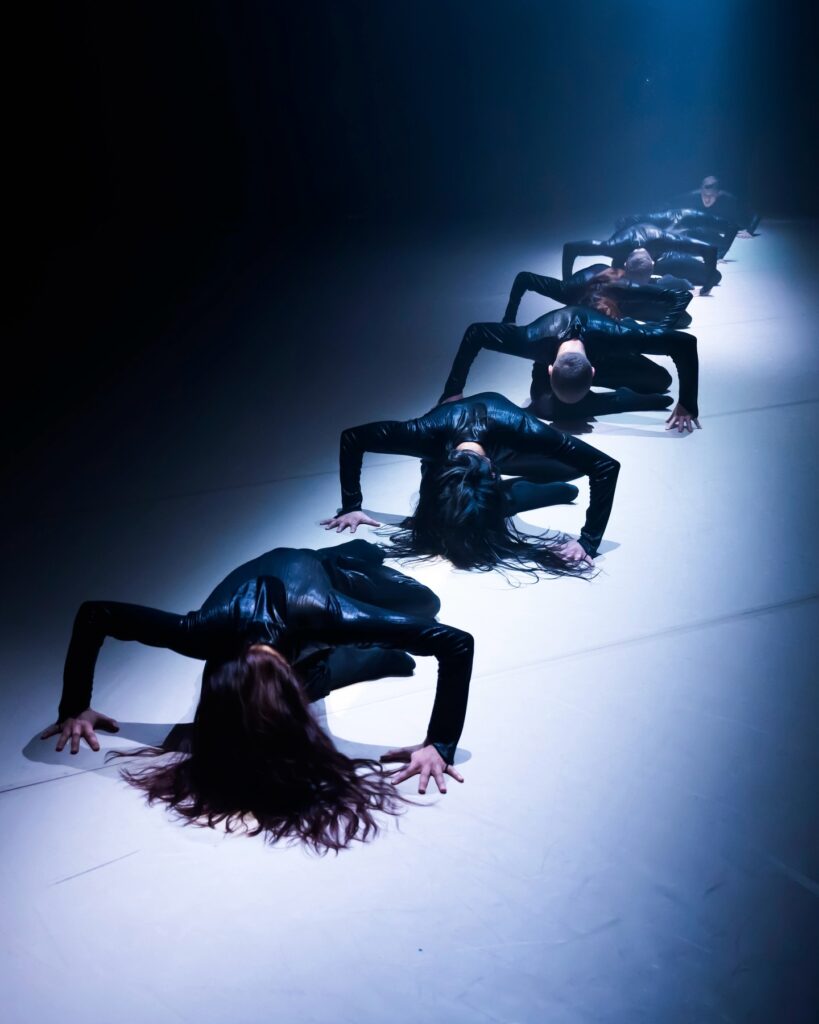
Following a brief intermission, the evening transitioned to the premiere of White Echo. Choreographed by Helge Letonja and executed by the versatile ensemble of ŻfinMalta, the work served as a poetic, contemplative counterpart to the evening’s opening work. Letonja draws heavy philosophical inspiration from the Freudian dichotomy of Eros and Thanatos, the primal struggle between the drive for life and the pull toward stasis. Under this lens, the dancers navigated the stage as if caught within an invisible psychological web, their movements oscillating between creation and dissolution.
The visual language of the piece was striking. A neon light structure, reminiscent of a skeletal winter branch, anchored the upstage area, while a heavy black rope served as a versatile dramatic tool. This rope did more than merely bisect the performance space. The dancers manipulated it with such visceral intent that it functioned as an additional performer; a tether, a barrier, and an extension of the body itself. The costuming further deepened Letonja’s Freudian inquiry: nine dancers were adorned in emerald green tops and black leather skirts, while a single performer stood in stark, sombre contrast, dressed entirely in black, perhaps a personification of the Thanatos shadow lurking within the collective.
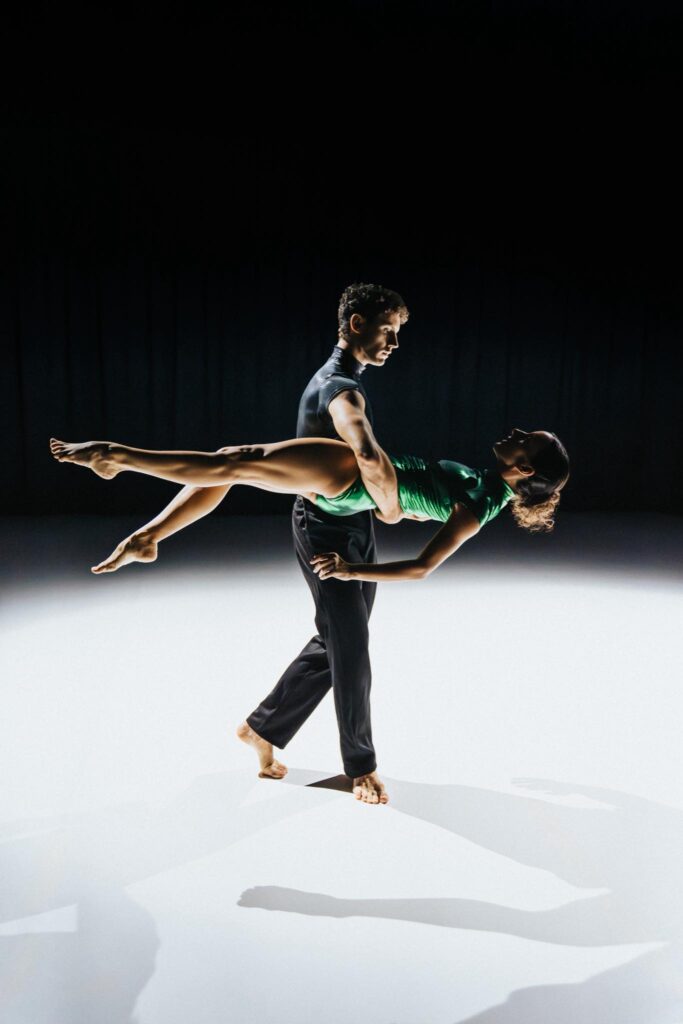
The choreography masterfully explored the magnetism of human proximity. The movements echoed the way bodies are irresistibly drawn together by a primal need for intimacy, only to be repelled by the inherent uncertainty of their environment. This tension was defined by a constant interplay between fluidity and friction. Moreover, the titular ‘Echo’ was physically realised through kinetic ripples, where a singular impulse from one dancer would cascade through the ensemble, vibrating across the stage like a stone cast into still water.
In contrast to the almost industrial-like rigour and mechanical urgency of Fulgence, White Echo adopted a more organic, atmospheric aesthetic. The focus shifted toward the physiological, the shared rhythm of breath and the infinitesimal redistribution of weight that signalled a ‘climactic’ shift in the work’s temperament. This was not a dance of rebellion, but one of resonance and survival. However, White Echo did feel remarkably expansive. One could clearly perceive a multitude of layers yet to be unearthed, suggesting a work so substantial it could easily sustain a full evening’s performance in its own right.
Ultimately, XitwaŻfin proved to be an exceptional showcase of contemporary dance that transcended the boundaries of a traditional double bill. By pairing the relentless, feverish energy of Of Curious Nature with the emotional depth of ŻfinMalta, the production offered a complete sensory arc. The evening was a testament to the power of international collaboration, leaving the audience with the profound realisation that dance, at its best, is an echo of our most hidden internal states.