
For the first time ever, I found myself looking at a performance from a dual position. I was not only observing the work from a critical lens, but I also got to experience it through the immediate, visceral experience of a parent. The latter profoundly enriched the entire experience.
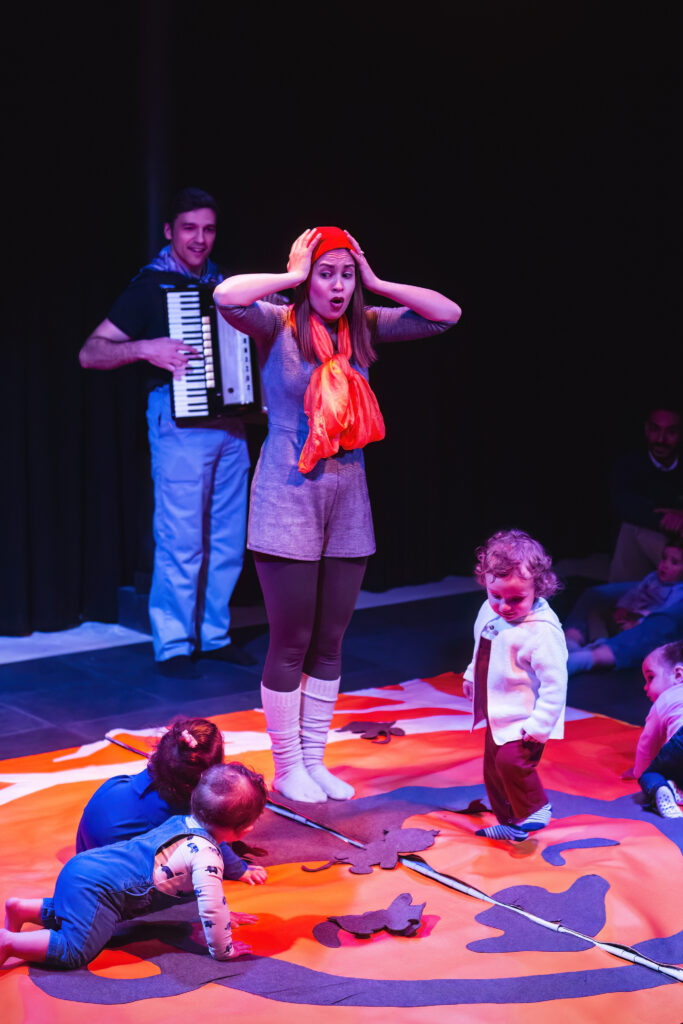
Chasing Rainbows positioned itself as a sensory-friendly exploration of the world of colours, clearly signalled by its evocative title. Specifically curated for an audience spanning the crucial 0–2-year age bracket, the performance served as a discovery mechanism, using coloured lighting design and minimal set components to create a series of coloured worlds. The execution felt akin to a sensory-friendly iteration of ‘Ms Rachel’, a popular, early developmental programme. The performance offered a meaningful integration of theatrical elements with pedagogical attention to sensory input.
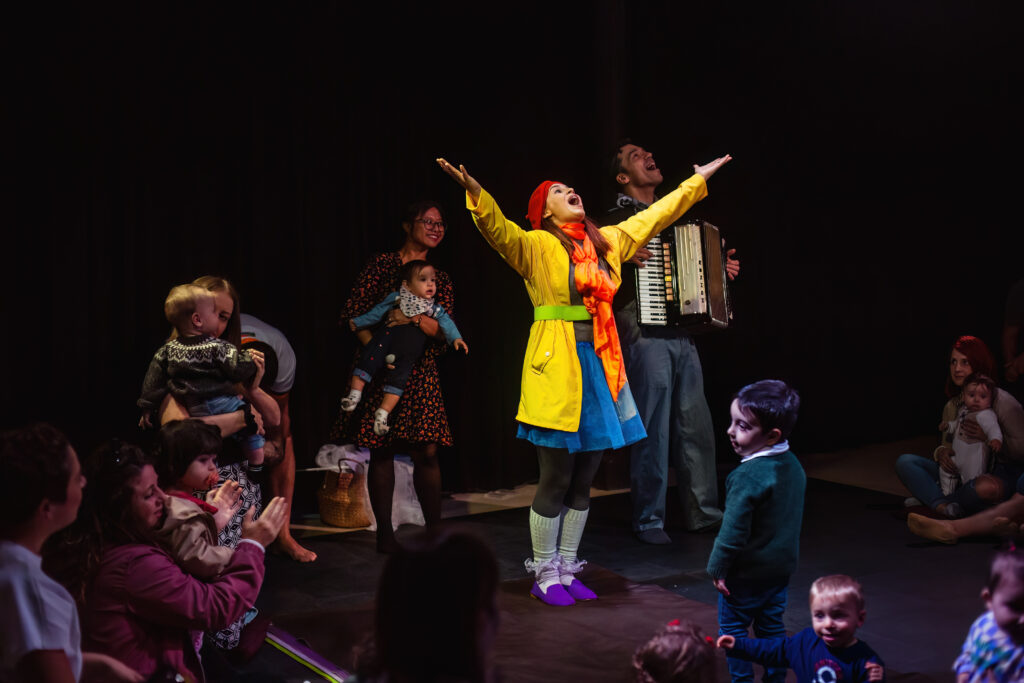
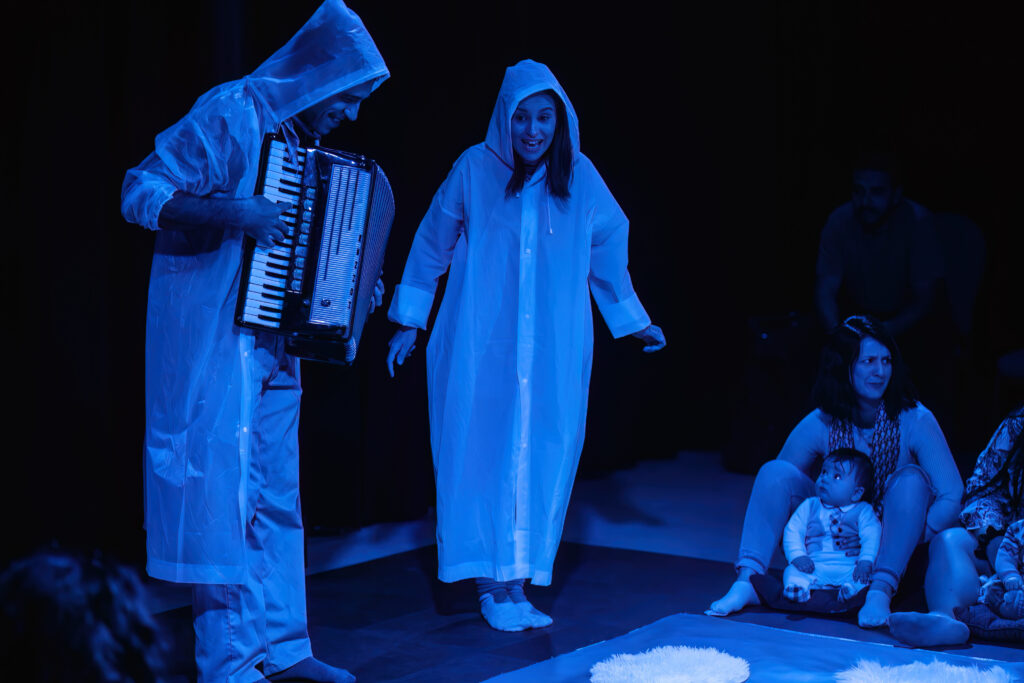
The deliberate choreography of invitation began the moment we approached the venue. Entry was mediated by a performer, holding an umbrella and dressed in a white raincoat. She was positioned under a makeshift, ceiling-suspended cloud. The ‘rain’, presented as long, soft strings hanging from a flat two-dimensional cardboard cut out of a cloud, necessitated a tactile interaction to gain access to the main space. Passing through the cloud, you are led into a room dominated by deep blue hues and ambient sound design mimicking a gentle rainfall. A second performer, playing an accordion, greeted the audience members, as we positioned ourselves on the cushions scattered across the floor. As a parent, I deeply appreciated the measured, child-first approach. The performers took genuine time to acknowledge each child, regardless of age, ranging down to seven months. This was not a perfunctory transition but a careful establishment of a secure and friendly environment, a crucial prerequisite for creating a somewhat safe space, particularly with the target demographic, rather than merely depositing them into a formal performative space.
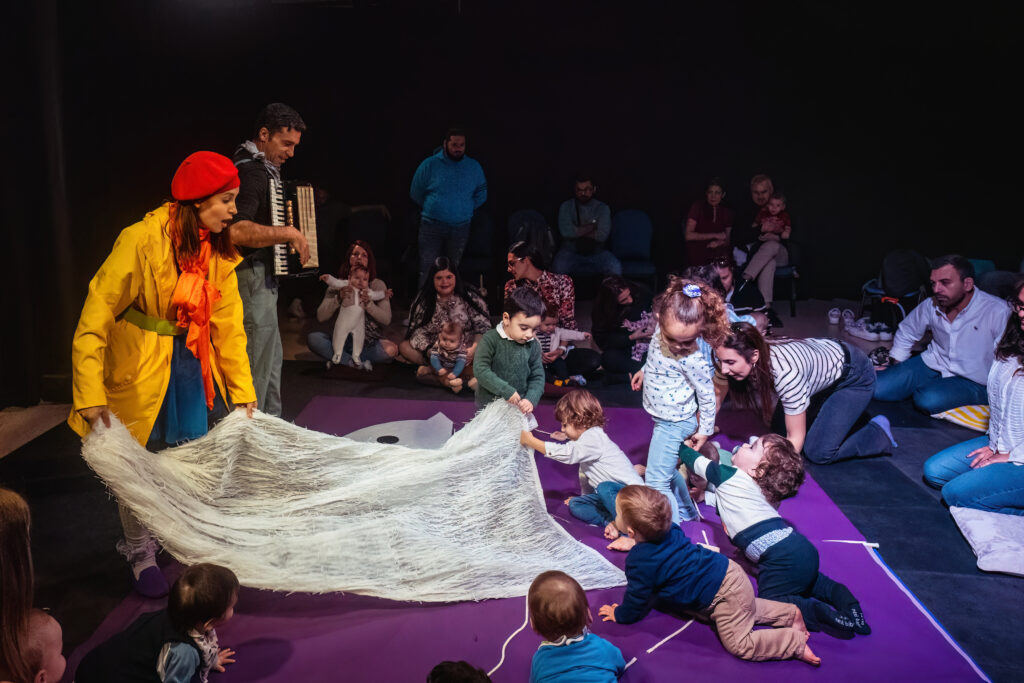
The core of the set comprised two major elements: a massive, carpet-sized, picture book dominating the centre of the floor and a constellation of suspended paper lanterns hanging from the ceiling to imitate the arch of the rainbow. These lanterns were dynamically lit to cycle through the colours of the rainbow. Each chromatic shift initiated the turn of a page in the central book, creating an almost symbiotic relationship between light and narrative. The book’s pages were themselves highly textural and featured age-appropriate animal imagery, instantly recognisable to the target group. The entire sequence, the lighting change, the slow reveal of the next colour, and the turning of the oversized page, was greeted with excited anticipation from the young audience. My own child’s high level of observational intensity confirmed the success of this immersive, multi-sensory
environment, which managed to create distinct, highly tactile new worlds with each transition.
While the environment successfully fostered a sense of child agency and participation, a crucial area for a slight refinement lies in the pacing of the interactive elements and the articulation of audience parameters. Although the space intrinsically invited engagement, the transitions between segments felt somewhat abrupt. The performers could have enhanced the experience by allowing more significant moments of unstructured exploration and interaction with the textured elements and lights before moving to the next chromatic scene. Furthermore, given the developmental imperative for gross motor movement in this age group and the inherent difficulty of keeping them still in one place, a brief, supportive pre-performance note to parents encouraging free, gentle roaming or tactile interaction would have been invaluable. This minor adjustment in communication would fully validate the children’s spontaneous desire to move and engage, completing the promise of the sensory-friendly atmosphere.
While the environment successfully fostered a sense of child agency and participation, a crucial area for a slight refinement lies in the pacing of the interactive elements and the articulation of audience parameters. Although the space intrinsically invited engagement, the transitions between segments felt somewhat abrupt. The performers could have enhanced the experience by allowing more significant moments of unstructured exploration and interaction with the textured elements and lights before moving to the next chromatic scene. Furthermore, given the developmental imperative for gross motor movement in this age group and the inherent difficulty of keeping them still in one place, a brief, supportive pre-performance note to parents encouraging free, gentle roaming or tactile interaction would have been invaluable. This minor adjustment in communication would fully validate the children’s spontaneous desire to move and engage, completing the promise of the sensory-friendly atmosphere.