
Mireille's
Point of View
Charlotte's Point of View
Do you imagine coming home to a humanoid robot asking you about your day? We’re pretty much there already, maybe not in Malta yet, but with Japan being the world leader on robotics, we can already experience automation in our houses. Think: vacuum cleaning robots, Alexa pods, and smart refrigerators. And while I personally am a lover of sci-fi and making our collective lives easier, Tesla Optimus robots give me the ick. Human-adjacent and uncanny behaviours cause my fight or flight instincts kick in, and I know I am not the only one. So, colour me intrigued, when I hear of the Manoel Theatre staging a play on robots by the late Anthony Portelli that had yet to premiere on the Maltese stage.
Last Saturday, I had the pleasure of watching SOFIE at the Manoel Theatre, a production that masterfully blends farce, social commentary and tender moments. Written by Anthony Portelli, revised by Simon Bartolo and directed by Josette Ciappara, the winning play of this year’s Francis Ebejer Studio Competition, is both hilarious and sheds light on our relationship with technology.
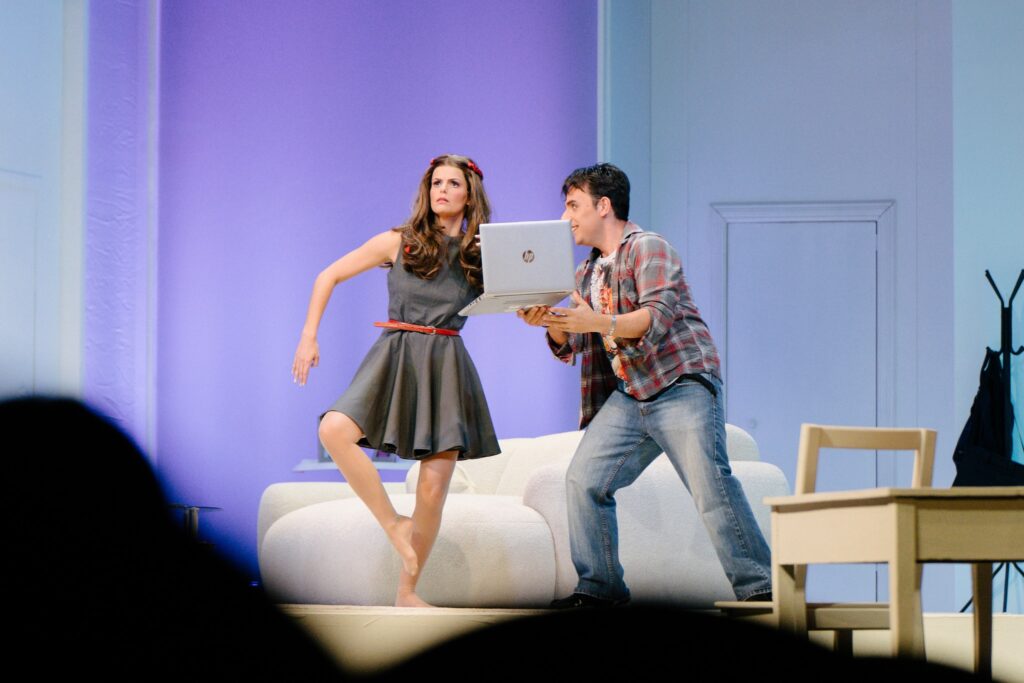
Back when I used to work with Teatru Malta I vaguely remember flipping through a Portelli script called S.O.F.I.A, a humanoid robot embedded in Maltese society – I believe this was around 2019/20. Seeing SOFIE coming out of Studio Francis Ebejer, (a project that saw its functions shift from an award led by the Manoel Theatre, to a think tank led by Teatru Malta, Manoel Theatre, and Spazju Kreattiv, to now an R&D platform by the former three entities), one can imagine the transformation this script took to bring it to 2025. SOFIE is an Anthony Portelli farce, edited by Simon Bartolo, directed by Josette Ciappara, and produced by the Manoel Theatre, staged between the 14th and the 21st of November 2025, with a cast of established actors starring Simon Curmi (as Thomas), Magda van Kuilenburg (as Serena), Christine Francalanza (as Mary), Mario (Snits) Spiteri and Emmanuel Cassar (as the Inspectors), along with Justin Calleja (as Mark) and dancer Sarah Vella as the titular robot, SOFIE, and Jasmine.
Anthony Portelli’s satire married well with Simon Bartolo’s editing, bringing a very solid script onto the national theatre stage. And while certain themes were explored beautifully, I question whether some went over the audience’s heads as they munched on snacks. A whole row behind us left at the interval, which I think was due to the double-entendre comedy that I feel is synonymous with Maltese humour, at times very overtly sexual. SOFIE, played by Sarah Vella who performed excellently as a humanoid robot, and as Jasmine, Thomas’ mistress, were both subjected to such humour which at face value might push some into a prudish retreat.
SOFIE opens with Thomas expecting a drone, receiving instead what seems to be a life-size female robot. The robot, named Sofie, must navigate a human household: Thomas’s wife Serena is sceptical, their son Mark is amused, the maid is baffled, and even the Customs Department winds up involved. Through this, the play asks uncomfortable but necessary questions about materialism and how technology seeps into the most intimate corners of human life.
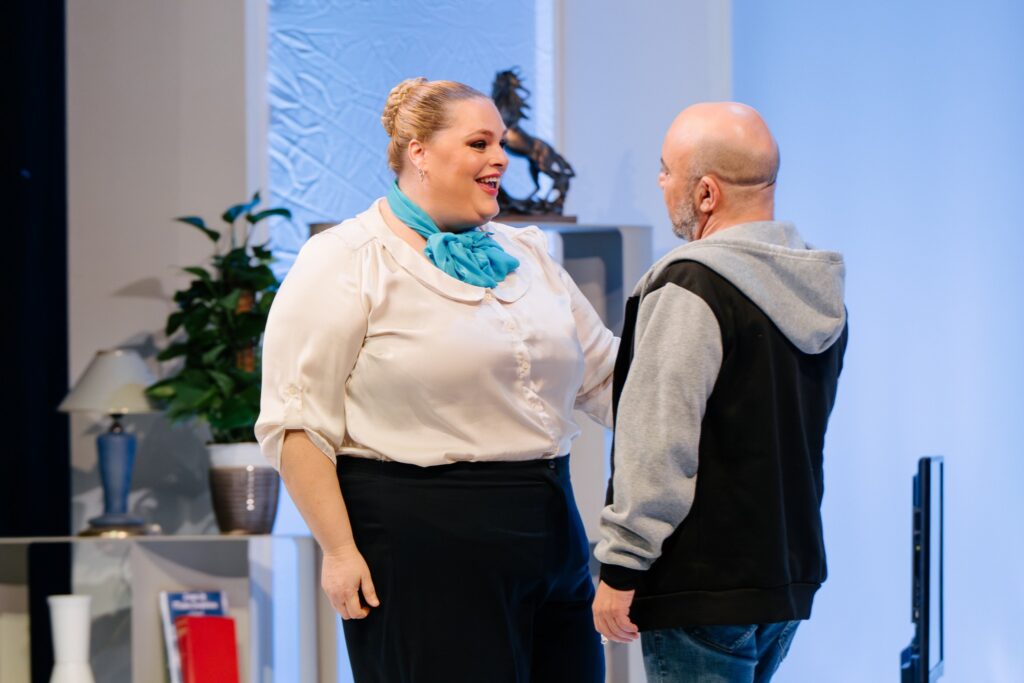
The relationships explored between women (here I am including SOFIE as one) created an interesting dynamic. SOFIE and Mary, the cleaning lady, a boisterous Maltese character played by Christine Francalanza, who had the audience right in her palm, taught SOFIE a few lazy tricks when it comes to work culture while putting the robot to work for her. Magda van Kuilenburg as Serena, Thomas’s wife, living in a loveless marriage, showcased a strong-headed partner who pushes her husband around. The human women serve as drivers for the plot, while Thomas, a short-statured, emasculated man who leads a double life, cheats on his wife with his young mistress Jasmine, who looks exactly like SOFIE. It turns out that SOFIE’s likeness to Jasmine was not by mere coincidence, but a fabrication by Thomas himself, in order to cheat on his wife in the family home without getting caught. The male characters are all led by their sexual fantasies, with questions about SOFIE’s gender and sexual abilities surfacing at almost every opportunity. Thomas sees SOFIE as a tool to help him cheat, and while his son Mark and the two Inspectors feel a sexual pull towards the robot. Emmanuel Cassar and Mario (Snits) Spiteri both played the goofy fake inspectors with such skilful manoeuvring that only veteran comics could accomplish, adding to the strength this cast had. Hats off to the director for casting veterans, while I felt Justin Calleja’s acting did not reflect that of a teenager younger than 18 years, as was clearly mentioned in the play, but rather that of a young adult studying at tertiary level, with a degree of maturity in his movements across the stage. Overall, the garishness of this subject matter, while sometimes awkward to watch due to the hamminess, might have been used as a reflection of how easily men objectify women, even those of a robotic nature.
As the narrative unfolded, the play occasionally widened its lens to comment on broader social realities. Among these was the theme of migration, approached in ways that were at times subtle and at other times more explicit. For example, Mary forcing SOFIE to clean in her stead, the mention of labour laws and citizenship issues when discussing SOFIE’s autonomy, and her learning capabilities all contributed meaningfully to this layer. Racial discrimination and implicit bias toward SOFIE also surfaced, with characters assuming she came from China when, in fact, she was manufactured in North Korea, something she makes clear through her use of the Korean language. This even drew some quiet titters from the audience, particularly when the Maltese characters reacted in confusion to her greetings in a language they simply heard as “Asian.” However, a particular scene in which SOFIE delivers a monologue describing a nightmare about what it means to be a migrant on a boat felt jarring, especially since nothing related to current events or any direct discussion of irregular migration had been introduced beforehand. Because this thread appeared so abruptly and without prior contextual cues, the moment felt somewhat detached from the play’s otherwise coherent internal logic, limiting its overall impact.
The cast delivered a strong performance, each actor bringing depth to their role while playing to the strengths of a farcical comedy. Simon Curmi portrays Thomas with hubris. He makes us believe in his sincerity;, after all, he thought he was ordering a drone, not a humanoid robot. Sarah Vella’s double performance as Sofie and Jasmine, the mistress, is one of the production’s standout achievements. As Sofie, she plays with precision; composed, curious, and yearning. Her movements measured, her expressions minimal but intentional, never robotic in a cliché way, but restrained enough to suggest a consciousness still forming. In total contrast, her Jasmine is a volcanic presence – fiery, impulsive, and emotionally explosive. The fact that both roles are performed by the same actor strengthens the play’s commentary on objectification, projection, and the male gaze. Thomas’s human lover and the robot built to serve him are two extremes, and Vella makes each one feel embodied, distinct, and compelling. As for Magda van Kuilenburg, Justin Calleja, Christine Francalanza, Mario (Snits) Spiteri, and Emmanuel Cassar, each actor brings their own strengths to the piece, whether it’s sharply timed comedy, emotional grounding, or satire. Their performances help build the play’s rhythm, especially in moments where misunderstandings multiply and the absurdity peaks.
The play leans into a migration metaphor, drawing parallels between Sofie’s “arrival” and the experience of migration or displacement. At times, such as the dream scene, I felt the metaphor was a little heavy-handed. It risked spoon-feeding the audience rather than letting the connection emerge organically. But at the same time, I understand that its clarity ensures that the social commentary hits home. But it also opened up a space for real questions about belonging, otherness, and the labour dynamics of newcomers, whether it be a human or a machine. An uncomfortable undercurrent I felt in the play is the objectification of Sofie as a female robot, an idealised helper or companion. The play taps into traditional gendered fantasies. Vella’s performance helps complicate this further as she resists being a one-dimensional object by giving Sofie emotional depth.
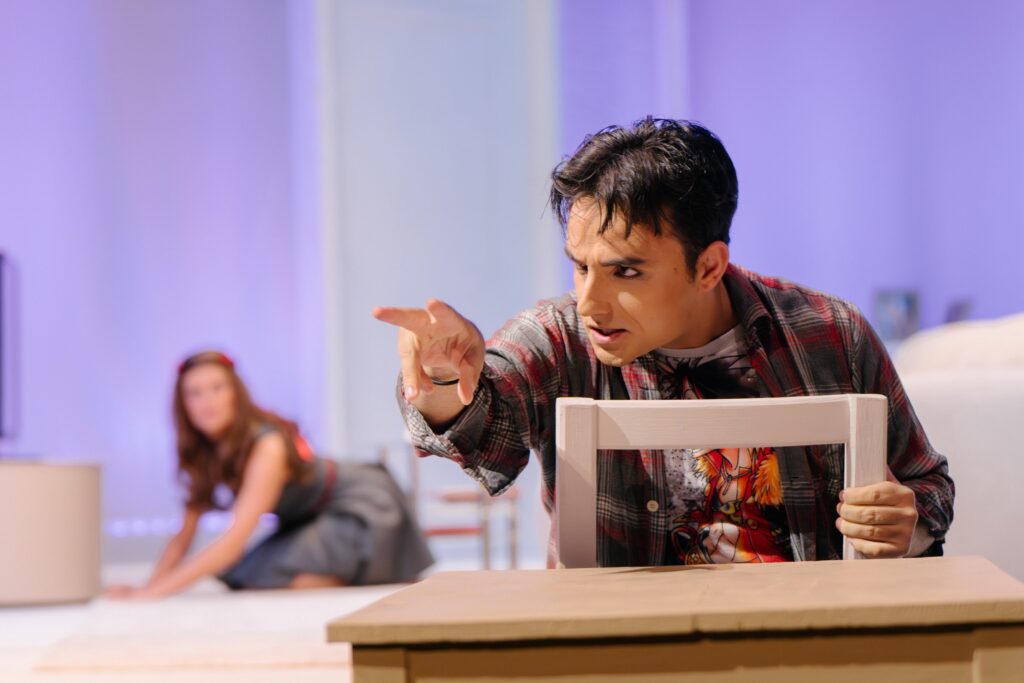
Pierre Portelli’s set design was clean, modern, and uncomplicated, depicting the interior of a family home. Downstage right, on the elevated orchestra pit, stood a simple kitchenette, while downstage left was a dining table with chairs. The main stage featured a living room with a sofa and TV. A door on stage right led to an offstage bathroom; upstage centre was the main door of the house leading to the exterior; and four exits were placed on stage left, one of which was blocked by SOFIE’s packaging box. Clement Gauci Peresso’s costumes worked, grounding the characters visually and complementing the production’s aesthetic.
There were, however, some small details in the set that proved confusing. The box in question had Japanese rather than Korean orthography, raising the question of whether this was intended as another layer of commentary from the creative team, or whether the crew themselves fell into the same simplistic “Asian” conflation as the characters. Additionally, the main door opened with a regular door handle rather than a lock, which felt somewhat inconsistent with the home’s design. Another issue was in relation to the surtitles above the curtain which I tried not to follow as they were not synchronised with the action and narrative onstage.
The set was subtly lit by Chris Gatt, who effectively reflected the action and mood of each scene and sub-scene. However, there was one choreographed sequence involving the two inspectors chasing SOFIE into one of the bedrooms that felt clumsy on multiple levels. While the three performers exited stage left and performed a fight vocally offstage, their return was awkward, especially as the chase culminated in a tussle behind a draped section where the lighting, sound, and movement were not synchronised. Being the penultimate scene of a farce, where slapstick humour and physicality are expected, a more tightly choreographed sequence, making full use of all exits and entrances in a Scooby-Doo–esque chase, would likely have worked better than the cacophony of bodies bumping into each other on a small stage.
The absence of microphones was a breath of fresh air at the Manoel, and with such a strong cast, amplification was entirely unnecessary. Albert Garcia’s sound design further strengthened the production, showing a clear sensitivity to the demands of comedy. Well-timed effects accentuated the farcical elements, while softer ambient underscoring maintained momentum between scenes. It was a soundscape that enhanced the humour without drawing attention to itself which is an often overlooked but essential element in this genre.
Pierre Portelli’s set design and choice of colour is restrained but effective: the walls, furniture, and props suggest an everyday middle-class household. Chris Gatt’s lighting design furthered this ordinariness of the family’s daily life. As the comedy edges toward more surreal or reflective moments, the lighting subtly shifts, highlighting moments of both emotional vulnerability and absurdity. Having said that, when lighting wasn’t as subtle, specifically during the chase scene, this led to it feeling clumsy and badly choreographed. The colour palette and direction felt coherent with the costume design by Clement Gauci Peresso, and created a unified visual world.
One of the most striking aspects of SOFIE was the use of theatre acoustics: I noticed there was no reliance on visible microphones. The actors’ voices carried naturally, which gave the performance an intimate, organic feel. This choice grounded the technology-themed play in human presence. Albert Garzia’s live and original sound design felt deliberate. Moments of silence, natural room noise, and small audio cues seemed to complement the action without overwhelming it. It worked in harmony with the pacing of the play, supporting both the comedic beats and more thoughtful moments.
I should admit that I didn’t follow the surtitles continuously. When I glanced at them, they seemed to lead the actors rather than sync with them. This made me wonder whether the system was slightly ahead, or perhaps there was a delay in reading. That said, when I did pick them up, the translation captured the gist, but the mismatch in timing was a little distracting. I’m not sure if this was a technical glitch or by design, but it did affect how smoothly I could engage if I were to have followed and I wondered how effective they were to those who followed.
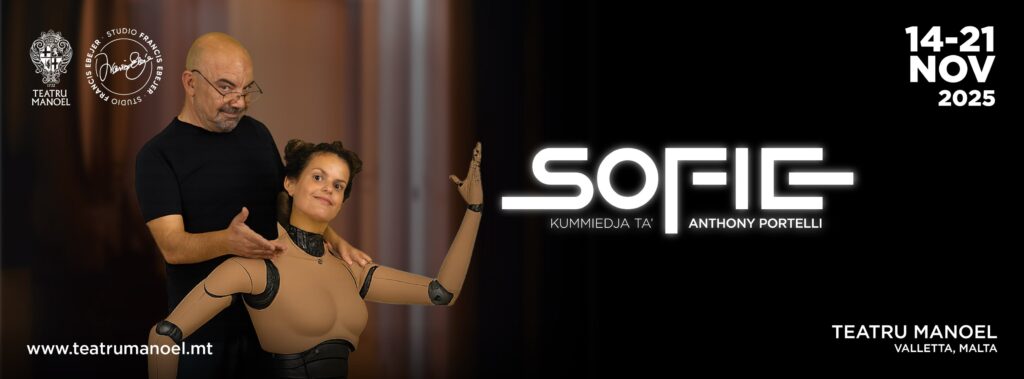
I found the marketing of this production disappointing. The poster did not do the production justice. We see Sarah Vella’s head pasted onto a robotic mannequin of sorts, with Simon Curmi standing behind her in his tech-bro aesthetic (black shirt, thin wire glasses resting precariously at the tip of his nose). The background, although blurred, features a corridor and some doors. It is here that I question whether any research was conducted, whether the marketing relied solely on Simon Curmi’s pull to sell the show, or whether overall laziness was at the core of the matter.
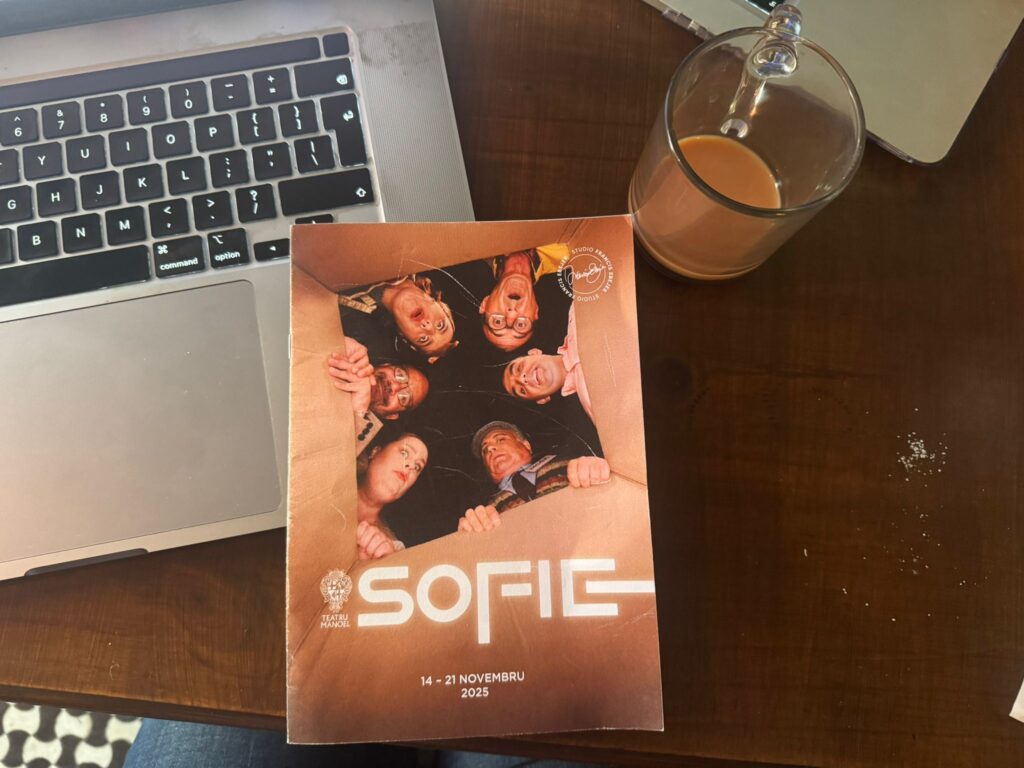
The promo video premiered a month before opening weekend, showcasing Simon Curmi carrying a box down Old Theatre Street, tailed by Cassar and Snits. It then cuts to the whole cast staring down at the box, (the first time we meet Serena, Mark, and Mary) before finally revealing Sarah Vella contorted inside it, smiling back. (She reminded me of Sofie Dossi, the American contortionist known for folding herself into luggage.) Again, the bankability of Curmi, Snits, and Cassar is foregrounded, and while I always prefer simple over overly complicated shoots, the promotional material lacked the level of polish expected from a national theatre. In fact, the folio used the shot of the cast looking into the box as its main cover, a photo that features distracting light reflections in glasses obscuring faces, awkward facial expressions, and clumsy staging.
Ultimately, the marketing did the production a disservice. What appeared on posters and promos felt rushed and unimaginative. It flattened a nuanced production into something cheap and forgettable. There needs to be awareness on how marketing affects audiences and their spending power, particularly when production houses are publicly funded. Had I not had previous interaction with the script many years ago and appreciated Josette Ciappara’s direction and Anthony Portelli’s writing, I might not have attended this performance.
The only real pity surrounding SOFIE lies not in the production itself, but in its marketing. The promotional material was, frankly, confusing. It never quite captured what the play actually is, nor the themes it tackles with such humour and intelligence. I can’t help but feel this may have discouraged people from attending.
While the rich flaunt their robots like accessories (think Kim Kardashian playing rock–paper–scissors with her $30K Tesla robot while wearing a similarly priced rock on her finger) SOFIE leaves us with a more grounded question: is this fascination with artificial companionship really progress, or just another mask for exploitation? In many ways, that tension mirrors the production itself. There were moments of sharp satire, strong performances (particularly from the veteran comics and from Sarah Vella in her dual roles), and clever commentary on labour, autonomy, and bias. The set was clean and effective, and the absence of microphones allowed the cast’s projection and timing to shine. Yet the production also stumbled: certain scenes were clumsily choreographed, the migration monologue felt jarringly out of place, and the marketing did the work no favours, underselling the conceptual and comedic strengths of the show.
What SOFIE ultimately succeeds in doing is provoking reflection (while sometimes deliberately, sometimes accidentally) on how quickly humans objectify what they desire, fear, or fail to understand. When the play commits to its core satire, it is sharp, funny, and surprisingly layered. When it stretches itself too thin, the cracks show. Still, it offers enough wit, energy, and thematic ambition to keep audiences engaged, and it raises questions that linger well beyond the final curtain.
What struck me about SOFIE is how timely it feels, despite the script having been written more than a decade ago. As someone with little prior knowledge of robotics or AI, I found its sense of time wonderfully ambiguous. The play could be set in the past, the present, or some near future. This ambiguity can be effective and gives the production room to play, allowing its themes to resonate across different landscapes. At the same time, I appreciated the decision to bring in references to current affairs, anchoring the story firmly in today’s world. SOFIE is a triumph of local theatre. It’s funny, thought-provoking, and deeply human, even as it tackles artificial intelligence. The direction is confident, the cast is strong, and the set, lighting and sound design work in harmony to support both the farce and the existential questions underneath. If I were to nitpick, I might say that some themes felt slightly overdone in places, and the surtitles could be more tightly synchronised. Yet these are relatively small quibbles in an otherwise very polished piece.