
Few actor-turned-directors manage to display this much potential on their first try. Harris Dickinson’s Urchin portrays harsh realities with honesty and compassion, all while displaying a clear strength of auteurial vision. Frank Dillane, best known for playing a young Tom Riddle in the Harry Potter film saga, makes his own debut as a leading man. Dillane portrays the film’s main character, Mike, a skittish addict who finds himself off the streets for the first time in five years. As one would expect, such a journey is less than straightforward.
After serving a nine-month prison sentence, Mike is given the chance to build a sober life off the streets, and for a while, things seem to be running smoothly. Yet the heart of Urchin is built around the cyclical, self-sabotaging habits that tie Mike to his old ways, which prove too heavy to be abandoned as quickly or as easily as his new surroundings demand of him. The more experimental and surreal scenes in the film seem to examine Mike’s subconscious, reflecting the complications of agency in the face of addiction. In the first of these scenes for example, the camera follows water down a shower drain. Streaks of glowing colour start to appear out of the dark tunnel, and eventually morph into entire glowing, pulsating cells, one of which seems to be a brain neuron. These scenes are undeniably the most mesmerisingly, aesthetically beautiful of the film, yet, disconnected as they are to any sort of functioning reality, their beauty is as dangerous as it is alluring.

Urchin shows, furthermore, moments of friendship and genuine human connection, ones which are entirely dependent on Mike’s sobriety and stability. The first scenes of the film are all but void of such instances, with Mike being ignored by passersby as he asks for spare change and at one point getting thrown out of a restaurant while nodding off in one of the booths. The equally strange and heartbreaking core of the film emanates not just from the internal chasm that Mike is faced with in fact, but also from the world around him. It is this latter part in particular that makes this film not just stand out from other, more traditional anti-hero films, but in a lot of ways transcend them. The scenes which are as far from the surreal as one can get, for example the scenes in which Mike interacts with the social worker assigned to his case, despite being deeply realistic, are also strange precisely because of such realism. They display that oddly euphoric absurdity that appears at the very peak of the bleak and the mundane. In the environment of the social worker’s office for example, any genuine connection is interrupted by phone calls emerging from some other bureaucratic node, or awkward tones and sentences that seek to maintain a professional distance with the child-like, somewhat volatile Mike.
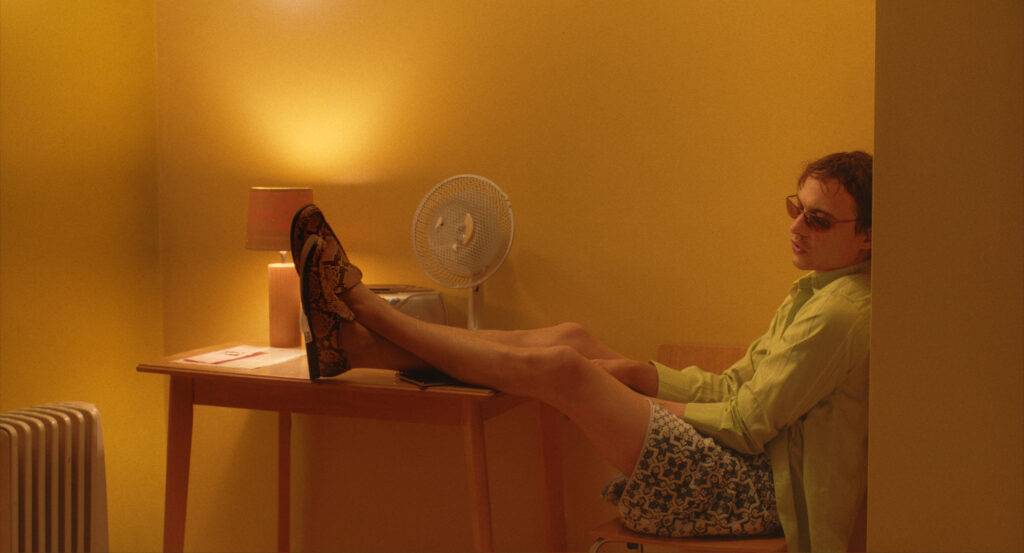
The peculiarity of both Mike’s internal world and his external one makes for a film that is bittersweet, funny, and at times even terrifying to think about, but it is tied together splendidly in a script that feels so thoroughly spontaneous it makes you wonder how it lived on paper before being translated so seamlessly into film. It could only be pulled off in fact because of some exceptional casting choices. Urchin is a film that is clearly guided by Mike’s character, and Dillane does a wonderful job at making the audience sympathise with Mike even when he falls back into addictive, destructive tendencies, but the handful of secondary characters that appear throughout are incredibly complex in their own right. Buckso Dhillon-Woolley, who plays the aforementioned social worker and Megan Northam as Andrea, a girl who Mike befriends and eventually dates, are particularly well cast, but also of note is the role of Nathan, a character played by Dickinson himself. Nathan is a fellow street-dweller who robs Mike and also serves as a mirror of his worst tendencies. Urchin, both through his work as actor, but more importantly, as filmmaker, firmly cements Dickinson as one to keep an eye out for.