
The Call to Creative Courage
a review of Naħliflek
by Giulia Privitelli
O Lord, God Almighty, help me with what I am about to do … give me strength now.
Judith 13: 4, 7
The story of Judith is not among the major passages of the Bible, nor is it found in every version (it is missing, for example, in the Protestant Bible), and it reads not as a historical work but a fictional one—a literary masterpiece, at that. It is an account full of art, full of symbolic meaning, full of teaching about faithfulness and about the power of God—the Word, the Voice. It is about the unfolding of history, the heartbreaking cries of the oppressed, and the maddening call to resist and fight the evil ways of man. It is no small wonder that Artemisia Gentileschi (1593–1653) would find in the verses of this Jewish heroine’s story the creative courage to make her voice heard above misogynistic violence and injustice, and her art—and life—finally seen. But seen, not to be gained, possessed, and consumed—a living Arte-fact. No, seen so as to be believed—a mirror of a story that belongs to all; the naked truth: in fact as in fiction, in art as in life, in past as in present. It is to this call across the centuries that Naħliflek bravely responds.
Bravely because with such a powerful protagonist as the lead, flanked by the equally iconic biblical Judith and Susannah, and the artist’s unforgettable rendition of both, this theatrical piece could have easily fallen into the, well, theatrical: exaggerated and laboured by the heavyweights that came before, like some equivalent to a tribute concert, or an awkward stilted tableaux vivant. But just like Artemisia, the production was not after some cheap copy. The play, presented its own version of a gesamtkunstwerk, set within the ostentatious setting of a baroque church dedicated to the Virgin of Pilar in Valletta. It had a vision and held it.
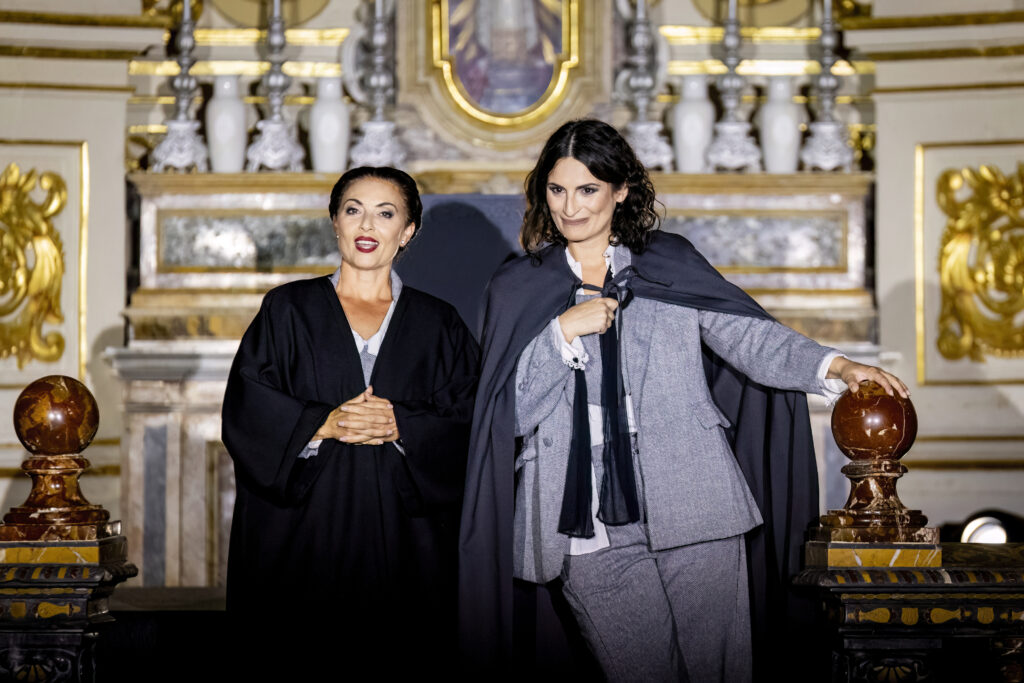
Or rather, it parsed its way through a loaded script to arrive to its most essential core: Huwa veru! Huwa veru! It is true! It is true! What is true? The script of the play itself is based on the court transcription of Artemisia’s own seven-month trial over four centuries ago, now for the first-time ever translated into the Maltese language; a feat in itself! But aside from the historical and legal facts on which the play is founded, the core truth of its message, of its relevance to this day and age, is what all the heightened drama is for: if the church is suddenly flooded in red light, if the words—too many—are repeated and rushed and contradicted, if the echoing acoustics clash into a deafening noise and the rising power of a voice—many voices—are suddenly snuffed out into a devastating silence, it is there to heighten that one underlying truth: that in the hope of overcoming injustice, it is one’s art, or one’s words, that must be raised.
Another great mind is said to have described hope as having two beautiful daughters, which I find particularly fitting in this case: anger and courage; anger at the way things are, and courage to do something about it. I couldn’t dissociate these three throughout the whole one-hour of the show’s duration: hope, anger, courage, dancing around each other, sometimes, almost battling one another. A bit like the three actors (Kim Dalli, Clare Agius, and Sarah-Lee Zammit), formidably swirling around each other, fluidly but without confusion, transitioning between roles, each taking the ‘throne’ of the judge, each having their say, and each distinctly, and finally, coming into their own.
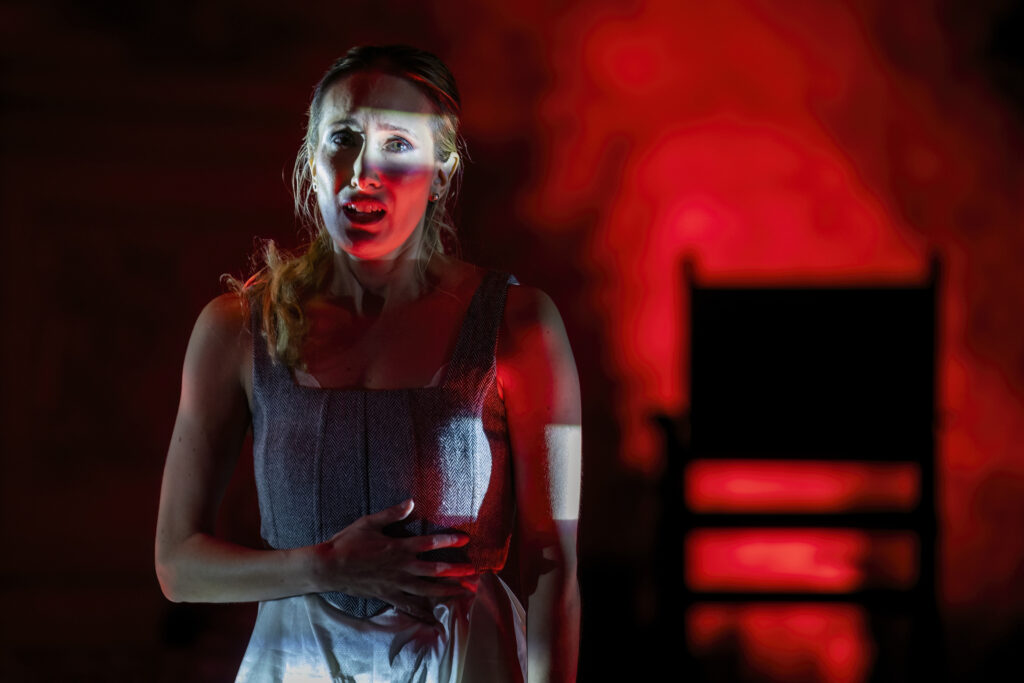
I felt myself, at times, slip into the trap of what several trials-by-jury, I suppose, are riddled with: circular and often contradictory arguments, and the repeated retelling, sometimes with variations, of the same scenario, witness after witness. It can get tiring if you pay too much close attention to the words being spoken. I fear the promised subtitles during a couple of the performances might contribute to this overwhelming sensation that the key to untangle this fight for justice lies with how well you are able to keep track of the words, and the chronology of the facts. It is, perhaps, the same frustration that one might feel if, at times, the words cannot be heard clearly, from the back, and at times even from the front. Why am I sitting at the back? Why did I take the front row bench? Why is the music suddenly so loud? Let go of the details; listen only so as to see; and take the whole picture in. No one really paid head to Artemisia when she sought to explain the meaning and reasoning of why she painted what, or how. She had to show, not tell. She was a painter after all.
Words are raised with power—not so much the voice of the dominant, or of the judge, but the voice of the spirit, which can be the voice of the unheard many, echoing through history, through literature, music, and art. Enter the fourth protagonist (Claire Tonna)—and I should add the fifth, Analise Mifsud—who is present throughout but is only truly audible, and then visible, at the turning point of the drama, when it shifts to the everyday, the everywhere, the everyone. If it hadn’t before, here is when the story disarms and dishevels and finds its way beneath everyone’s skin. It certainly found its way beneath mine. But that is creative courage: the power that allows centuries to pass, of breaking and breakage, only for things to be made anew again. Of this, one can be sure. Naħliflek.
Naħliflek, produced by Daniel Azzopardi and directed by Marta Vella, is on show at the Church of Our Lady of Pilar, Valletta, between 17–19 October and 23–26 October, at 8:00pm. The shows on 19 and 24 October will have English subtitles. This project is supported by Arts Council Malta, in collaboration with the Istituto Italiano di Cultura, La Valletta & Heritage Malta.